
Protocols & Policy · Prediction markets
Utah sues Kalshi and Susquehanna, calling its contracts illegal gambling
After winning in federal court, Utah's attorney general has taken Kalshi and its trading partners to state court, seeking an injunction and the return of fees.
Utah has asked a state court to shut down Kalshi's sports, election and other event contracts in the state and make Kalshi and the trading firm Susquehanna hand back what they earned there. Attorney General Derek Brown's 103-page complaint, filed in the Third Judicial District Court in Salt Lake County, calls the contracts illegal gambling and a public nuisance [1]. These are the state's claims and have not been proven in court.
An event contract is a yes-or-no bet on whether something will happen, priced between 0 and $1, that pays $1 if you are right. Kalshi runs a federally registered exchange for them, and that registration is the heart of the fight.
How the state says it works
The complaint says Kalshi "plays the same role as a traditional sportsbook" (¶ 2, p. 2) [1]. It names Susquehanna International Group as a "market maker" that serves "as an institutional counterparty for retail bettors on the Kalshi platform, routinely taking positions opposite retail bettors' gambling wagers" (¶ 31, p. 11) [1]. In plain terms, the state argues that big trading firms take the other side of ordinary customers' bets, the way a bookmaker does.
The money
The state says Kalshi charges "$0.01 to $0.02 per wager" (¶ 105, p. 35) and estimates that Kalshi "has made between $30,591,600 and $61,183,200 in fees from Illegal Wagers placed by Utah accounts" (¶ 106, p. 35) [1]. The complaint itself calls these "estimates based on publicly available information" and says the true number "could be more or less" (n. 58, p. 35) [1]. It cites testimony from Kalshi's own head of markets that 32,940 Utah accounts had fully completed sign-up (¶ 98, p. 34) [1].
What Utah wants
The prayer for relief asks for preliminary and permanent injunctions, restitution and damages, "an equitable accounting and disgorgement," a finding of public nuisance, and punitive damages (pp. 62-63) [1].
How we got here
Kalshi sued Utah first, in federal court in February [2]. On Aug. 4, U.S. District Judge Robert J. Shelby granted Utah summary judgment, holding that federal commodities law does not override Utah's power to ban gambling, according to the attorney general's office [2]. The new complaint cites that ruling (p. 3, n. 2) [1]. The state case moves the fight from defending Utah's law to enforcing it. The timeline below shows each step, with the source for every date.
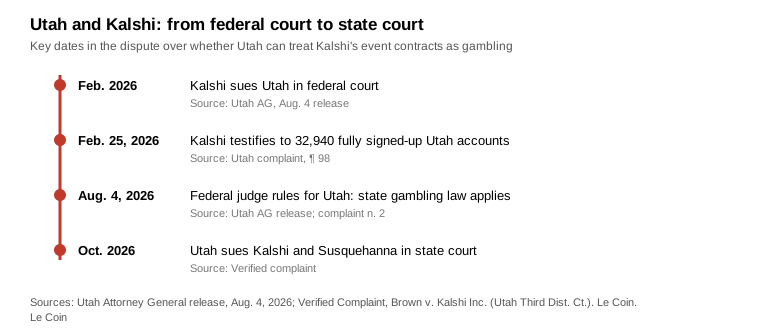
Sources: Utah Attorney General release, Aug. 4, 2026; Verified Complaint, Brown v. Kalshi Inc. Chart: Le Coin.
The objection
Kalshi's position, as the attorney general's office described it, is that because it operates a federally registered exchange, Utah cannot treat its contracts as gambling [2]. Kalshi's news page carried no statement on the new suit when we checked [3].
The tell
In Le Coin's view, the tell is that Utah sued an outside market maker, Susquehanna, alongside Kalshi and its in-house market maker, Kalshi Trading, which puts a firm that supplies prices on the hook with the venue.
Sources
[1] Verified Complaint and Jury Demand, Derek Brown, Attorney General v. Kalshi Inc. et al., Third Judicial District Court, Salt Lake County (copy posted by Utah News Dispatch). https://utahnewsdispatch.com/wp-content/uploads/2026/10/KalshiComplaint.pdf (accessed Oct. 20, 2026, 5:00 p.m. ET) [2] Utah Attorney General, "Utah defeats Kalshi in federal court: State can enforce its anti-gambling laws," Aug. 4, 2026. https://attorneygeneral.utah.gov/utah-defeats-kalshi-in-federal-court/ (accessed Oct. 20, 2026, 5:07 p.m. ET) [3] Kalshi News page (no statement on Utah found). https://kalshi.com/blog (accessed Oct. 20, 2026, 5:00 p.m. ET)
Holding the Corner.
Not financial advice.