
Analysis
Prediction markets favor a Democratic House, putting crypto's Washington gains in play
How the 2026 midterms and the 2028 election could shape U.S. digital-asset rules: the stalled Clarity Act, crypto PAC money, candidate records and scenarios, with Kalshi odds as a reference point.
Research and analysis only, not investment, financial, legal or tax advice or a recommendation to buy, sell or hold any asset. Full disclosure at the end.
The crypto industry's wins in Washington so far rest mostly on agency decisions, not new laws, so the Nov. 3 midterms will decide how long those wins last. At 4:45 p.m. ET on Oct. 22, Kalshi traders priced Democrats at 91.3% to win the House. That is a market price, not a forecast.
Kalshi is a CFTC-regulated exchange where traders buy $1 contracts that pay out if an event happens, so a 91-cent price reads loosely as a 91% chance. Thin markets can mislead, and every price below is a snapshot.
Le Coin's research report sets those prices against the record: roll-call votes, FEC filings and agency documents.
The bill that stalled
The Digital Asset Market Clarity Act (H.R. 3633) is a "market structure" bill. It would divide crypto oversight between the Securities and Exchange Commission, which regulates securities, and the Commodity Futures Trading Commission, which regulates commodities and derivatives.
The House passed it 294–134 on July 17, 2025 (Roll no. 199). All 216 Republicans voted yes, and Democrats split 78 to 134.
The Senate never voted on the bill itself. On Sept. 15, 2026, a motion to end debate on taking it up failed 49–50 (Record Vote 234). All 49 yes votes were Republicans. The 50 no votes were 44 Democrats, two independents and four Republicans: Susan Collins, Josh Hawley, Jerry Moran and Thom Tillis. Tillis then entered a motion to reconsider, which keeps a re-vote possible this year. None is scheduled. Bills that are not enacted die when this Congress ends on Jan. 3, 2027.
At 4:45 p.m. ET, Kalshi priced a crypto market-structure law before Jan. 1, 2027 at 5.8%. It was 17% at the Sept. 14 close and fell to 8.4% the day cloture failed. A law before Jan. 1, 2028 traded at 26%, down from 51% before the vote, though that contract is thinly traded. Kalshi's rules define a qualifying bill by what it does, not its name, so a renamed successor could count.
What the agencies did instead
Without a statute, the SEC and CFTC have set policy themselves:
- In March 2026 the SEC issued an interpretation that sorts tokens into five categories.
- In August it proposed "Regulation Crypto Assets," with offering exemptions and a safe harbor. It is not final.
- In October the CFTC opened an advance notice on crypto markets, with comments due Dec. 14.
A future commission can revise all three. Only a law binds the next administration. In Le Coin's view, that is what raises the stakes of these elections.
The one federal crypto statute is the GENIUS Act, the stablecoin law, signed on July 18, 2025, as Public Law 119-27. It passed the Senate 68–30 on June 17, 2025, with Democrats including Jon Ossoff, Kirsten Gillibrand and Adam Schiff voting yes. Its text lets state-chartered issuers with up to $10 billion outstanding stay under a state regime if that regime is "substantially similar" to the federal one.
Where the crypto money went
FEC filings through Sept. 30 show Fairshake, the largest crypto super PAC, with $138.2 million raised in the 2026 cycle and $83.9 million in cash. A super PAC can spend unlimited sums on ads but cannot coordinate with candidates. Fairshake's largest donors were:
- Ripple: $48 million
- Coinbase: $25 million
- a16z's AH Capital Management: $23.8 million
Fairshake separately reported about $38.6 million from selling bitcoin. It also transferred $70 million to two affiliated PACs: Protect Progress, which backs Democrats, and Defend American Jobs, which backs Republicans. A fourth PAC, Digital Freedom Fund, received about $21.3 million from Winklevoss Capital Fund, paid in bitcoin: 188 coins its filings list as "not liquidated."
The biggest target is Ohio's special Senate race. The PACs have spent about $36.3 million supporting Republican Sen. Jon Husted and $16.4 million opposing Democrat Sherrod Brown, nearly all of it since Sept. 22. Husted voted for both GENIUS and Clarity cloture. At 4:45 p.m. ET, Kalshi priced Brown at 68%, up from 54% at the Sept. 14 close. Timing alone does not show whether the ads are working.
Spending did not fall after the Senate vote. The four PACs spent $73.5 million through Sept. 15 and $69.3 million from Sept. 16 to Oct. 21, as money shifted from primaries to general elections (Le Coin sums of FEC filings). October figures rest on fast-filed notices and are a floor.
Four ways the midterms could go
Kalshi priced Democrats at 69% for the Senate at 4:45 p.m. ET, up from 52% at the Sept. 14 close. Le Coin has not found a sourced cause for that move.
The report sets out four outcomes:
- Democrats win both chambers.
- Republicans keep the Senate and Democrats take the House.
- Republicans hold both chambers.
- A narrow split decided by a seat or two.
It does not multiply the chamber prices into a combined probability, because the races are not independent.
One constraint survives every scenario: the Senate's 60-vote threshold to end debate. Stablecoins drew bipartisan votes and market structure did not, so in Le Coin's view any 2027 market-structure bill would likely need Democratic support whoever wins.
Committee gavels change with control. Today Sen. Tim Scott chairs Senate Banking, with Sen. Elizabeth Warren as ranking member. Sen. John Boozman chairs Senate Agriculture, with Sen. Amy Klobuchar as ranking member. Rep. French Hill chairs House Financial Services, with Rep. Maxine Waters as ranking member. Who holds those seats in 2027 is unknown.
2028 and the durability question
At 4:45 p.m. ET, Kalshi priced Democrats at 59% to win the presidency in 2028. In the nomination markets:
- Republicans: J.D. Vance leads at 41%.
- Democrats: the field is fragmented. Ossoff is at 16%, Gavin Newsom at 15% and Alexandria Ocasio-Cortez at 14%.
Ossoff's record splits: yes on GENIUS, no on Clarity cloture. Ocasio-Cortez voted no on Clarity in the House. Vance, Newsom and Marco Rubio cast no recorded votes on these bills. The report lists dated actions for Vance (remarks at the Bitcoin 2025 Conference) and Newsom (a 2022 executive order on blockchain), but does not characterize their overall crypto positions or those of most of the field.
Price history offers no shortcut. Across seven periods of party control since 2013, CoinMarketCap data show bitcoin, ether, XRP and litecoin results varying widely within each party's terms. The sample is too small, and too shaped by market cycles, to attribute returns to party control.
The candidates' records
Le Coin's roster lists 34 officeholders and candidates. Each entry is tied to a dated primary source: a recorded vote, a committee report, or the person's own statement or official action. All 216 House Republicans who voted backed the Clarity Act (H.R. 3633, Roll no. 199). Democrats split: 18 Senate Democrats backed the GENIUS stablecoin law in the Senate, but none voted to advance the Clarity Act there on Sep. 15, 2026. Four Senate Republicans also voted no on that motion. Crypto super PACs have spent most heavily in Ohio, backing Jon Husted and opposing Sherrod Brown. The full table, with sources and FEC spending, is in the downloadable report.
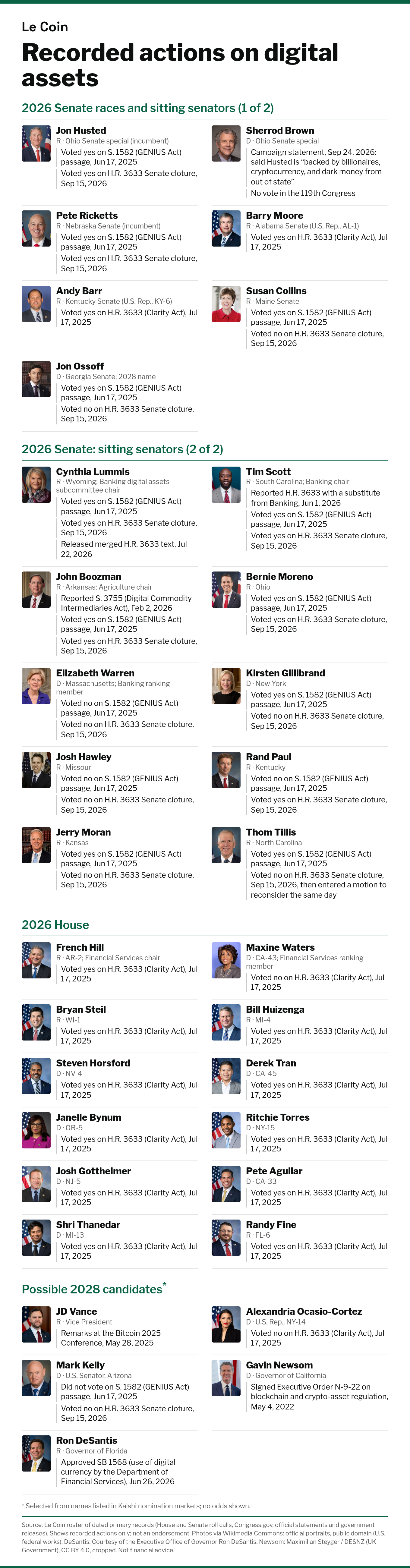
Chart: Le Coin. Photos: U.S. Senate and U.S. House official portraits (public domain); JD Vance: Emily J. Higgins (public domain); Gavin Newsom: Maximilian Steyger / DESNZ (UK Government), CC BY 4.0, cropped; Ron DeSantis: Courtesy of the Executive Office of Governor Ron DeSantis.
Read the full report
The full report includes:
- the bill's path and the Senate floor record
- candidate records drawn from roll-call votes
- PAC donors and candidate-level spending
- the four scenarios and the 2029 outlook
- state and international comparisons
- price history by period
- a table of uncertainties to monitor
Every figure is sourced and time-stamped. [Download the full report (PDF)]
Election Day is Nov. 3, 2026.
Disclosure. Le Coin's Analysis reports are research and analysis only. They are not investment, financial, legal or tax advice, and nothing in them is a recommendation to buy, sell or hold any asset. Information may change and may be incomplete. Prediction-market odds, such as Kalshi's, are market prices, not forecasts or guarantees. Past performance does not predict future results. Do your own research, or consult a licensed adviser. Le Coin's desks don't trade the assets they cover, and we take no payment, tokens or other benefit from any company, project or person we write about. If a report touches a conflict, we disclose it in that report or keep the desk off it.
Sources: Kalshi public API (Oct. 22, 2026, 4:45 p.m. ET; history from daily candles pulled 4:36 p.m. ET); House Clerk Roll no. 199; Senate Record Votes 234 and 318; Congressional Record, Sept. 15, 2026; Congress.gov; GENIUS Act enrolled text and Public Law 119-27 (GovInfo); FEC filings via api.open.fec.gov (pulled 4:33–4:34 p.m. ET Oct. 22); Senate Banking, Senate Agriculture and House Financial Services membership pages (4:46 p.m. ET Oct. 22); SEC and CFTC releases; CoinMarketCap daily closes (accessed 4:33 p.m. ET Oct. 22). Full citations are in the report.
Holding the Corner.
Not financial advice.