
Protocols & Policy · Protocol upgrades
Solana payments now aim to settle for good in under a second
Solana's Alpenglow upgrade went live on Oct. 21, cutting the time before a transaction can't be reversed from about 12.8 seconds to a target of about 150 milliseconds, according to the Solana Foundation.
Payments on Solana are now designed to become final in a fraction of a second instead of about 13 seconds, after the network switched to a new way of agreeing on blocks on Oct. 21. Finality is the point at which a transaction can no longer be reversed; the Solana Foundation says it took about 12.8 seconds under the old system and now targets roughly 150 milliseconds with the upgrade, called Alpenglow [1].
What changed
Alpenglow replaces TowerBFT, the process Solana's validators used to agree on the order of transactions. Under Alpenglow, validators "send votes directly to each other instead of as transactions, aggregate them into certificates, and finalize a block in one or two rounds," the Foundation says [1]. These are the Foundation's figures, not Le Coin measurements, and 150 milliseconds is a target.
The chart below shows how large the claimed drop is.
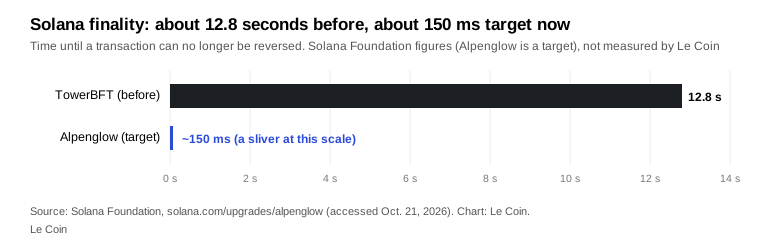
Source: Solana Foundation. Chart: Le Coin.
How the switch happened
Alpenglow activated at the start of epoch 1064, but the network "kept running TowerBFT for the first 5,000 slots, about 18 minutes," according to the Foundation [1]. Solana's own block records match that. Epoch 1064 began at slot 459,648,000, at 9:36:05 a.m. ET [2]. The Foundation names slot 459,653,000 as the start of Alpenglow consensus [1], but that slot was skipped: the network produced no block there, and the first block after it came at slot 459,653,008, at 9:54:03 a.m. ET [2]. The timeline below pins those steps to the chain.
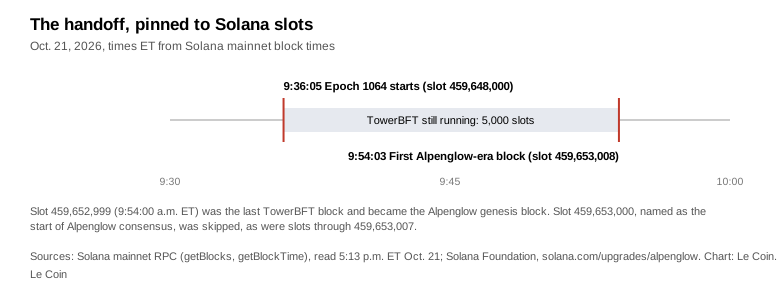
Sources: Solana mainnet block times; Solana Foundation. Chart: Le Coin.
Who it helps
For exchanges, faster finality means a deposit can be treated as settled sooner, since the risk that it gets reversed falls away within the target window. Payment firms get closer to card-like speed: the Foundation points to "a seemingly instant confirmation at the point of sale" [1]. Stablecoin issuers and their partners can redeem or credit tokens on Solana with less time spent waiting for confirmation. How much of that each firm actually uses depends on how many confirmations its own policy requires, which the upgrade does not set.
What stays the same
Users have nothing to do. "Nothing about signing, sending, or approving a transaction changed," the Foundation says, and "the SVM, transaction formats, and fee mechanics are untouched" [1]. Fees, accounts and apps work as before. Indexers and trading systems that stream whole blocks do have work to do, the Foundation says, because the way blocks are produced and streamed changed [1]. Le Coin covered on Oct. 20 why the upgrade also changes Solana's transaction counts [3].
The objection
A target is not a track record. The 150-millisecond figure is what the system is designed to do; how it holds up under heavy load, or when validators go offline, will only show over weeks of live traffic. The second part of Alpenglow, a new way of spreading block data called Rotor, "is not yet scheduled," the Foundation says [1].
The tell
In Le Coin's view, the tell is whether exchanges and payment firms cut the confirmation waits they require for Solana deposits, because that is where faster finality reaches customers.
Sources
[1] Solana Foundation, "Alpenglow" upgrade page. https://solana.com/upgrades/alpenglow (accessed Oct. 21, 2026, 5:12 p.m. ET) [2] Solana mainnet public RPC, block records for slots 459,648,000, 459,652,999, 459,653,000 and 459,653,008. https://api.mainnet-beta.solana.com (accessed Oct. 21, 2026, 5:13 p.m. ET) [3] Le Coin, "Solana's Alpenglow upgrade will shrink its activity numbers by design," Oct. 20, 2026. https://lecoin.news/protocols-policy/solana-alpenglow-activity-metrics/ (accessed Oct. 21, 2026, 5:12 p.m. ET)
Holding the Corner.
Not financial advice.