
Protocols & Policy · Stablecoin rules
Bank regulator sets stablecoin rules that take effect January 18
The OCC's final GENIUS Act rule tells banks and would-be issuers how to run a dollar stablecoin, drops a proposed test on yield payments through partners, and leaves money-laundering rules and the application window for later.
Banks and companies that want to issue dollar stablecoins under federal bank supervision now have their rulebook, and it takes effect on Jan. 18, 2027. The Office of the Comptroller of the Currency (OCC) issued its final rule under the GENIUS Act on Oct. 21, but it has not opened applications yet [1].
A stablecoin is a crypto token meant to hold a steady value, usually one dollar, backed by reserves the issuer keeps.
What the rule covers
The rule sets requirements for "permitted payment stablecoin issuers and foreign payment stablecoin issuers under the OCC's jurisdiction, as well as certain custody activities conducted by OCC-supervised entities," the OCC said [1]. Comptroller Jonathan V. Gould described it as "strong standards for reserve backing, redemption, and risk management" [1]. The OCC published its proposal on March 2, 2026, and said it took late comments until July 1 (p. 3) [2].
Two pieces are missing. Rules on the Bank Secrecy Act, anti-money laundering and Office of Foreign Assets Control sanctions "will be addressed in a separate rulemaking in coordination with the Department of Treasury," the OCC said [1]; the rule text says those comments "will be addressed in a separate rulemaking" (p. 5) [2]. And the OCC "will announce in a separate news release when it will begin accepting and processing applications and waiver requests" [1].
When things happen
The timeline below, built only from the OCC's documents, shows the one fixed date and the items still waiting for one.
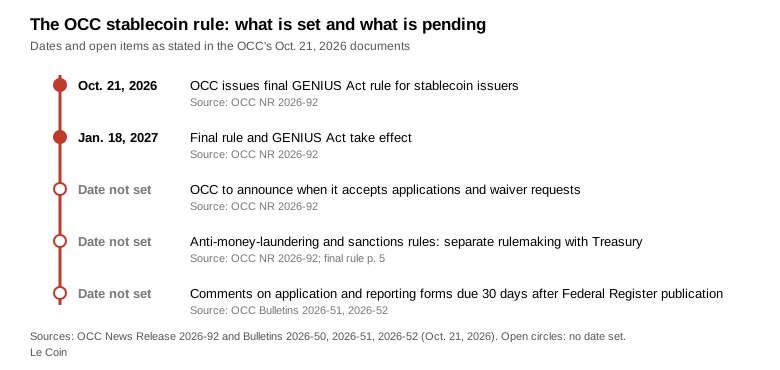
Sources: OCC News Release 2026-92 and Bulletins 2026-50, 2026-51 and 2026-52. Timeline: Le Coin.
The OCC also published draft application and reporting forms; comments on each are due 30 days after they appear in the Federal Register [3][4].
The yield fight
A central question in the rule is whether issuers can pass returns to holders through partners. The GENIUS Act bars an issuer from paying a holder "any form of interest or yield (whether in cash, tokens, or other consideration) solely in connection with the holding, use, or retention" of the stablecoin, and the final rule keeps that ban (§ 15.10(c)(4), p. 657) [2].
What changed is the test. The proposal would have presumed that certain deals with affiliates and related third parties broke the ban. After reviewing comments, "the OCC has determined to eliminate the rebuttable presumption from the final rule" (p. 98) [2]. It said the presumption "could have been both overinclusive and underinclusive" (p. 114) [2].
The OCC did not replace it with a list. It "is not including a list of prohibited or permitted arrangements" and will judge each one on "all relevant facts and circumstances" (p. 104) [2]. It "has not provided a general safe harbor" (p. 105) and "retains its authority to address evasion" of the yield ban (p. 101) [2]. On rewards, it declined to add "the facilitation of independently provided customer rewards" to the list of permitted issuer activities, "without additional information" (p. 76) [2].
The objection
In Le Coin's view, case-by-case review cuts both ways. Issuers and partners lose the bright line the proposal would have drawn around suspect deals, and they gain no safe harbor, a blanket assurance that a type of deal is allowed, in return. The OCC itself says it will "closely monitor" the industry and adjust the framework "to the extent necessary" [1].
This rule is separate from Treasury's own GENIUS Act rulemaking.
The tell
In Le Coin's view, the tell is the date the OCC opens applications, because until then no one can become a federally supervised issuer under this rule.
Sources
[1] OCC News Release 2026-92, "OCC Advances U.S. Digital Asset Leadership with Final Rule to Implement GENIUS Act," Oct. 21, 2026. https://www.occ.gov/news-issuances/news-releases/2026/nr-occ-2026-92.html (accessed Oct. 21, 2026, 7:10 a.m. ET) [2] OCC Bulletin 2026-50, final rule implementing the GENIUS Act (721 pp.). https://www.occ.gov/news-issuances/news-releases/2026/nr-occ-2026-92a.pdf (accessed Oct. 21, 2026, 7:10 a.m. ET) [3] OCC Bulletin 2026-51, waivers and application submission guidance. https://www.occ.gov/news-issuances/news-releases/2026/nr-occ-2026-92b.pdf (accessed Oct. 21, 2026, 7:10 a.m. ET) [4] OCC Bulletin 2026-52, revised reporting forms. https://www.occ.gov/news-issuances/news-releases/2026/nr-occ-2026-92c.pdf (accessed Oct. 21, 2026, 7:10 a.m. ET)
Holding the Corner.
Not financial advice.