
Protocols & Policy · Stablecoin rules
Banks and crypto firms split on stablecoin copies in Treasury comments
Bank groups want Treasury's GENIUS Act rule to stop wrapped stablecoins from slipping past it; crypto and payments firms want bridging judged by what holders actually own.
Treasury's stablecoin rules will decide which dollar tokens American platforms can offer, and the banks and the crypto industry have just asked it for opposite things on one point: wrapped tokens. A wrapped stablecoin is a new token, made by a go-between such as a bridge, that stands in for a regular stablecoin locked away somewhere else, often so it can move to another blockchain.
Treasury's proposal would implement Section 3 of the GENIUS Act, the 2025 federal law that sets up a licensing regime for dollar stablecoins. Section 3 sets the limits on who may issue, offer and sell payment stablecoins in the United States [14, p. 53368]. In plain terms, Section 3 makes it unlawful for anyone other than a permitted issuer to issue a payment stablecoin here, and restricts which coins platforms may offer or sell to U.S. customers [14, p. 53368]. The proposal does not settle wrapping; it asks commenters when moving a stablecoin across blockchains, or wrapping it, should count as an issuance, and when a bridge operator becomes an issuer (Questions 19 to 21) [14, p. 53373]. It gives no date for a final rule.
Comments closed Oct. 19. As of 1:06 p.m. ET on Oct. 20, the docket showed 161 letters, 84 of them posted that day [1]. These are requests to the agency, not rules.
The banks: close the door
The American Bankers Association wants key terms defined "so that State-affiliated issuers, wrapped tokens, and other structures cannot sidestep Section 3" [2, p. 2]. It warns that "the holder of the wrapped token often has no claim against the original issuer or its reserves and must rely on the intermediary" [2, p. 5]. The Bank Policy Institute asks Treasury to "treat arrangements, such as wrapped or bridged arrangements, as new issuances or impermissible evasion when they are intended to evade the prohibitions of the GENIUS Act rather than to facilitate legitimate cross-chain interoperability" [3, p. 2].
The Independent Community Bankers of America cares most about its members' own products: it asks Treasury to "expressly clarify that its treatment of bridged or wrapped payment stablecoins does not apply to a genuine tokenized deposit" [4, p. 3], meaning a bank deposit recorded as a token. SIFMA, the securities industry group, sits between the camps. It wants Treasury to "confirm that cross-chain transfers that preserve the holder's claim against the original issuer are not issuances, while addressing the disclosure and evasion risks posed by wrapped tokens that shift the holder's claim to an intermediary" [5, p. 4].
The crypto firms: judge what holders own
Stripe asks Treasury to "apply a functional approach to cross-chain bridging and wrapping," which "would emphasize the economic interests and legal rights of a tokenholder over the form of the electronic record" [9, p. 1]. Circle says "a separately created entitlement should be assessed independently under the statutory payment-stablecoin definition and should not automatically be attributed to the underlying issuer" [7, p. 14]. Anchorage Digital asks Treasury "to treat bridge and minting technology providers as technical vendors, and to distinguish native payment stablecoins from bridged or derivative tokens created by third parties" [10, p. 1]. Andreessen Horowitz argues that "bridge operators and related software providers who only engage in the technical process of minting or creating a payment stablecoin do not 'issue', are not 'issuers'" [11, p. 6].
Who asked for what
The table below sums up each filer's main ask, wrapping-related where the letter has one.
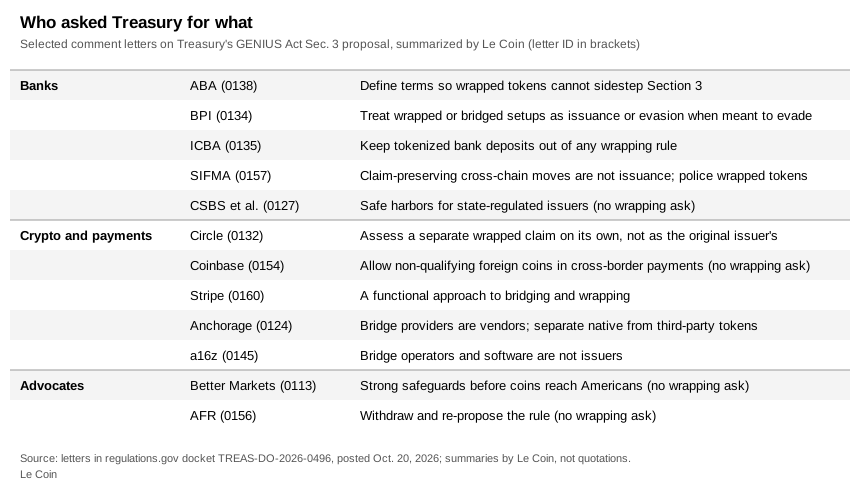
Several major filers did not address wrapping at all. Coinbase's main request concerns crypto platforms, which the law calls digital asset service providers, or DASPs: it wants Treasury to "confirm that a DASP may use a non-qualifying foreign payment stablecoin to complete a cross-border payment for a U.S. customer who never holds that stablecoin" [8, p. 3]. The state regulators led by the Conference of State Bank Supervisors say "Treasury should implement safe harbors that permit payment stablecoin issuers to operate under qualifying state regimes as of the effective date" [6, p. 1].
The objection from outside both camps
Consumer advocates want a tougher rule across the board. Better Markets says stablecoin availability "should therefore be conditioned on meaningful regulatory safeguards" [12, p. 3]. Americans for Financial Reform Education Fund says "the Treasury Department should withdraw the proposed rule" and re-propose it [13, p. 1].
In Le Coin's view, the wrapping fight is narrower than it looks: the banks and the crypto firms agree that a token keeping the holder's claim on the original issuer is different from one that swaps it for a claim on a go-between. They disagree on who must prove which is which.
What to watch
In Le Coin's view, the tell is whether Treasury's final rule answers its own Question 21 by drawing the line where SIFMA and the crypto firms put it, at whether the holder keeps a claim on the original issuer, or where the banks put it, at any wrapper that could serve as a path around the Act.
Sources
- Docket TREAS-DO-2026-0496 comment list (regulations.gov API), 161 comments, 84 posted Oct. 20, 2026, https://www.regulations.gov/docket/TREAS-DO-2026-0496, accessed 2026-10-20, 1:06 p.m. ET.
- American Bankers Association, comment letter, TREAS-DO-2026-0496-0138, https://downloads.regulations.gov/TREAS-DO-2026-0496-0138/attachment_1.pdf, accessed 2026-10-20, 1:05 p.m. ET.
- Bank Policy Institute, comment letter, TREAS-DO-2026-0496-0134, https://downloads.regulations.gov/TREAS-DO-2026-0496-0134/attachment_1.pdf, accessed 2026-10-20, 1:05 p.m. ET.
- Independent Community Bankers of America, comment letter, TREAS-DO-2026-0496-0135, https://downloads.regulations.gov/TREAS-DO-2026-0496-0135/attachment_1.pdf, accessed 2026-10-20, 1:09 p.m. ET.
- Securities Industry and Financial Markets Association, comment letter, TREAS-DO-2026-0496-0157, https://downloads.regulations.gov/TREAS-DO-2026-0496-0157/attachment_1.pdf, accessed 2026-10-20, 1:10 p.m. ET.
- Conference of State Bank Supervisors et al. (state regulators), comment letter, TREAS-DO-2026-0496-0127, https://downloads.regulations.gov/TREAS-DO-2026-0496-0127/attachment_1.pdf, accessed 2026-10-20, 1:05 p.m. ET.
- Circle Internet Group, comment letter, TREAS-DO-2026-0496-0132, https://downloads.regulations.gov/TREAS-DO-2026-0496-0132/attachment_1.pdf, accessed 2026-10-20, 1:05 p.m. ET.
- Coinbase, comment letter, TREAS-DO-2026-0496-0154, https://downloads.regulations.gov/TREAS-DO-2026-0496-0154/attachment_1.pdf, accessed 2026-10-20, 1:05 p.m. ET.
- Stripe, LLC, comment letter, TREAS-DO-2026-0496-0160, https://downloads.regulations.gov/TREAS-DO-2026-0496-0160/attachment_1.pdf, accessed 2026-10-20, 1:05 p.m. ET.
- Anchorage Digital Bank N.A., comment letter, TREAS-DO-2026-0496-0124, https://downloads.regulations.gov/TREAS-DO-2026-0496-0124/attachment_1.pdf, accessed 2026-10-20, 1:10 p.m. ET.
- Andreessen Horowitz (a16z), comment letter, TREAS-DO-2026-0496-0145, https://downloads.regulations.gov/TREAS-DO-2026-0496-0145/attachment_1.pdf, accessed 2026-10-20, 1:10 p.m. ET.
- Better Markets, comment letter, TREAS-DO-2026-0496-0113, https://downloads.regulations.gov/TREAS-DO-2026-0496-0113/attachment_1.pdf, accessed 2026-10-20, 1:10 p.m. ET.
- Americans for Financial Reform Education Fund, comment letter, TREAS-DO-2026-0496-0156, https://downloads.regulations.gov/TREAS-DO-2026-0496-0156/attachment_1.pdf, accessed 2026-10-20, 1:10 p.m. ET.
- Department of the Treasury, "GENIUS Act Regulations on Payment Stablecoin Issuance, Offer, and Sale," proposed rule, 91 FR 53368 (Aug. 18, 2026), https://www.govinfo.gov/content/pkg/FR-2026-08-18/pdf/2026-16796.pdf, accessed 2026-10-20, 1:14 p.m. ET.
Holding the Corner.
Not financial advice.