
Protocols & Policy · Tokenization
Malaysia's central bank moves bond settlement onto round-the-clock digital rails
Bank Negara Malaysia's new SSDS+ platform records tokenised bonds and sukuk on a shared ledger and links to a 24/7 payment system that settles in central bank money, though no issue has been announced on it yet.
Malaysia's central bank has launched a platform that records bonds and sukuk on a shared digital ledger and links to its round-the-clock payment system, which settles in money the central bank itself issues. Bank Negara Malaysia (BNM) says its new SSDS+ platform is ready for tokenised government and corporate bonds, including retail issues, but it has not announced any bond issued on it yet [1].
What launched
SSDS+ is BNM's "next-generation platform for the issuance, depository, and safekeeping of tokenised bonds and sukuk," the bank said on Oct. 20 [1]. Sukuk are Islamic bonds structured so investors share in the returns of an underlying asset rather than earning interest, which sharia bars. BNM built the system "in-house using cloud and distributed ledger technologies," on top of SSDS, the central securities depository for Malaysia's wholesale market [1].
How it works
Two BNM systems split the job. The diagram below, drawn only from BNM's release, shows which system holds the bond and which moves the money.
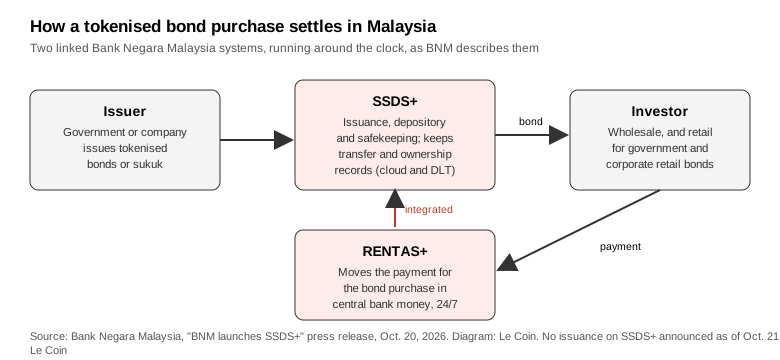
Source: Bank Negara Malaysia, SSDS+ press release, Oct. 20, 2026. Diagram: Le Coin.
SSDS+ "manages tokenised securities transfer and ownership records," while RENTAS+ "facilitates the corresponding secure transfer of payments for bond purchases in central bank money," BNM said [1]. RENTAS+ is BNM's upgraded interbank settlement system, which since October 2025 has settled funds "24/7, 365 days a year" [2]. Linking the two means a bond and its payment could change hands outside banking hours [1].
Who gains
Issuers get a central depository built for tokenised bonds. BNM says digital securities "can simplify transactions, enable greater flexibility in the design of financial instruments, and broaden access to investment opportunities" [1]. Banks that hold and trade government paper could settle at night or on weekends. Retail investors are named as a target: SSDS+ is meant to handle "tokenised government and corporate retail bonds" alongside wholesale issues [1].
What stays the same
The money does not change. Settlement still runs in central bank money through BNM's own system, not through a stablecoin or a private token [1]. SSDS+ builds on SSDS, the depository BNM already runs [1]. BNM said in October 2025 that RENTAS, its interbank payment and securities settlement system, "stands as the largest sukuk depository in the world, with USD300 billion sukuk in custody" [2].
The objection
A platform is not a market. BNM has named no issuer, issue date or volume, and has not said who runs the ledger or which institutions can connect [1]. Governor Abdul Rasheed Ghaffour said the launch "marks a major milestone in modernising Malaysia's financial market infrastructure." BNM has announced no bond issued through it [1].
The tell
In Le Coin's view, the tell is the first tokenised retail bond on SSDS+: when one is sold, the system stops being plumbing on paper.
Sources
[1] Bank Negara Malaysia, "BNM launches SSDS+: Powering digital and tokenised bond and sukuk issuance," press release, Oct. 20, 2026. https://www.bnm.gov.my/-/ssdsplus (accessed Oct. 21, 2026, 6:08 a.m. ET) [2] Bank Negara Malaysia, RENTAS+ launch press release, Oct. 7, 2025. https://www.bnm.gov.my/-/pr-rentas (accessed Oct. 21, 2026, 6:09 a.m. ET)
Holding the Corner.
Not financial advice.