
Protocols & Policy · Bank adoption
Strategy Says Big-Bank Bitcoin Adoption Rose to 34% in Its Own Index
Strategy's Bitcoin Banking Adoption Index, posted to its investor relations page on Oct. 12, scores 25 banks and puts Fidelity first at 77%. The company scores itself into the method: three of the 15 dimensions score lending against its MSTR stock and STRC preferred, or products built on STRC.
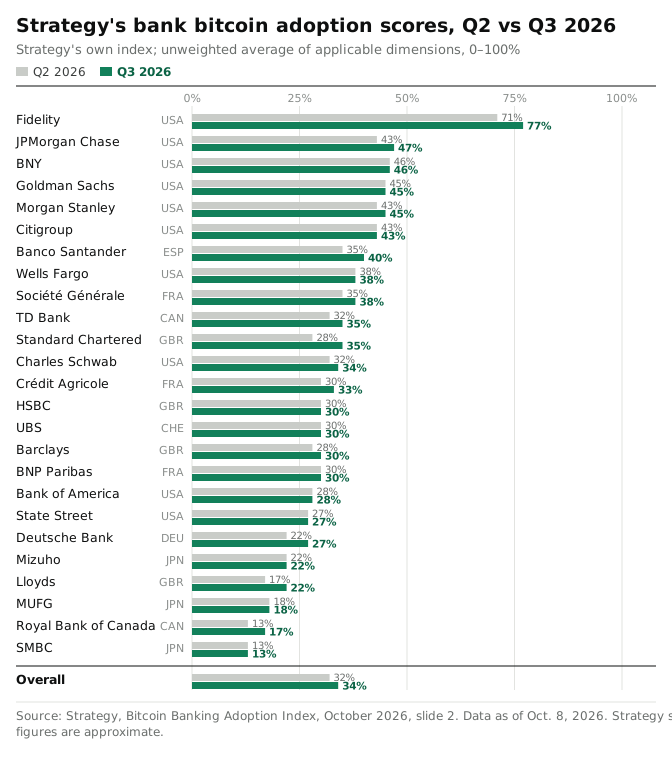
Strategy, the company behind MSTR stock and STRC preferred, says adoption of bitcoin and related digital assets at the world's biggest banks rose this quarter. Its "Bitcoin Banking Adoption Index," a nine-slide deck listed on its investor relations page on Oct. 12, reads "Bitcoin Banking Adoption Index: 34% Overall" (slide 2). The prior quarter's figure in the same table is 32%.
The scores are Strategy's own. The company built the index, picked the banks and graded them, from "public sources as of October 8, 2026" (slide 2).
The index is not new this month. Strategy's chief executive, Phong Le, introduced it on X on July 13 at 32%, and Strategy's official account reposted that post (source 4). Strategy's Q2 presentation, dated July 30, already showed the index at 32%. In it, Strategy charted a series under the title "Banks Are Embracing Bitcoin YoY": 9% in December 2023, 14% in December 2024, 24% in December 2025 and 32% in July 2026 (Q2 presentation, slide 44). The slide labels the series "% of top 25 global banks offering Bitcoin-related services," but its footnote defines it as the index's "overall score across the 25 leading global banks, each scored on 15 dimensions." Those are different measures: a share of banks is not an average score. The July 32% matches the Q2 index figure in the October deck (slide 2).
What it measures
Strategy says it scores 25 banks "across 15 dimensions in four categories: Trading & Custody, Products, Margin, and Leadership" (slide 7). Each dimension gets one of five ratings, "0, 0.25, 0.5, 0.75, 1.0," running "from no activity (0), through limited / pilot / third-party, to full, productized, broadly available (1.0)" (slide 7).
The dimensions include trading in bitcoin and bitcoin exchange-traded products, bitcoin custody, stablecoins, tokens, blockchain activity, margin lending and a formal bitcoin allocation for client portfolios (slides 2, 8, 9). A bank's score is "the unweighted average of its applicable dimensions" (slide 7). Dimensions that do not fit a bank's model are marked N/A and "excluded from both the sum and the count, never scored as 0" (slide 7).
The bank pool, Strategy says, came from the top 30 institutions on four asset measures plus the 2025 Financial Stability Board list of globally systemic banks (slide 7). Strategy excluded the Chinese giants, citing "state-controlled ownership and a more restrictive capital-markets environment" (slide 7). It added Lloyds "on the strength of its partnership with AnchorWatch, a bitcoin insurance provider" (slide 7).
Who ranks where
On Strategy's Q3 scores (slide 2), Fidelity leads at 77%, up from 71%. JPMorgan Chase follows at 47%, then BNY at 46%, and Goldman Sachs and Morgan Stanley at 45%. Citigroup is at 43%, Banco Santander at 40%, and Wells Fargo and Société Générale at 38%.
At the bottom, Mizuho and Lloyds are at 22%, MUFG at 18%, Royal Bank of Canada at 17% and SMBC at 13% (slide 2). Fifteen of the 25 banks are outside the US, from Spain, France, Canada, the UK, Switzerland, Germany and Japan.
Strategy lists "17 Updates Raised Scores" (slide 4), shown below. Another 28 items left scores unchanged, including Citigroup's "Bitcoin custody announced for later in 2026" (slide 5).
| Institution | Dimension | Q2 → Q3 | Strategy's stated update |
|---|---|---|---|
| Banco Santander | ETP Trading | 0 → 75 | Bitcoin-linked ETF access for Spanish retail clients |
| Barclays | Tokens | 25 → 50 | Live UK tokenized-deposit customer transactions |
| Charles Schwab | Allocation | 0 → 25 | Published illustrative Bitcoin allocation guidance |
| Crédit Agricole | Stablecoin | 50 → 75 | EURXT launched on Ethereum |
| Crédit Agricole | Executive | 50 → 75 | Digital-assets head on Group Management Committee |
| Deutsche Bank | Blockchain | 0 → 75 | Completed first euro cross-border pilot transaction on Partior |
| Fidelity | Margin – ETP | 0 → 75 | IBIT, FBTC and ARKB marginable |
| JPMorgan | Allocation | 0 → 25 | Private Bank discusses Bitcoin as satellite allocation |
| JPMorgan | Credit vs BTC | 25 → 50 | BTC-backed credit reported live for institutions |
| Lloyds | ETP Trading | 0 → 75 | Bitcoin ETPs available through Share Dealing |
| Morgan Stanley | BTC Custody | 25 → 50 | E*TRADE rollout completed with Zerohash custody |
| RBC | Tokens | 0 → 50 | Project Samara tokenized-bond pilot |
| Société Générale | ETP Trading | 25 → 75 | BoursoBank offers Bitcoin ETNs |
| Standard Chartered | Stablecoin | 50 → 75 | HKDAP limited public-blockchain launch |
| Standard Chartered | Blockchain | 0 → 75 | Live euro-denominated cross-border client transactions on Partior |
| TD Bank | Tokens | 25 → 50 | Project Samara tokenized-bond pilot |
| TD Bank | ETP Trading | 50 → 75 | Crypto ETFs available through TD Direct Investing |
Source: Strategy, slide 4, "17 Updates Raised Scores." Data as of Oct. 8, 2026.
Le Coin's view: what the deck leaves open
First, the 17 increases are not all new events. Strategy's footnote says they include "5 Q3 2026 developments and 12 prior-period items re-reviewed this quarter" (slide 4). The deck does not say how much of the two-point rise comes from re-reviews rather than new bank activity.
Second, Strategy grades banks partly on Strategy's own products. The Margin dimensions score lending "against MSTR equity" and "against STRC preferred," and underwriting for "Bitcoin treasury companies (e.g., Strategy, Strive)" (slide 9). Slide 8 also scores "digital money / yield" defined as instruments "built on Digital Credit (“STRC”)." A bank can raise its score by doing business tied to Strategy's securities.
Third, Strategy says "Every score carries a per-cell source note" (slide 7), but the deck shows no source notes. Readers cannot check any single cell from the slides alone.
Fourth, an unweighted average with N/A cells dropped means banks are scored on different numbers of dimensions. Fidelity, Citigroup and Charles Schwab each carry one N/A, BNY four, State Street three (slide 2). Strategy calls the figures "approximate" (slide 2).
The index is a scorecard from a bitcoin treasury company about how banks treat bitcoin. Read it as Strategy's case, with its evidence still to be shown.
Sources
- Strategy, "Bitcoin Banking Adoption Index," October 2026, slides 1–9. https://assets.contentstack.io/v3/assets/bltf8d808d9b8cebd37/bltc5c5553aa9a04f68/6acd0d0b9355c04e1e7ab319/Strategy_Bank_Bitcoin_Adoption_Index_Slides_v.Website.pdf (accessed Oct. 13, 2026, 11:22 a.m. ET)
- Strategy, Investor Relations, Events and Presentations listing, dated Oct. 12, 2026. https://www.strategy.com/investor-relations/events-presentations (accessed Oct. 13, 2026, 11:23 a.m. ET)
- Strategy, "Q2 2026 Financial Results" presentation, July 30, 2026, slide 44. https://assets.contentstack.io/v3/assets/bltf8d808d9b8cebd37/blt112f20b1e4c24a84/6a6bcf5c1dd9934bc74056f4/strategy-q2-2026-financial-results-presentation_3.pdf (accessed Oct. 13, 2026, 11:34 a.m. ET)
- Phong Le, Strategy chief executive, post on X, July 13, 2026, reposted by Strategy's official account. https://x.com/phongle/status/2076712392134713720 (accessed Oct. 13, 2026, 11:52 a.m. ET)
Holding the Corner.
Not financial advice.