
Markets · Bitcoin
UK Court Rules Chinese Law Governs Claims to More Than 61,000 Seized Bitcoin
A London judge ruled on Oct. 12 that Chinese law governs whether victims of Zhimin Qian's fraud own any of the bitcoin police seized, and left the content of Chinese law, and so the outcome of the claims, to a later stage.
A High Court judge in London has ruled that Chinese law, not English law, will decide whether victims of a Chinese investment fraud own any of the more than 61,000 bitcoin that British police seized from Zhimin Qian. "The applicable law is Chinese law," Mr Justice Turner wrote in a judgment handed down Oct. 12 (para. 238).
The ruling answers one narrow question. The judge described the issue "at this stage" as "limited to" whether English law, Chinese law "or a combination of the two will later fall to be applied" to the victims' claims (para. 2). It does not decide who owns the coins, whether any victim gets paid, or what the state does with them. The judgment does not value the bitcoin; it puts the recovered proceeds at "several billion pounds sterling" (para. 1).
Why it matters: the route victims hoped to use just got harder. The case is a civil recovery action, a court process under the Proceeds of Crime Act 2002 (PoCA) that lets the state take property shown to come from crime without a new criminal conviction. Victims can block that only through section 281, which requires each applicant to show "the property he claims belongs to him" (para. 18). The judge stressed that the section "does not create any broader compensation scheme" for people who lost money to crime; being owed money by the fraudsters is not enough (para. 19).
The mechanism is a choice-of-law test, the rule courts use to pick which country's legal system governs a dispute. The victims argued for English law, or a mix, on four grounds (para. 10). The Director of Public Prosecutions, who brought the case, argued Chinese law applies "on any analysis" (para. 9). The judge sided with the prosecutor: "Whether the issues are analysed under Rome I, Rome II or the common-law rules of private international law, the result is the same" (para. 238). Rome I and Rome II are EU rules on contract and non-contract claims that were kept in UK domestic law after Brexit (para. 39). His conclusion: "the existence and content of any proprietary rights" behind the claims "must be assessed by reference to Chinese law" (para. 246).
The agreed facts explain the pull toward China. The schemes "were designed and carried out in China" (para. 5, assumed fact 5), victims paid in Chinese currency into accounts at Chinese bank branches (para. 5, assumed facts 12 and 13), and at least 128,409 investment contracts were linked to the fraud (para. 5, assumed fact 10).
Fig. 1. From seizure to the Chinese-law ruling, and what comes next (Source: [2026] EWHC 2509 (KB), source 1; dates tagged to paragraphs in source 2.) Alt text: Timeline: police seize devices and keys in London, Oct. 31 and Nov. 1, 2018; property freezing order, Dec. 21, 2023; Ms Qian arrested, April 2024; management receivership order, June 4, 2025; judgment and declaration, Jan. 21, 2026; applicable-law hearing, July 7 to 9, 2026; judgment handed down, Oct. 12, 2026; still to come, no date: consequential order and evidence on Chinese law.
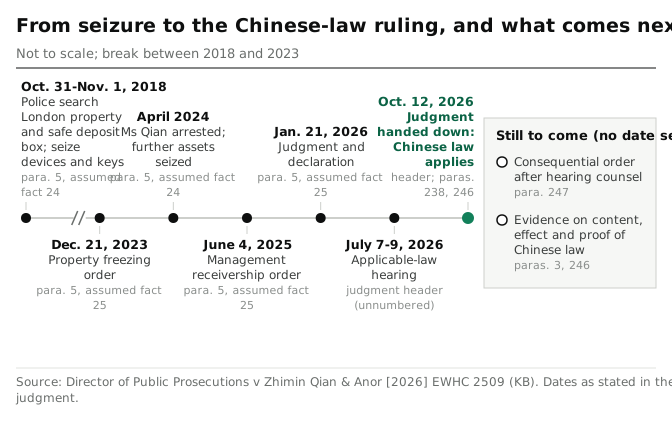
The objection: this is not a ruling that the UK keeps the bitcoin. Nobody has yet shown the court what Chinese law says. "No evidence has yet been adduced either as to the content of Chinese law," the judge noted (para. 3), and "any issues concerning the content, effect or proof of that law are matters for a later stage" (para. 246). If Chinese law gives victims a property interest in what their money bought, the ruling could still work in their favor. The judge also flagged that, even where victims meet the statutory test, the court arguably keeps "a residual discretion" over whether to grant their claims (para. 20).
Table 1. What the judgment says, in figures (Source: [2026] EWHC 2509 (KB), source 1; RMB-to-sterling conversions as stated in the agreed facts.)
| Item | Figure | Where |
|---|---|---|
| Bitcoin in the seized property | "more than 61,000" | para. 5, fact 24 |
| Investor money taken, 2014-2017 | about RMB 40.2 billion (about £4.1 billion) | para. 5, fact 16 |
| Paid back to some investors | about RMB 34.1 billion (about £3.4 billion) | para. 5, fact 17 |
| Investment contracts linked to fraud | at least 128,409 | para. 5, fact 10 |
| Value of recovered proceeds | "several billion pounds sterling" | para. 1 |
The tell that would change the view: expert evidence on Chinese property law at the next stage. If the court accepts that Chinese law lets victims follow their money into the bitcoin, the claims under section 281 survive and the coins could go back to them. If not, the property stays on track for recovery by the state. Until then, the order the judge will make is still to come: "I will hear counsel as to the precise form of order consequential upon this judgment" (para. 247).
The checkable fact: the Metropolitan Police searched a London property and safe deposit box rented by Ms Qian and Ms Wen on Oct. 31 and Nov. 1, 2018, and seized devices used to access the bitcoin and the "keys" to some of it (para. 5, assumed fact 24).
Sources:
- Director of Public Prosecutions v Zhimin Qian & Anor [2026] EWHC 2509 (KB), handed down Oct. 12, 2026 (data source for Table 1): https://caselaw.nationalarchives.gov.uk/ewhc/kb/2026/2509 (accessed Oct. 13, 2026, 9:22 a.m. ET)
- Fig. 1 data and calculation note: dates as stated in the judgment, ordered by Le Coin; no other calculation. Data file drafts/wip/markets-2026-10-13-uk-bitcoin-ruling.fig-1-data.csv (source: https://caselaw.nationalarchives.gov.uk/ewhc/kb/2026/2509, accessed Oct. 13, 2026, 9:22 a.m. ET)
Holding the Corner.
Not financial advice.