
At a glance
- Rollups are layer-2 networks that "derive their security directly from layer 1 Ethereum consensus," per ethereum.org [1].
- Optimistic rollups assume transactions are valid unless challenged; zero-knowledge rollups submit a proof for each batch [1].
- EIP-4844 added cheaper "blob" data for rollups; blobs are deleted after about 18 days [2][3].
- The OP Stack spec gives withdrawals a 7-day challenge period; Base's docs give 5 days, or 1 day with two proofs [5][8].
- Base sets its own withdrawal window, and changed it from 7 days to 5 in its Beryl upgrade [9].
1. What it is
Doing the work off Ethereum
Ethereum's main chain can process only so many transactions. A rollup runs transactions on a separate chain, bundles them, and posts the results back to Ethereum. Ethereum.org groups rollups among the "layer 2" solutions that "derive their security directly from layer 1 Ethereum consensus" [1].
Analogy, not the mechanism itself: a branch office handles the day's sales, then files one summary with head office, which keeps the official books.
Two kinds of rollup
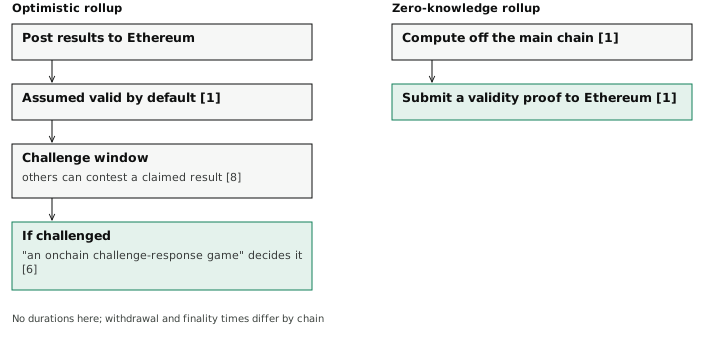
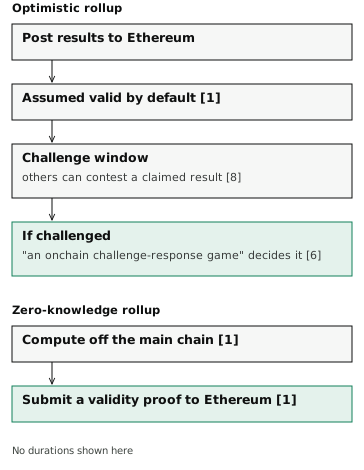
Ethereum.org describes two types [1]. Optimistic rollups assume transactions are valid by default and run the computation on Ethereum only "in the event of a challenge." Zero-knowledge rollups run the computation off the main chain and submit a validity proof to it.
What a rollup is not
Ethereum.org treats some designs separately [1]. A validium "uses validity proofs like zero-knowledge rollups but data is not stored on the main layer 1 Ethereum chain." The difference is where the transaction data is kept.
Base as the case study
Base is a layer-2 network that settles on Ethereum, and withdrawals from it pass through a dispute game, an onchain process that gives others time to contest a claimed result before funds are released [8]. Its withdrawal specification uses the OptimismPortal contract on Ethereum [8], and its documentation lists the Optimism network upgrades, from Canyon to Jovian, in its own upgrade history [11]. It calls Azul, live on mainnet May 28, 2026, "Base's first independent network upgrade" [11].
Where Arbitrum fits
Arbitrum One is another layer-2 network on Ethereum, built on a different software stack, Nitro. Le Coin's Arbitrum dive covers its sequencer, its dispute system and its Security Council. This page uses Base to show the general pattern.
2. How it works
Batches posted to Ethereum
A rollup's operator collects transactions, orders them into blocks and posts the data to Ethereum in batches. Base's docs give documented targets for each step: a "Flashblock" inclusion, an early preconfirmation block, in about 200 milliseconds, an L2 block in about 2 seconds, inclusion of the batch on Ethereum in about 2 minutes, and finality of that batch on Ethereum in about 20 minutes [7].
Blobs: cheaper rollup data
EIP-4844, "Shard Blob Transactions," added a new transaction type, 0x03, that carries "blobs" of data [2]. Each blob holds 4,096 field elements [2]. Ethereum.org says blob data "is automatically deleted after a fixed time period (set to 4096 epochs at time of writing, or about 18 days)," and that "this means rollups can send their data much more cheaply" [3].
Analogy, not the mechanism itself: a blob is a notice pinned to a public board for a couple of weeks, long enough for anyone to copy it, instead of being carved into the building forever.
Deposits from Ethereum
Moving funds into the rollup starts on Ethereum. The OP Stack spec defines deposited transactions as transactions "which are initiated on L1, and executed on L2" [4]. They "are derived from Layer 1 blocks, and must be included as part of the protocol" [4].
Withdrawals back to Ethereum
Leaving takes longer. Under the OP Stack spec, a withdrawal is first proven on Ethereum. Then, "after the withdrawal is proven, it enters a 7 day challenge period, allowing time for other network participants to challenge the integrity of the corresponding output root" [5]. An output root is a short fingerprint of the rollup's state that is posted to Ethereum. After that, it can be finalized on Ethereum [5].
Settling a dispute
If someone challenges a result, the OP Stack's fault proof decides it. The spec describes "an onchain challenge-response game that bisects to a disagreed block" state transition, narrowing the dispute down to a single step that Ethereum can check [6].
Analogy, not the mechanism itself: two people disagree about a long sum, so they halve the column again and again until they reach the single line where their answers split, and a referee checks only that line.
Regular transactions don't wait
The challenge window applies to withdrawals to Ethereum. Base's docs say that "regular transactions within Base, such as swaps or sends, do not have this wait" [7].
3. What changed
Proto-danksharding (March 2024)
EIP-4844 went live on Ethereum mainnet "with the Cancun-Deneb ('Dencun') network upgrade in March 2024," per ethereum.org [3].
Why it mattered: rollups gained a dedicated, short-lived place to post their data, which ethereum.org says lets them "pass the savings on to end users in the form of cheaper transactions" [3].
Base's two-proof fast path
Base's Azul upgrade, live on mainnet May 28, 2026, introduced a "multi-proof system" [11]. Under it, a withdrawal can finalize after 1 day "when both a TEE proof and a ZK proof back the same proposal" [8]. TEE stands for trusted execution environment, a form of secure computing hardware; a ZK proof is a cryptographic proof.
Base shortens its window (Beryl)
Base's Beryl upgrade, live on mainnet June 25, 2026 [10], reduced "the single-proof dispute game finalization window" from "7 days to 5 days," while the two-proof path "remains at 1 day" [9]. Base said the change "frees capital for fast-bridge liquidity providers sooner" [9].
Why it mattered: users who withdraw through the standard path get their funds on Ethereum two days sooner.
Two windows, two sources
| Path | Window | Source |
|---|---|---|
| OP Stack specification, default | 7 days | OP Stack withdrawals spec [5] |
| Base, single proof (since Beryl) | 5 days | Base withdrawals spec [8]; Beryl [9] |
| Base, TEE and ZK proofs together | 1 day | Base withdrawals spec [8]; Beryl [9] |
Base sets its own withdrawal window. The OP Stack spec's 7 days is the generic design; Base's documentation gives the periods that apply on Base [8][9]. A reader who sees "7 days" elsewhere may be reading the generic spec, or a page written before Beryl.
Base's own upgrades
Base's upgrade history lists Optimism's network upgrades through Jovian, then Base-specific ones [11]. Azul was "Base's first independent network upgrade," and Beryl followed [10][11].
4. What is open
Who can challenge, and how fast
The 5-day and 1-day windows rest on Base's proof system [8]. The window "gives network participants time to dispute an invalid output root before withdrawals that depend on it can be finalized" [8]. How often that system is tested by real disputes is beyond this page's sources.
Rules that can change
Beryl shows that a rollup's withdrawal window is a setting its operators can change through an upgrade [9]. Readers should check a rollup's current documentation rather than relying on a figure from the generic spec.
Hardware trust in the fast path
The 1-day path needs a TEE proof alongside a ZK proof [8]. A TEE proof relies on the hardware that produced it. Base's docs give the 1-day window only when a ZK proof backs the same proposal as well [8].
Blob data is temporary
Blobs are deleted after about 18 days [3]. Anyone who wants to check a rollup's history after that needs another copy of the data. Ethereum.org's own text gives the period as set "at time of writing," so it can change [3].
Different stacks, different settings
Rollups share a pattern but not their numbers. Base's windows differ from the OP Stack default [5][8], and Arbitrum sets its own; see the Arbitrum dive.
What this page leaves out
By Learning Hub policy, this dive carries no price, market value or network-usage figures. Base's timings above are documented targets, not measurements. This page does not cover zero-knowledge rollups in depth, Base's launch history or its Security Council, or how the sequencer orders transactions.
Sources
- 1ethereum.org, "Scaling." https://ethereum.org/en/developers/docs/scaling/
- 2EIP-4844, "Shard Blob Transactions." https://eips.ethereum.org/EIPS/eip-4844
- 3ethereum.org, "Danksharding." https://ethereum.org/en/roadmap/danksharding/
- 4OP Stack specifications, "Deposits," commit f47d083. https://github.com/ethereum-optimism/specs/blob/f47d0831c6aa01542a6b399f864641b426fde6cd/specs/protocol/deposits.md
- 5OP Stack specifications, "Withdrawals," commit f47d083. https://github.com/ethereum-optimism/specs/blob/f47d0831c6aa01542a6b399f864641b426fde6cd/specs/protocol/withdrawals.md
- 6OP Stack specifications, "Fault Proof," commit f47d083. https://github.com/ethereum-optimism/specs/blob/f47d0831c6aa01542a6b399f864641b426fde6cd/specs/fault-proof/index.md
- 7Base documentation, "Transaction Finality." https://docs.base.org/base-chain/network-information/transaction-finality
- 8Base documentation, "Withdrawals." https://docs.base.org/specifications/base-protocol/bridging/withdrawals
- 9Base documentation, "Beryl: Faster Withdrawals." https://docs.base.org/upgrades/beryl/reducing-canonical-withdrawal-delay
- 10Base documentation, "Beryl Overview." https://docs.base.org/upgrades/beryl/overview
- 11Base documentation, "Azul Overview." https://docs.base.org/upgrades/azul/overviewHolding the Corner.
Not financial advice.