
Protocols & Policy · Enforcement
SEC charges two firms over alleged $130M scheme built on false filings
The SEC says BG Wealth Sharing and DSJ Exchange took in more than $130 million from investors in over 40 states, using filings they made with the agency to look regulated. The firms have not responded in court.
The Securities and Exchange Commission on Oct. 29 sued two Colorado-incorporated companies, BG Wealth Sharing Ltd and DSJ Exchange PTY Ltd, alleging that they took in more than $130 million from investors through a crypto trading scheme that used false SEC filings to look legitimate. The agency says the firms, which it calls "foreign-operated," left investors with losses of more than $100 million (Complaint ¶¶6, 9, 17–18; Release 2026-110).
These are allegations in a civil complaint. No court has ruled on them, the defendants have not yet answered, and Le Coin did not seek a response because neither the release nor the complaint lists a contact.
How the SEC says it worked
The mechanism is borrowed credibility. According to the complaint, DSJ Exchange filed a Form D, a short notice companies file when they raise money without registering an offering, on July 11, 2025, claiming a $100 million offering. BG Wealth filed a Form ADV, the registration form investment advisers use, on Aug. 16, 2025, as an exempt reporting adviser (¶¶17–18). Filing either form does not mean the SEC has reviewed or approved anything. The SEC says the firms used the filings to suggest it had. They also displayed "fake certificates with the SEC's seal," according to Laura D'Allaird, an SEC enforcement official quoted below.
The pitch, as the complaint describes it, promised "risk-free returns" from trading "signals" for crypto assets (¶¶1–2). The complaint calls the technology "Super Intelligence (SI)," because a Sept. 29 executive order told federal agencies to use that term in place of artificial intelligence (fn. 1). Investors were told to open accounts at DSJ Exchange and deposit USDC, USDT or ether there (¶30). The SEC says the firms sent no more than $25 million back to wallet addresses likely tied to investors in what it calls Ponzi-like payments, kept the rest, and charged withdrawal fees of up to 20% (¶¶5, 8, 47).
The promises were specific, according to the complaint. BG Wealth said it was the world's largest hedge fund and an SEC-licensed investment adviser, promised returns of at least 60% a month, told investors they could double their principal in 40 days and assured them the investments carried "zero risk." It credited the signals, which it said were 99.6% accurate, to its founder (¶2). Investors copied alphanumeric "trading signals" into their DSJ Exchange accounts, and the platform displayed trades, profits and growing balances. The SEC says the trading never happened as described and the displayed profits were illusory (¶¶4–5).
The scheme spread, the complaint says, through a multi-level marketing structure: U.S.-based promoters, social media, encrypted messaging channels, weekly live videoconferences and roadshow events in major U.S. cities. Investors could earn bonuses, commissions and "transaction volume dividends" by recruiting others (¶7). After authorities seized one of BG Wealth's principal websites in April 2026, BG Wealth blamed a "Chinese hack," according to the SEC. DSJ Exchange later blocked withdrawals altogether, and investors were told to pay "tax" and deposit more to move to a new platform called HQI Exchange. Those who paid still could not withdraw, the complaint says (¶8).
The evidence
Figure 1. The SEC's case in numbers
| Figure (alleged) | Value | Window | Complaint |
|---|---|---|---|
| Deposits received | over $130,000,000 | March–June 2026 | ¶¶6, 43 |
| Investor losses | over $100,000,000 | whole scheme | ¶9 |
| Paid back as Ponzi-like payments | up to $25,000,000 | whole scheme | ¶¶5, 47 |
| Blockchain addresses that sent deposits | over 223,000 | March–June 2026 | ¶¶6, 43 |
| U.S. states reached | over 40 | — | ¶43 |
| Withdrawal fees | up to 20% | — | ¶8 |
| Offering claimed on DSJ's Form D | $100,000,000 | July 11, 2025 | ¶18 |
Source: SEC complaint, No. 3:26-cv-12746 (N.D. Cal.). All figures are SEC allegations.
Addresses are not people. The 223,000 figure counts the crypto wallet addresses that sent deposits, and one investor can use many. The complaint describes the victims as "tens of thousands" of retail investors (¶1).
Regulators were circling well before the suit. At least seven foreign regulators issued warnings starting in May 2025. Seven states, Alaska, Hawaii, Oklahoma, Texas, Utah, Washington and Wisconsin, issued warnings or cease-and-desist orders starting in March 2026, and the FBI seized BG Wealth's original website domain on April 23, 2026 (¶¶69–72). Then on Sept. 29, 2026, DSJ Exchange changed its name on the SEC's EDGAR filing system to Horizon Crest Capital Inc. and filed a new Form D (¶76). The SEC says it has since removed the earlier Form ADV and Form D from its site.
Figure 2. BG Wealth and DSJ Exchange, 2025–2026
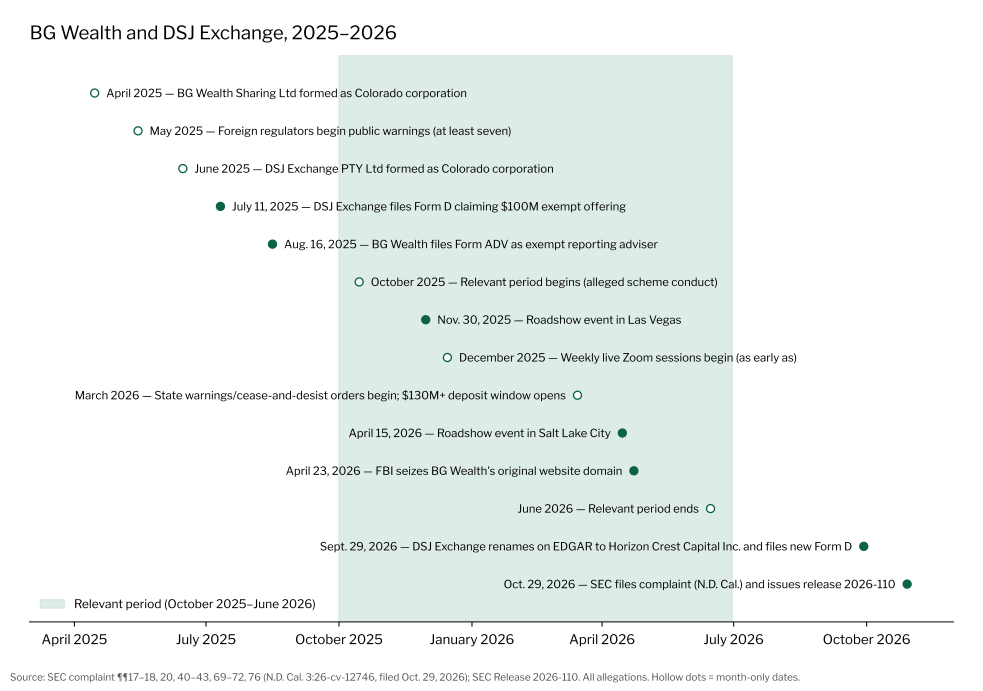
Source: SEC complaint ¶¶17–18, 20, 40–43, 69–72, 76 (N.D. Cal. 3:26-cv-12746, filed Oct. 29, 2026); SEC Release 2026-110. All allegations. Hollow dots = month-only dates.
"They further sustained the ruse by displaying fake certificates with the SEC's seal and making periodic payments to certain investors – a Ponzi-like tactic – while misappropriating the remaining funds," said Laura D'Allaird, chief of the SEC Enforcement Division's Cyber and Emerging Technologies Unit.
The SEC charges both companies with fraud under Section 17(a) of the Securities Act and Section 10(b) of the Exchange Act and Rule 10b-5. It charges BG Wealth alone under Sections 204(a) and 207 of the Investment Advisers Act, which require advisers to keep records and file reports with the SEC and bar false statements in those filings (¶10). It asks for permanent injunctions, disgorgement with prejudgment interest and civil penalties against both firms, plus conduct-based injunctions against BG Wealth. The complaint also seeks an order barring BG Wealth from filing Forms ADV as an exempt reporting adviser (¶11), and it has demanded a jury. The SEC says the case belongs in Northern California in part because the firms took money from at least 45 residents of that district (¶15).
The objection
A skeptic would say a civil suit against two shell-like companies recovers little. The SEC names no parallel criminal case and no individual defendant, and the money left through crypto wallets.
Le Coin's view: the recovery may be small, but the case is aimed at the filing system itself. Exempt filings are self-reported and unreviewed, and the SEC is now saying in court that using them as a badge is fraud. That is a warning to the next scheme, and to anyone who treats an EDGAR entry as a license.
The tell
Watch the docket in San Francisco for service on the defendants and any motion to freeze assets. Watch, too, whether Horizon Crest Capital's new Form D stays on EDGAR.
Sources
- SEC, Press Release 2026-110, "Two Entities Charged in $130 Million Fraud Scheme That Used False SEC Filings to Boost Investor Confidence," Oct. 29, 2026, https://www.sec.gov/newsroom/press-releases/2026-110-two-entities-charged-130-million-fraud-scheme-used-false-sec-filings-boost-investor-confidence
- SEC v. BG Wealth Sharing Ltd and DSJ Exchange PTY Ltd, Complaint, No. 3:26-cv-12746 (N.D. Cal., filed Oct. 29, 2026), https://www.sec.gov/files/litigation/complaints/2026/comp-pr2026-110.pdf
- Figure data: facts.csv and timeline.csv, compiled by Le Coin's Digital Assets desk from sources 1 and 2.
Holding the Corner.
Not financial advice.