
Markets · News
Mastercard lets AI agents pay for services within a set budget
In early access, Agent Pay for Machines puts Mastercard's permission layer on top of an open web payment protocol, with settlement on Base and through BVNK.
Mastercard opened early access on Oct. 20 to Agent Pay for Machines, a system that lets AI software agents pay for digital services on a business's behalf while staying inside a budget the business sets. The stakes, in Le Coin's reading: a card network is putting its own permission layer on top of an open web payment protocol, betting that the hard part of machine payments is controlling who may spend, not moving the money.
Mastercard put it plainly: "Payments aren't the hard part. Authority is."
How it works
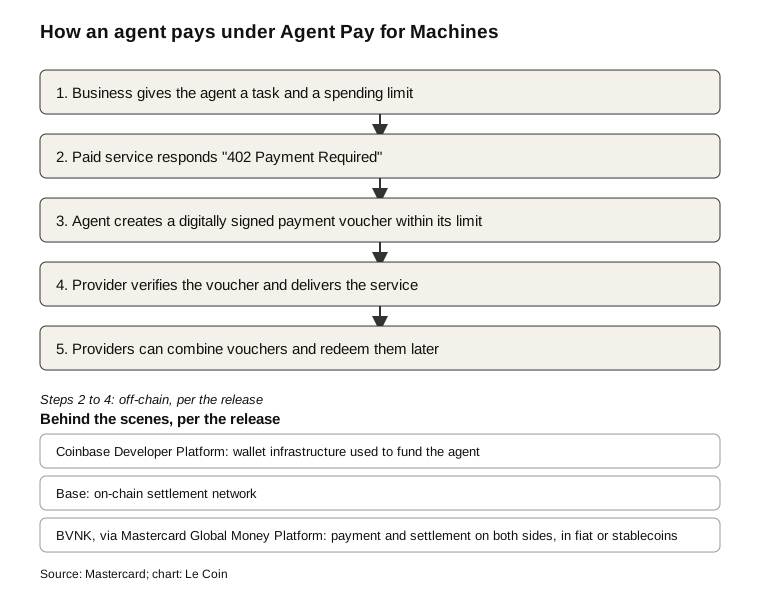
The system builds on x402, which Mastercard describes as an open protocol that lets digital services request payment online. A business gives an agent a task and a spending limit. When the agent reaches a paid service, the service answers "402 Payment Required," and the agent creates a digitally signed payment voucher, which the release calls a secure promise to pay within the approved limit. The provider verifies the voucher and delivers the service. Mastercard says these exchanges happen off-chain, meaning outside a blockchain, and providers can combine vouchers and redeem them later.
Money moves behind that layer. Per the release, Coinbase Developer Platform supplies the wallet infrastructure used to fund the agent, and Base, a blockchain network, provides on-chain settlement. BVNK acts as the agent wallet and uses Mastercard Global Money Platform to handle payment and settlement on both sides in fiat or stablecoins (digital tokens designed to hold a steady value, usually one dollar), so sellers can be paid in their preferred currency, token or rail. Le Coin covered that platform on Oct. 15.
The evidence
The steps Mastercard describes run in the order shown in the diagram below, with settlement handled separately behind the scenes.
Source: Mastercard; chart: Le Coin
At Cloudflare Connect, Mastercard demonstrated a pilot with Hype, a marketing agency. Hype gave an agent a task, planning a sample campaign for a protein bar launch, and a defined budget. The agent bought social media research from AIsa and eight campaign images through Cloudflare: nine payments to two merchants under one approved budget, with no separate accounts, API keys (the access codes software uses to log in to a service) or invoices, according to the release. Mastercard said it ran pilots with Cloudflare, Ant International, AIsa, Base, BVNK, Coinbase and Hype. Early access gives developers the first version of buyer and seller APIs, a toolkit, a sandbox and documentation.
In Le Coin's view, the design splits the job cleanly: the business holds spending authority through the limit it sets, the agent signs promises against it, and real money settles later, behind the scenes. The open question is who answers when an agent signs a voucher it should not have.
The objection
In Le Coin's view, the fair objection is that this is a demonstration, not a business. The release gives no volumes, fees or general launch date, and nine payments in one staged demo say nothing about demand. Mastercard says its roadmap will be shaped by what customers and partners need.
What to watch
In Le Coin's view, the tell is whether early access turns into a dated general launch with named merchants beyond the pilot group.
Sources
- Mastercard, "What happens when AI agents start paying each other? Watch Mastercard Agent Pay for Machines in action," Oct. 20, 2026. https://www.mastercard.com/us/en/news-and-trends/press/2026/october/Mastercard-Agent-Pay-for-Machines-in-action.html (accessed 1:47 p.m. ET, Oct. 20, 2026)
Holding the Corner.
Not financial advice.