Utah has turned its fight with Kalshi into a criminal case. The state's attorney general filed 14 counts on Oct. 28 against KalshiEX LLC, the company behind the Kalshi prediction market, and named its co-founders, Chief Executive Tarek Mansour and Chief Operating Officer Luana Lopes Lara, as co-defendants. The state says Kalshi's sports event contracts, trades that pay out on the result of a game, are illegal online gambling under Utah law. These are allegations in a charging document; no one has been convicted, and the defendants are presumed innocent.
The timing is the story. One day earlier, on Oct. 27, the Commodity Futures Trading Commission sued Utah to stop it from using state law to shut down exchanges the CFTC registers. Washington says it alone polices these markets. Utah is now testing that claim with a prosecutor rather than a regulator, and the people with the most at stake are the two founders whose names are on the caption.
What Utah alleges
The filing, a co-defendant information dated Oct. 28 in the Third Judicial District Court in Salt Lake County, rests on an undercover investigation. A special agent in the attorney general's office, Scott Eggerman, says he opened a Kalshi account on Sept. 13 under a Utah persona, confirmed that his location and internet address were in Utah, and placed wagers through Sept. 24 on NFL, college football, MLS, MLB and NHL games from Salt Lake and Davis counties. Kalshi charged a fee on each wager, he says, and that fee is the state's hook: proceeds, in Utah's telling, from unlawful activity.
The 14 counts break down as follows.
Figure 1. The 14 counts in Utah's filing
| Count | Offense | Degree | Statute (Utah Code Ann.) | Alleged date (2026) |
|---|---|---|---|---|
| 1 | Pattern of unlawful activity | Second-degree felony | §§ 76-17-407; 76-2-204 | Sept. 13–26 |
| 2 | Online gambling promotion | Third-degree felony | §§ 76-9-1404; 76-2-204 | Sept. 13 |
| 3–4 | Online gambling promotion | Third-degree felony | same | Sept. 14 |
| 5–9 | Online gambling promotion | Third-degree felony | same | Sept. 20 |
| 10–11 | Online gambling promotion | Third-degree felony | same | Sept. 23 |
| 12–13 | Online gambling promotion | Third-degree felony | same | Sept. 24 |
| 14 | General gambling promotion | Class A misdemeanor | §§ 76-9-1405(2), (3)(a); 76-2-204 | Sept. 13–26 |
Source: Utah v. KalshiEX, information dated Oct. 28, 2026. KalshiEX LLC is the charged defendant on each count. All counts are allegations.
That is 13 felonies and one misdemeanor, built on 12 wagers. Each count says the conduct was authorized or "recklessly tolerated" by Kalshi's board or "high managerial agents," the standard Utah uses to hold a company criminally liable. The pattern count is the heavy one: the state says the 12 wagers form a pattern and that Kalshi "used or invested those proceeds in the operation of its ongoing enterprise."
The founders' exposure rests on two paragraphs. The probable-cause declaration describes Mansour and Lopes Lara as co-founders and says that, in public recordings, each claimed direct control over the company's operations. Paragraphs 23 and 24 allege that each "conducted or participated" in the enterprise's affairs through a pattern of unlawful activity. The case numbers on the published copy are blank, so it is not yet clear how the court has docketed the co-defendants.
Why the federal fight matters
The defence everyone expects is preemption: the idea that federal law overrides conflicting state law. Kalshi is a CFTC-registered exchange, and its position has been that the Commodity Exchange Act puts its contracts beyond state gambling statutes.
According to Utah's filing, Kalshi already tested that argument in Utah and lost the first round. The filing says KalshiEX sued Gov. Spencer J. Cox and other officials in federal court in Utah on Feb. 23, 2026 (case 2:26-cv-00151), that Judge Robert J. Shelby ruled on Aug. 4 that the federal law does not preempt Utah's gambling laws, and that the Tenth Circuit refused on Sept. 8 to block that ruling while Kalshi appeals. Le Coin has not independently checked the federal docket. The appeal, by the filing's own account, is still pending. Utah's filing alleges that Kalshi and both founders kept offering the contracts in the state anyway.
Figure 2. Kalshi and Utah, 2026
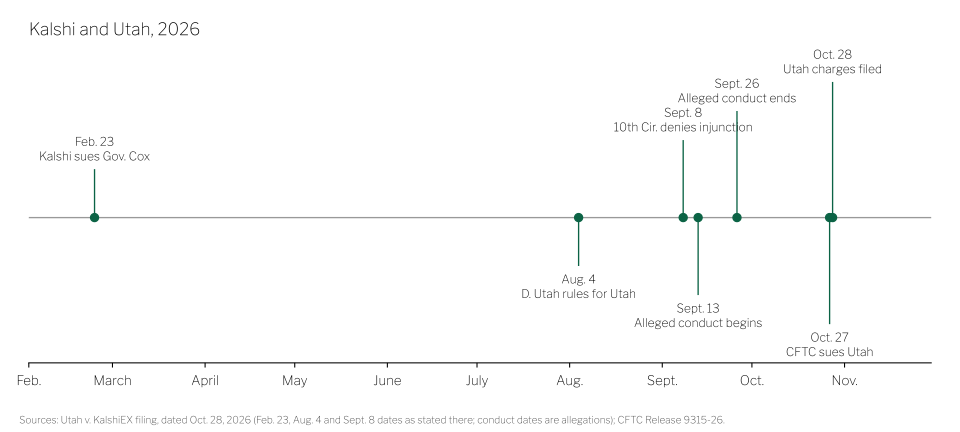
Sources: Utah v. KalshiEX filing, dated Oct. 28, 2026 (Feb. 23, Aug. 4 and Sept. 8 dates as stated there; conduct dates are allegations); CFTC Release 9315-26.
The CFTC's Oct. 27 suit is a separate track. Its release says Utah had filed "civil enforcement actions in state court against CFTC-regulated markets and other businesses," and that the CFTC has also started proceedings against nine other states. The release came out a day before the criminal filing and does not mention it. CFTC Chairman Michael S. Selig said "Congress entrusted the CFTC to be the federal regulator with sole responsibility to oversee these markets."
The objection
A skeptic would say this is leverage, not law. Twelve small wagers by an undercover agent are a thin base for a racketeering-style count, and a criminal case against a federally registered exchange invites exactly the federal-court collision the CFTC just started.
Le Coin's view: the objection underrates what Utah gains even if it never wins at trial. A criminal case puts personal risk on two executives, which a civil fine does not. For any registered exchange offering sports contracts, the open question is no longer whether states object. It is whether executives will travel to, or keep serving, states that are willing to charge them.
Le Coin found no public response from Kalshi on its newsroom or its X account as of 1:09 p.m. ET on Oct. 29.
The tell
Watch the federal docket in the CFTC's suit against Utah. A request to halt the state's enforcement, and how quickly a judge rules on it, will show whether Washington can stop a state prosecution before Kalshi or its founders have to answer the charges in Salt Lake County.
Sources
- State of Utah v. KalshiEX, LLC, Tarek Mansour and Luana Lopes Lara, Co-Defendant Information and Declaration of Probable Cause, Third Judicial District Court, Salt Lake Department, AGO No. 9465862, Oct. 28, 2026, https://attorneygeneral.utah.gov/wp-content/uploads/2026/10/Utah-v.-Kalshi.pdf
- CFTC, Release No. 9315-26, "CFTC Sues to Block State Enforcement in Utah Amid Ongoing Efforts to Preserve Jurisdiction," Oct. 27, 2026, https://www.cftc.gov/PressRoom/PressReleases/9315-26
Holding the Corner.
Not financial advice.