The National Football League has asked the Supreme Court to decide whether Kalshi's sports event contracts are federal swaps or state-regulated gambling, and it wants the answer to be gambling. In an amicus brief filed Oct. 8 in Flaherty v. KalshiEX, LLC, No. 26-299, the league backs New Jersey's gaming regulators and says event contracts tied to NFL games are big business: on the first Sunday of this season, "more than half of all prediction-markets' trading volume" was NFL-related, "$1.8 billion out of $3.3 billion total" (NFL brief, p. 1).
An event contract pays out on whether something happens, such as a team winning a game. Kalshi lists them on a designated contract market, or DCM, an exchange licensed by the Commodity Futures Trading Commission. If those contracts are "swaps" under federal law, Kalshi argues, the CFTC's exclusive jurisdiction pushes state gambling law aside.
The case matters now because the federal appeals courts have split, and the answer decides whether prediction markets can offer sports contracts in every state under one federal regulator or must answer to each state's gaming agency.
The question in front of the Court
The NFL frames the question presented as "whether Congress, through the 2010 Dodd-Frank Wall Street Reform and Consumer Protection Act, preempted States from regulating sports bets if those bets are offered on DCMs" (p. 1). That is the league's phrasing of the issue. New Jersey's own wording is in its Sept. 2 petition, which this piece does not quote.
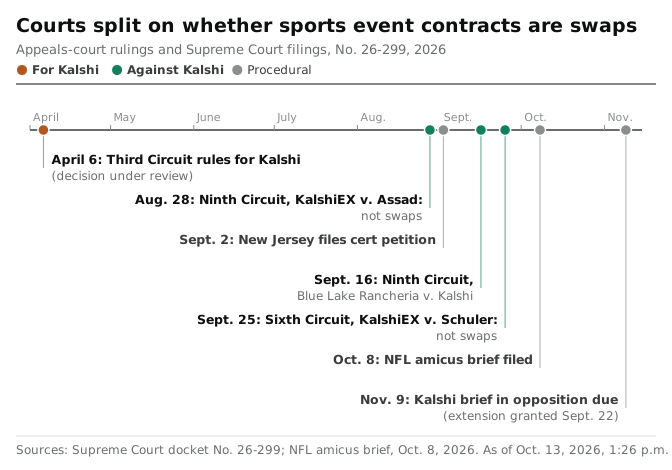
The ruling under review came from the Third Circuit, which decided the case on April 6, 2026 (docket). The brief summarizes it: the court held that "Kalshi's sports-related event contracts" fall within the CFTC's "exclusive jurisdiction" over swaps traded on a DCM, so that "field preemption" displaces state law (p. 4, quoting the Third Circuit opinion).
Two other circuits went the other way. The Sixth Circuit, in KalshiEX LLC v. Schuler on Sept. 25, concluded that "Kalshi's sports-event contracts do not satisfy the statutory definition of a swap," and the Ninth Circuit reached the same result in KalshiEX, LLC v. Assad on Aug. 28 (p. 4, as the brief cites them). The NFL says this "split of authority" poses "a significant challenge to the NFL's game-integrity and consumer-protection efforts" (p. 4).
The league's argument: swaps hedge risk, bets create it
The legal core is a reading of one word. "Read in its statutory and historical context," the brief says, "Dodd-Frank's definition of 'swap' reaches only instruments created and used for the purpose of hedging preexisting risk." It does not reach, in the brief's words, "wagers that create risk primarily for gambling purposes" (p. 7).
The league adds a timing point. Dodd-Frank passed in 2010, when the federal sports-betting ban known as PASPA was still in force. Congress, the brief argues, did not "federalize a multi-billion-dollar sports-betting industry" through "a single definition in Dodd-Frank" (p. 7).
It also raises two constitutional flags. Its Part III headings say a broad reading of "swap" poses Commerce Clause questions and that federalizing sports betting regulation is a "major question" under the Court's doctrine of that name (pp. 20-23). On the second, the brief says the CFTC's "recent discovery of 'unheralded power'" in a "long-extant statute" should be met "with a measure of skepticism" (p. 23, quoting Supreme Court precedent).
Why a football league cares
The brief is mostly about oversight, and it is specific. The NFL keeps a list of "prohibited wagers" that its licensed sportsbook partners follow, and says it "has publicly urged the DCMs and the Commission to adopt the same list," but that they "thus far have declined to do so" (p. 5).
On age, it says state authorities "generally impose a minimum age of 21," while the CFTC allows "18-year-olds to place sports wagers on DCMs." The result, in the brief's words, is that "in almost every state, an 18-year-old could not bet on a game through Caesars Sportsbook, but could bet on the same game through Kalshi" (p. 5).
On staffing, it compares state regulators, Nevada and Pennsylvania with "close to 400 employees each," with a CFTC that "has only 543 employees covering the entire country," with responsibilities that "include a broad range of derivatives beyond event contracts," citing a CFTC memo of Sept. 29, 2025 (p. 6).
The league prefers the states' answer, but wants one soon
The brief's ask is speed. "It is important that this Court grant certiorari now to provide clarity before another NFL season goes by," it says (p. 7). If the Court sides with the Sixth and Ninth Circuits, "the full panoply of state regulatory protections will apply to DCMs." If it sides with the Third Circuit, the NFL says it and others "could redouble their efforts this year" to press the CFTC, the exchanges and Congress "before the 2027 NFL season begins" (p. 7).
Le Coin's view: that hedge is the most useful line in the brief for anyone running a prediction market. The league is not asking to end sports event contracts. It is asking for sportsbook-style rules on them, from whichever regulator wins. The legal fight is over who writes the rules. The commercial fight is over whether the rules look like a sportsbook's.
What to watch
The NFL is one of several outside filers. Since Sept. 22 the docket lists amicus briefs from the National Council of Legislators from Gaming States, the International Association of Gaming Regulators and others, the Cabazon Band of Cahuilla Indians, Ohio and other states, Stop Predatory Gambling and others, former Sen. Christopher J. Dodd, 145 Indian Tribes and others, and former CFTC Chairman Gary Gensler, plus briefs submitted by the American Gaming Association and the Casino Association of New Jersey (docket). No brief from the National Basketball Association appears on the docket as of 1:26 p.m. ET.
Kalshi has not yet filed its answer. It asked for more time, and the Clerk extended the deadline for its brief in opposition to Nov. 9, 2026 (docket; Kalshi letter of Sept. 18).
Sources
- Supreme Court of the United States, Docket No. 26-299, Flaherty v. KalshiEX, LLC. https://www.supremecourt.gov/docket/docketfiles/html/public/26-299.html (accessed Oct. 13, 2026, 1:26 p.m. ET)
- Brief of Amicus Curiae National Football League in Support of Petitioners, No. 26-299, Oct. 8, 2026. https://www.supremecourt.gov/DocketPDF/26/26-299/428826/20261008053543625_NFL%20Amicus%20Brief.pdf (accessed Oct. 13, 2026, 1:26 p.m. ET)
- KalshiEX LLC, letter to the Clerk requesting an extension of time, Sept. 18, 2026. https://www.supremecourt.gov/DocketPDF/26/26-299/424953/20260918212129443_Flaherty%20v.%20Kalshi%20-%20BIO%20Extension%20Letter.pdf (accessed Oct. 13, 2026, 1:26 p.m. ET)
Holding the Corner.
Not financial advice.