Standard Chartered, which calls itself a global systemically important bank, says it now holds Ripple's dollar stablecoin for institutional clients and plans to let that stablecoin back trades at LMAX Group without the tokens ever leaving the bank. RLUSD is a token meant to stay worth $1, backed by Treasury bills and cash, and collateral is the money a trading firm posts with a venue so the venue will let it trade.
The two halves have different status. Custody is live: the bank says it supports RLUSD on the XRP Ledger through Standard Chartered Bank's DIFC branch, which the Dubai Financial Services Authority regulates. The LMAX link is planned. Both the bank's release and LMAX's say "the agreed future capabilities remain subject to final documentation, successful testing, applicable laws and regulations, internal approvals and jurisdictional readiness." Neither gives a date.
Why it matters to trading desks: the releases describe a setup that avoids moving the tokens to the trading venue. In Le Coin's view, that transfer is the costly part for a trading firm. It takes time, adds operational risk and leaves the firm's collateral exposed if the venue fails.
The mechanism is what the releases call collateral mirroring. The tokens stay in Standard Chartered's custody. LMAX would recognise their value as collateral for "agreed LMAX Group products and solutions across trading and collateral management." The parties say the arrangement "is expected to" reduce "transfer-related operational risk" and "optimise counterparty exposure." In plain terms, the bank would keep holding the tokens and LMAX would count their value as collateral, without the tokens moving. The releases do not say how often that value is updated, what haircut LMAX would apply, or which products qualify.
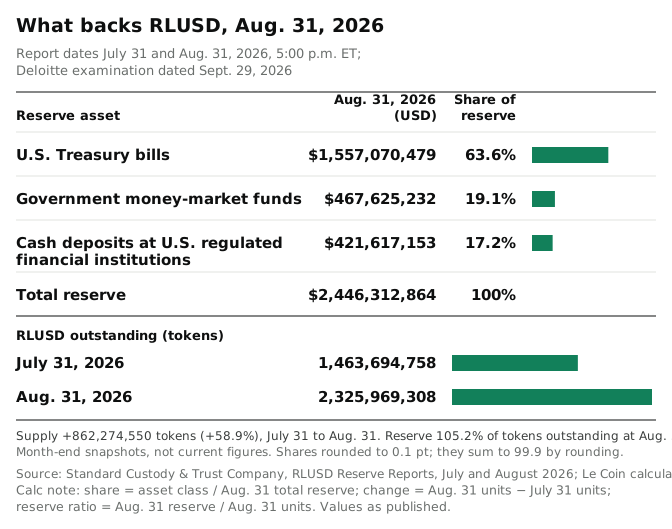
What sits behind each token matters to a venue taking it as collateral. RLUSD's issuer, Standard Custody & Trust Company, a Ripple subsidiary, publishes a monthly reserve report examined by Deloitte & Touche.
Fig. 1. What backs RLUSD, Aug. 31, 2026 (Source: RLUSD Reserve Report, August 2026, report time 5:00 p.m. ET, source 5; July 31 supply from the July 2026 report, source 6. Shares and change calculated by Le Coin, source 8.)
| Aug. 31, 2026 | Share of reserve | |
|---|---|---|
| U.S. Treasury bills | $1,557,070,479 | 63.6% |
| Government money-market funds | $467,625,232 | 19.1% |
| Cash deposits at U.S. regulated financial institutions | $421,617,153 | 17.2% |
| Total reserve | $2,446,312,864 | 100% |
| RLUSD outstanding | 2,325,969,308 | |
| RLUSD outstanding, July 31, 2026 | 1,463,694,758 |
Supply rose by 862,274,550 tokens, or 58.9%, between the July 31 and Aug. 31 report dates, and the reserve stood at 105.2% of tokens outstanding at Aug. 31, by our calculation. Most of that growth came in the last two weeks of August: the same report counts 1,763,215,434 tokens at Aug. 17. The report does not say who holds them or why supply jumped.
The LMAX link has history. On Jan. 15, LMAX said it would "integrate RLUSD as a core collateral asset" across spot crypto, perpetual futures and CFD trading, and that Ripple "will provide $150 million in financing" to LMAX. Ripple is therefore a financier of the venue that plans to accept its token as collateral. On Oct. 8, Standard Chartered's Singapore unit said it plans to offer custody of selected cryptoassets, stablecoins and tokenised assets there, subject to regulatory requirements, building on its presence in the UAE, Luxembourg and Hong Kong.
The objection is that this is a bank press release with no date. That is true of the LMAX half. The custody half is live in a regulated branch. Le Coin's view is that the mechanism is the news. A bank that keeps the token while a venue lends against its value keeps the stablecoin inside a bank's perimeter, where custody rules and a regulator already apply. If it works, the money a firm parks at an exchange to trade could stay at a bank. If it stalls, it stalls on the conditions both releases name, and those are worth tracking one by one.
What does not matter yet is size. Neither release says how much RLUSD Standard Chartered holds in custody or how much LMAX clients might post, so any dollar figure attached to the plan today would be a guess. The $150 million from January is financing for LMAX's growth strategy, and the October releases do not link it to the collateral plan.
Two details in the releases are worth a reader's caution. The bank's page titles its speaker, Waqar Chaudry, "Global Head of Digital Assets, Securities Services, Transaction Services," while LMAX's PDF gives "Global Head of Digital Assets, Financing & Securities Services, Transaction Services." And neither release states which LMAX entity or jurisdiction would accept the collateral.
What would make the plan real is the list the releases give: final documentation, successful testing, compliance with applicable laws and regulations, internal approvals and jurisdictional readiness. Both say "further details will be announced as implementation progresses," so the next primary is a joint release from Standard Chartered, LMAX and Ripple naming the products and a start date.
The checkable fact: Ripple's report for September 2026 is due within 30 days of month end, by Oct. 30 under the transparency page's own rule, and will show whether August's supply held.
Sources
- Standard Chartered press release, RLUSD custody and planned collateral integration, Singapore, Oct. 12, 2026: https://www.sc.com/en/press-release/standard-chartered-launches-rlusd-custody-and-joins-planned-collateral-integration-with-ripple-and-lmax-group/ (accessed Oct. 12, 2026, 9:24 a.m. ET)
- LMAX Group press release (PDF), Oct. 12, 2026: https://www.lmax.com/documents/press-release/lmax-group-ripple-and-standard-chartered-plan-rlusd-collateral-integration-as-standard-chartered-launches-rlusd-custody.pdf (accessed Oct. 12, 2026, 9:24 a.m. ET)
- Standard Chartered press release, Singapore custody plan, Oct. 8, 2026: https://www.sc.com/en/press-release/standard-chartered-advances-into-digital-asset-custody-offering-in-singapore/ (accessed Oct. 12, 2026, 9:24 a.m. ET)
- LMAX Group press release (PDF), LMAX and Ripple partnership, Jan. 15, 2026: https://www.lmax.com/documents/press-release/lmax-group-and-ripple-partner-to-accelerate-institutional-stablecoin-adoption-and-cross-asset-mobility.pdf (accessed Oct. 12, 2026, 9:24 a.m. ET)
- RLUSD Reserve Report, August 2026, Deloitte examination dated Sept. 29, 2026 (data source for Fig. 1): https://cdn.sanity.io/files/ior4a5y3/production/4981331c98a2bb203c0c9ab2584e8b2a0da80938.pdf (accessed Oct. 12, 2026, 9:24 a.m. ET)
- RLUSD Reserve Report, July 2026: https://cdn.sanity.io/files/ior4a5y3/production/42b2ca149329bbf0e34d5d687d30cbb750eea6b8.pdf (accessed Oct. 12, 2026, 9:24 a.m. ET)
- Ripple, RLUSD Transparency page: https://ripple.com/products/stablecoin/transparency/ (accessed Oct. 12, 2026, 9:24 a.m. ET)
- Fig. 1 calculation note: values as published in the two reports; shares are each asset class divided by the Aug. 31 total reserve; supply change is Aug. 31 units minus July 31 units; reserve ratio is Aug. 31 reserve divided by Aug. 31 units. Data file drafts/wip/markets-2026-10-12-sc-rlusd.fig-1-data.csv
Holding the Corner.
Not financial advice.