When U.S. banks pay more on deposits, stablecoin growth slows, according to a Bank for International Settlements working paper published Oct. 13, and banks raise those rates more aggressively once the Federal Reserve's policy rate tops about 3%. The authors conclude that banks' own deposit pricing helps set how fast stablecoins grow, and the Fed meets next on Oct. 27-28.
In Le Coin's view, the stakes run both ways for dollar stablecoin issuers such as Circle and Tether. By the authors' estimates, faster deposit repricing would slow their growth, and sticky deposit rates would leave that brake off.
The Fed's policy rate already sits above the paper's 3% line. On Sept. 16 the Federal Open Market Committee raised its target range for the federal funds rate to "3-3/4 to 4 percent." The Fed's October calendar lists the meeting's 2:00 p.m. ET entry and a 2:30 p.m. ET press conference on Oct. 28.
What the paper tests
Rashad Ahmed of the Andersen Institute for Finance and Economics and Iñaki Aldasoro of the BIS ask whether stablecoins and bank deposits are substitutes, meaning that demand for one falls when the return on the other rises. They use weekly U.S. data from January 2019 to June 2025. Their answer, on the BIS publication page: "Our results provide evidence that stablecoins and bank deposits are partial substitutes."
The key mechanism is pass-through, the share of a Fed rate change that banks hand on to depositors. The authors write that banks "reprice deposits more aggressively once it exceeds approximately 3%," referring to the federal funds rate, while Treasury bill rates move roughly in step at every level. They use that kink to separate the effect of deposit rates from other forces.
How large the effect is
The authors measure the effect against average ten-week stablecoin growth of 15% in their sample. The table below shows what their two main estimates imply for a 1 basis point rise in deposit rates, a hundredth of a percentage point. The authors note that a move that size is about 1.2 standard deviations of weekly deposit-rate changes. Ordinary least squares is a standard regression; the instrumental-variable estimate uses the 3% kink to strip out the feedback from stablecoin flows to deposit rates. These are the authors' model estimates for each basis point of deposit repricing, not a forecast.
| Estimate (paper's method) | Effect on ten-week growth | Implied ten-week growth |
|---|---|---|
| Ordinary least squares, with controls | about 3 percentage points lower | about 12% |
| Instrumental variable (deposit rate kink) | about 9 percentage points lower | about 6% |
Source: Ahmed and Aldasoro, BIS Working Paper 1382 (source 1), pp. 12 and 14; Table 2, p. 17.
Fig. 1. What a 1 basis point rise in deposit rates does to stablecoin growth (Source: Ahmed and Aldasoro, BIS Working Paper 1382, authors' estimates, pp. 12 and 14 and Table 2, source 1. Le Coin redraw; no calculations beyond the paper's.)
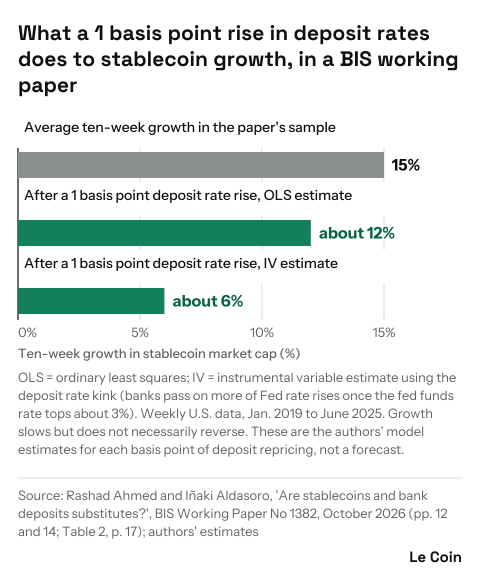
In both estimates, stablecoin supply keeps growing, only more slowly. "Growth slows but does not necessarily reverse," the authors write. They add that fully offsetting average growth under the first estimate would take about a 5 basis point deposit rate rise in one week, which they call "a 6-standard-deviation event."
The effect is stronger for Circle's USDC than for Tether's USDT. The authors tie that to USDC's closer links to U.S. users, and say demand for offshore-held stablecoins likely responds to different forces.
In Le Coin's view, that split matters most for the coin with the larger U.S. footprint: any deposit repricing after the Fed's meetings would bear on USDC most, by the paper's evidence.
The objections
The data stop in June 2025, so they do not cover the 16 months since. The authors say Haver Analytics suspended its deposit rate series that month, which ended their dataset.
The authors also flag their own limits. Their instrument's first-stage F-statistic, a test of how well the kink predicts deposit rates, is 9.78, "close to but below" the conventional threshold of 10. They work with aggregate data and write: "We cannot identify which holders substitute." The BIS page adds that the analysis "does not establish that stablecoin growth necessarily reduces aggregate bank deposits or lending."
The BIS publication page states that the views are the authors' and "do not necessarily reflect the views of the BIS or its member central banks."
The policy idea
The authors conclude that "banks retain some influence over the pace of that adoption through deposit pricing." For regulators, they call for weighing the pros and cons of "requiring some proportion of stablecoin reserves to be held in deposits," which they say would support liquidity but risk "concentrating large uninsured deposits in a small number of banks." They name a second lever: whether issuers may pay interest to holders.
In Le Coin's view, the paper reframes a debate that has mostly cast stablecoins as a threat to bank deposits. By the authors' estimates, banks' own pricing also helps set how fast the sector grows.
What to watch
The tell is deposit pricing after the Oct. 27-28 meeting, and whether USDC's growth diverges from USDT's. The paper does not forecast 2026 supply, and Le Coin makes no rate call.
What is not yet known: whether the 2019-2025 relationship holds under current U.S. stablecoin rules, and whether a newer deposit rate series will let the authors extend their data.
Sources
- Rashad Ahmed and Iñaki Aldasoro, "Are stablecoins and bank deposits substitutes?", BIS Working Paper No 1382, October 2026: https://www.bis.org/publications/working-paper-1382-are-stablecoins-and-bank-deposits-substitutes.pdf
- Bank for International Settlements, Working Paper 1382 publication page, published Oct. 13, 2026: https://www.bis.org/publications/working-paper-1382-are-stablecoins-and-bank-deposits-substitutes
- Federal Reserve Board, 2026 FOMC meeting calendar: https://www.federalreserve.gov/monetarypolicy/fomccalendars.htm
- Federal Reserve Board, FOMC statement, Sept. 16, 2026: https://www.federalreserve.gov/newsevents/pressreleases/monetary20260916a.htm
- Federal Reserve Board, October 2026 calendar: https://www.federalreserve.gov/newsevents/2026-october.htm
- Fig. 1 calculation note: values as published in BIS Working Paper 1382 (15% sample average; about 12% OLS and about 6% IV after a 1 basis point rise, pp. 12 and 14; Table 2, p. 17); Le Coin did no calculation.
Holding the Corner.
Not financial advice.