CoinShares on Oct. 23 published a research note mapping four ways stablecoins can move the earnings and valuations of listed banks, exchanges and payment networks without an investor buying a token, according to the CoinShares page [1]. Per that primary, total stablecoin supply stood at $305.83B as of 27 September 2026, 0.8% below the $308.16B of 31 March, with Tether and Circle holding 84.7% of it [1]. Today's record is that company research page, not a regulator finding or a Le Coin buy case on any bank, exchange or issuer [1].
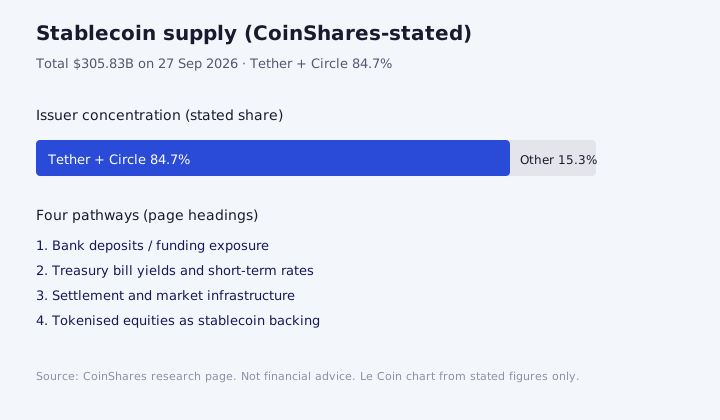
Figure 1 charts those CoinShares-stated concentration figures alongside the page's four pathway headings; the SVG is built only from numbers and labels on the note [1].
Deposit funding and bank equities
The first channel is deposit displacement. When cash leaves a current account for a token backed by safe assets, the bank replaces cheap funding with something that costs more [1]. Treasury advisers flagged $6.6T of U.S. transactional deposits as exposed in April 2025, and the page states that total stablecoin supply equals 4.6% of that pool [1]. An IMF study with data to June 2025 found no significant share-price reaction in large or community banks to stablecoin demand shocks, so the note reads the threat so far as a margin risk more than a funding shock [1]. The GENIUS Act, signed in July 2025, requires one dollar of reserves per token and bars issuers from paying interest to holders; CRS (6 March 2026) and CEA (April 2026) citations on the page frame banks against exchanges over platform rewards on tokens [1].
T-bill demand and short rates
The second channel is front-end bill demand. Reserves sit mostly in short-dated U.S. government instruments, so supply growth adds buying at the front end [1]. BIS research through March 2026 finds that a $3.5B inflow lowers three-month bill yields by 0.7 basis points on impact and about four basis points within ten days [1]. Tether's Q2 2026 attestation of 31 July reported $187.8B of total assets at 30 June, mostly U.S. government-backed and short-term liquidity [1]. The largest seven-day supply fall in the past year was $3.83B in the week to 1 February 2026 [1].
Settlement rails and equity collateral
The third channel is settlement and distribution revenue as stablecoins become the cash leg of on-chain trades [1]. Ethereum's share of supply fell from 53.0% to 48.0% between 31 March and 27 September 2026, while Tron rose from 28.0% to 30.9%, Solana from 4.8% to 5.4% and Hyperliquid from 1.7% to 2.5% [1]. Circle's five-year Binance deal, announced 22 September 2026 with a $100M equity investment at a 5.0% discount, shows distribution as a cost of defending reach; USDC share was 24.7% against 25.1% on 31 March [1].
The fourth channel is tokenised equities as collateral for synthetic dollars. Ethena said on 25 September 2026 that Binance will be its first venue for extending USDe's basis trade into equity perpetual futures [1]. USDe supply fell 74.7%, from $14.83B on 4 October 2025 to $3.75B on 28 April 2026, and stood at $4.94B on 27 September 2026 [1]. The page treats that drawdown as a design test that settled without breaking, while warning equity-perpetual hedges sit in thinner markets than crypto equivalents [1].
The objection
This is a CoinShares research note for TradFi equity exposure, not a claim that deposits are fleeing banks this quarter, that bill yields are set by stablecoin flows, or that any listed name is a buy [1]. The page does not publish Circle-Binance fee terms, independent USDe hedge stress tests, or Le Coin valuations [1]. A static market next to a $6.6T deposit pool is itself part of the finding [1].
The tell
In Le Coin's view, the tell is whether the four channels show up in bank NII screens, checkable bill responses to stablecoin flows, disclosed settlement-distribution economics, and independently reported collateral quality behind synthetic dollars [1]. A second tell is whether GENIUS-era rules on issuer interest versus exchange rewards change deposit competition in disclosed filings [1]. Neither is settled by today's note.
Sources
- CoinShares research-data page, "The four ways stablecoins reach an equity portfolio," published Oct. 23, 2026, https://coinshares.com/insights/research-data/the-four-ways-stablecoins-reach-an-equity-portfolio/ ; company research note (not a regulator finding); supply $305.83B as of 27 September 2026 (0.8% below $308.16B of 31 March); Tether+Circle 84.7%; $6.6T US transactional deposits flagged April 2025, supply = 4.6%; IMF to June 2025 no significant bank share-price reaction to demand shocks; GENIUS Act July 2025 $1 reserves / bars issuer interest; CRS 6 Mar 2026 + CEA April 2026 banks vs exchanges on rewards; BIS through March 2026 $3.5B inflow → 0.7 bp on impact / ~4 bp in 10 days on 3m bills; Tether Q2 2026 attestation 31 July: $187.8B assets at 30 June; largest 7-day supply fall $3.83B week to 1 Feb 2026; Ethereum 53.0%→48.0%, Tron 28.0%→30.9%, Solana 4.8%→5.4%, Hyperliquid 1.7%→2.5% Mar 31→Sep 27 2026; Circle×Binance five-year deal 22 Sep 2026 $100M equity at 5.0% discount; USDC 24.7% vs 25.1% Mar 31; Ethena Binance equity-perp basis 25 Sep 2026; USDe 74.7% fall $14.83B (4 Oct 2025)→$3.75B (28 Apr 2026), $4.94B on 27 Sep 2026; accessed Oct. 27, 2026, 1:29 p.m. ET.
Holding the Corner.
Not financial advice.