Bitcoin's weight in crypto decides how much a "crypto" allocation or index is really a bet on one asset, and right now that weight sits close to the middle of its history. Bitcoin held 60.11% of total crypto market value in CoinMarketCap's daily snapshot for Oct. 25 UTC, up 1.24 percentage points from 58.87% on Sept. 25 [1]. Across 4,921 daily readings since April 2013, the current level ranks 2,233rd from the top; 54.6% of days came in at or below it [1].
That share is what traders call bitcoin dominance: bitcoin's market value divided by the market value of every coin and token CoinMarketCap tracks. It is a ratio, so it moves when bitcoin moves against everything else, not when bitcoin moves alone.
How the ratio moves
Dominance can rise in a falling market. Over the past year, total crypto market value in the same CoinMarketCap series fell from about $3.74 trillion on Oct. 25, 2025 to about $2.70 trillion on Oct. 25, 2026, while bitcoin's share rose 0.98 points, from 59.13% to 60.11% [1]. Bitcoin lost value over that year; the rest of the market lost a little more. Bitcoin's latest UTC daily close, $81,074.19 on Oct. 23, sat 35.0% below its record close of $124,752.53 on Oct. 6, 2025 [2].
The ratio also moves when the denominator changes for reasons unrelated to bitcoin. Two matter most. The first is stablecoins, tokens built to hold about $1. A Le Coin derived measure, the top 100 stablecoins' market value divided by total market value, put them at 10.14% of the market on Oct. 21 [3]. That measure is not a CoinMarketCap field. When dollar tokens grow, bitcoin's share shrinks even if no one trades a single bitcoin. On Le Coin's arithmetic, stripping stablecoins out lifts bitcoin's Oct. 21 share from 60.10% to about 66.9% of the remaining market [1][3].
The second is dilution. Every new token CoinMarketCap lists adds its market value to the denominator. A token valued on a small float, meaning only a small slice of its supply trades, can add a large market value with little money behind it. Either way the ratio falls without any change in what bitcoin holders own.
What the record shows
The full series runs from 96.63% on Nov. 18, 2013, when bitcoin was nearly the whole market, to 32.44% on Jan. 14, 2018, during that cycle's token boom [1]. Since then its high was 71.80% on Jan. 3, 2021 [1]. The current 60.11% is well inside those bounds (Fig. 1).
Fig. 1. Bitcoin's share of total crypto market value, daily, April 2013 to Oct. 25, 2026. The share fell from above 90% to 32.44% in January 2018, peaked at 71.80% on Jan. 3, 2021, and now sits near 60%. Data: CoinMarketCap global metrics, accessed 8:39 p.m. ET Oct. 24, 2026; chart Le Coin [1].
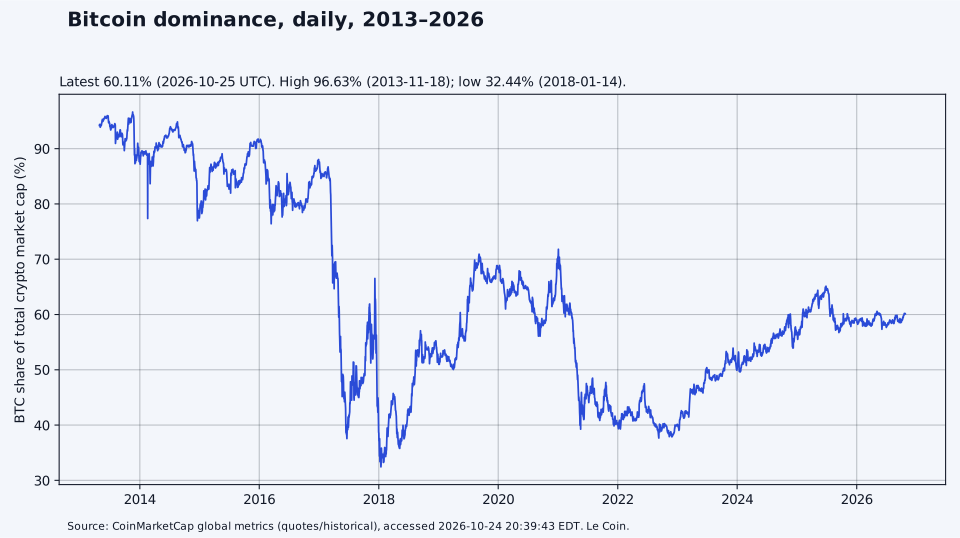
The recent moves are small against that range. Dominance is up 1.24 points over 30 days, 1.44 points over 90 days from 58.67% on July 27, and 0.98 points over 365 days [1]. Ether, the second-largest asset, held 10.65% on the same Oct. 25 reading [1].
The objection
A fair objection is that a middle reading on a 13-year chart compares unlike markets. The 2013 readings come from a market with no meaningful stablecoins; today Le Coin's derived measure puts dollar tokens at about a tenth of the denominator [1][3]. A 60% share in 2026 does not describe the same market structure as a 60% share in 2019.
The data has limits too. CoinMarketCap's daily series starts April 29, 2013. Five days that CoinMarketCap reported at 0% dominance, in December 2019 and in February and May 2020, are placeholders and are excluded, and the series has two date gaps [1]. The stablecoin measure uses the top 100 stablecoins and runs only to Oct. 21 [3].
The tell
Read descriptively, the numbers fit a market where bitcoin has held its ground against the rest rather than one where other tokens have taken share: dominance is up modestly over 30, 90 and 365 days, and bitcoin's share net of stablecoins is about two-thirds [1][3]. In Le Coin's view, the tell for whether that description still holds is whether dominance leaves the band of roughly a point and a half it has moved within on each of those windows, and whether the stablecoin share, rather than bitcoin itself, is what moves it.
Data: CoinMarketCap, global metrics and daily closes (UTC), accessed 8:39 p.m. ET Oct. 24, 2026 [1][2].
Sources
- CoinMarketCap Pro API, global metrics (quotes/historical, daily, UTC): BTC dominance 60.11% (Oct. 25, 2026 UTC snapshot, 8:00 p.m. ET Oct. 24); rank 2,233 of 4,921 days, 54.6th percentile; high 96.63% (Nov. 18, 2013); low 32.44% (Jan. 14, 2018); changes +1.24 pp (vs Sept. 25, 58.87%), +1.44 pp (vs July 27, 58.67%), +0.98 pp (vs Oct. 25, 2025, 59.13%); ETH dominance 10.65%; total market cap about $3.74T (Oct. 25, 2025) and about $2.70T (Oct. 25, 2026); BTC dominance 60.10% (Oct. 21, 2026); post-2018 high 71.80% (Jan. 3, 2021). Accessed 8:39 p.m. ET Oct. 24, 2026: https://coinmarketcap.com
- CoinMarketCap Pro API, Bitcoin daily OHLCV (USD, UTC): latest close $81,074.19 (Oct. 23, 2026); record close $124,752.53 (Oct. 6, 2025); 35.0% below record. Accessed 8:39 p.m. ET Oct. 24, 2026: https://coinmarketcap.com
- Le Coin derived stablecoin share from CoinMarketCap data: top-100 stablecoin market cap divided by total market cap, 10.14% on Oct. 21, 2026 UTC; not a CoinMarketCap field: https://coinmarketcap.com
Holding the Corner.
Not financial advice.