SoFi is asking crypto customers to move their idle dollars out of stablecoins and into a bank deposit. Its product page pitches SoFi Earn, or SOFIE, to people who have "idle crypto funds like stablecoins," and says the token "keeps those funds earning and FDIC insured" [1]. For anything that has to leave SoFi, the page points to the bank's own stablecoin, SOFID [1]. SoFi's SOFIE materials do not mention USDC, Circle's dollar stablecoin, by name, but the pitch is aimed at the kind of idle stablecoin balances USDC holds.
How SOFIE works. SoFi describes SOFIE as "a tokenized deposit representing a deposit liability of SoFi Bank, N.A., Member FDIC," adding that "Funds represented by SOFIE are eligible for FDIC insurance up to applicable FDIC rules and limits" and that "SOFIE is not a payment stablecoin" [1]. A tokenized deposit is an ordinary bank deposit recorded as a digital token. "Each SOFIE represents $1, and because it's a deposit, it earns interest," the FAQ says [1].
The rate is SoFi's to set. The bank's rate sheet lists an interest rate of 4.31368% and an annual percentage yield of 4.40% for an individual tokenized deposit account, "Effective as of October 20, 2026" [2]. Interest accrues daily on the end-of-day balance and is credited monthly, and the rate "may change at any time at SoFi Bank's discretion," with "no limit on the amount or frequency of any change" [2]. The product page adds that there is no minimum balance and that "Fees may reduce earnings" [1]. SoFi has not published how much SOFIE is outstanding.
On insurance, SoFi says funds represented by SOFIE are "insured up to $250,000 per depositor, per insured bank, for each account ownership category," and that the SOFIE balance "shares this limit" with the customer's other individual deposits at SoFi Bank, including checking and savings [1].
What SOFIE cannot do. SOFIE does not travel. "SOFIE itself stays on SoFi, but you can move its value on-chain," the FAQ says [1]. It can be used inside SoFi Crypto to buy other assets: SoFi says customers can use SOFIE "to buy other crypto coins and stablecoins like BTC, ETH, and SOFID" [1]. To move money out, a customer uses SOFIE to buy SOFID or "another crypto asset you can transfer out," then sends that on-chain [1]. SoFi warns that "once you use SOFIE to buy SOFID or another transferable crypto, that amount is no longer SOFIE," meaning it leaves the deposit and its insurance [1].
What SOFID is. SoFi calls SOFID "a payment stablecoin designed to maintain a stable value relative to the U.S. dollar," made available through SoFi Bank, and says it "is not a deposit, is not insured by FDIC or SIPC" [1]. A payment stablecoin is a token meant to hold a fixed dollar value, backed by reserves rather than by deposit insurance. SoFi says SOFID "is intended to be redeemable 1:1 for US dollars, with reserves consisting primarily of cash" [1].
The terms narrow that promise. Issuance and redemption at par, "1:1 USD, net of any applicable and disclosed fees," are available only to approved "SoFi Customers" under separate agreements, and "holding or transferring SOFID does not grant you any direct right to redeem SOFID with the Issuer" [3]. SoFi also says it has "no obligation to list SOFID on any exchange, support secondary market liquidity, or facilitate market making" [3]. SOFID exists only on blockchains SoFi lists on its platform, which it can add or remove "at its sole discretion" [3].
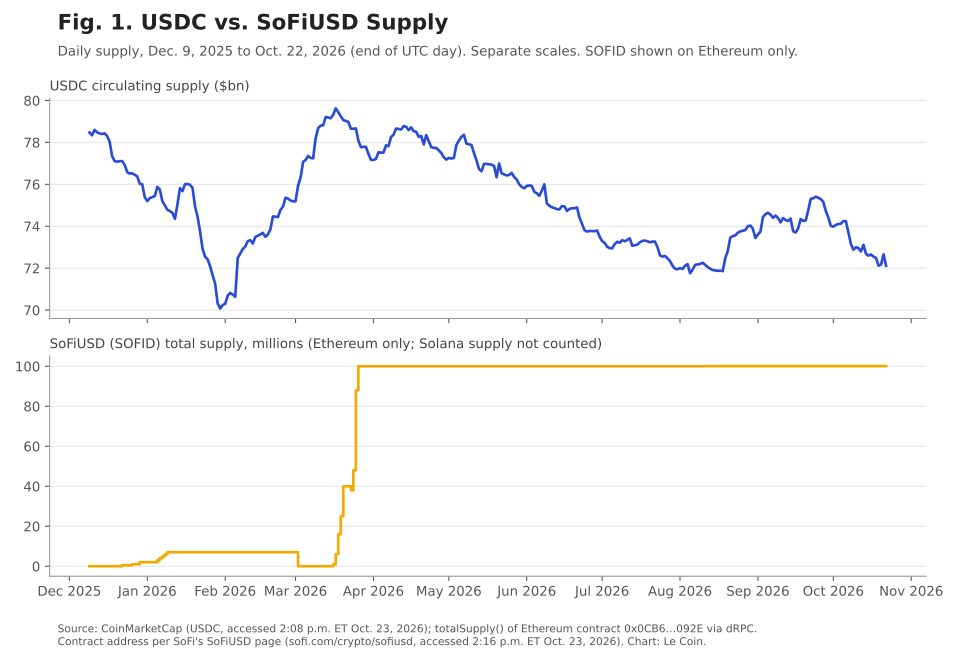
SoFi's Oct. 22 newsroom release says customers can "convert SOFIE 1:1 to SoFiUSD," SoFi's name for SOFID [10]; neither that release nor the product page lists a fee for the step [1][10]. SoFi's SoFiUSD page offers withdrawals to Ethereum or Solana wallets and links SOFID's Ethereum contract, 0x0CB6d03B0aC88A463F67B7Ad99f9f3ec4678092E, on Etherscan [6]. Fig. 1 uses Le Coin's own on-chain reading of SOFID's supply on Ethereum only; it does not count SOFID on other networks.
Fig. 1. USDC's circulating supply was about $72.1 billion on Oct. 22, according to CoinMarketCap [9], while SOFID's supply on Ethereum alone was about 100 million tokens. SoFi's SoFiUSD page links monthly reserve attestations; the latest posted, as of Aug. 31, 2026, counts 308,322,426 SOFID in circulation, including 100,077,124 issued on Ethereum and 214,693,983 on Solana [18]. On Ethereum, SOFID supply rose to about 7 million by Jan. 9, dropped to zero on March 2, reached about 100 million on March 26 and has been about flat since. Daily USDC circulating supply (CoinMarketCap, accessed 2:08 p.m. ET Oct. 23, 2026) vs. SoFiUSD (SOFID) total supply on Ethereum, Dec. 9, 2025 to Oct. 22, 2026; Ethereum only, Solana supply not counted. SOFID contract 0x0CB6d03B0aC88A463F67B7Ad99f9f3ec4678092E per SoFi's SoFiUSD page (sofi.com/crypto/sofiusd, accessed 2:16 p.m. ET Oct. 23, 2026). Chart: Le Coin.
What the charters allow
SoFi's bank charter. SoFi can offer SOFIE because it runs an insured national bank. The FDIC's BankFind database lists SoFi Bank, National Association, of Cottonwood Heights, Utah, as active, FDIC certificate 26881, chartered and regulated by the OCC (Office of the Comptroller of the Currency, the federal regulator of national banks), with deposits insured by the Deposit Insurance Fund [11]. SoFi's product page calls SOFIE "a tokenized deposit representing a deposit liability of SoFi Bank, N.A., Member FDIC," eligible for FDIC insurance "up to applicable FDIC rules and limits," and says "SOFIE is not a payment stablecoin" [1]. Separately, the OCC on July 23, 2026 approved a SoFi Bank operating subsidiary to "engage in the issuance and redemption of payment stablecoins," on condition that it conform to the GENIUS Act and its rules [28].
Why that is not a stablecoin. The GENIUS Act defines a payment stablecoin, a token whose issuer promises to redeem it for a fixed dollar amount, and expressly excludes "a deposit... including a deposit recorded using distributed ledger technology" (sec. 2(22)) [12]. Only a "permitted payment stablecoin issuer," such as an approved subsidiary of an insured bank, may issue a payment stablecoin in the United States (secs. 2(23), 3(a)) [12]. The OCC's rule implementing the act for issuers it supervises was published today at 91 FR 67000 (FR Doc. 2026-21706) and takes effect Jan. 18, 2027 [13].
Circle's trust bank. Circle's trust bank is open. The OCC granted preliminary conditional approval to First National Digital Currency Bank, N.A., Circle's proposed bank, on Dec. 12, 2025 [14]. Circle's latest 10-Q says the OCC gave final approval on July 9, 2026, and the bank opened July 24 as Circle National Trust, offering "fiduciary digital asset custody services" to Circle and its affiliates [15]. A national trust bank is a special-purpose bank that limits its activities to "the operations of a trust company and activities related thereto," such as custody and acting as a fiduciary, a manager of assets for others, under OCC rules [19]. The OCC says "most" national trust banks "do not offer loans or accept deposits and do not have FDIC insurance" [20], and its approval says Circle's bank "will not be an insured depository institution" [16]. Nothing in these documents authorizes Circle's bank to take insured deposits or issue tokenized deposits.
Other crypto firms.
- Anchorage Digital Bank N.A.: national trust bank since the OCC conditionally approved its conversion on Jan. 13, 2021 [17]; the OCC ended its 2021 operating agreement on Feb. 9, 2026 [21], and it is on the OCC's list of active trust banks as of Sept. 30, 2026 [22].
- BitGo Bank & Trust, N.A.: conversion conditionally approved Dec. 12, 2025 [14]; BitGo said on Jan. 29, 2026 that it had received "final approval" from the OCC "to operate as a national trust bank" [23], and the bank is on the OCC's active trust bank list [22].
- Paxos Trust Company, N.A. and Fidelity Digital Assets, N.A.: conversions conditionally approved Dec. 12, 2025 [14]; both appear on the OCC's list of active trust banks as of Sept. 30, 2026 [22].
- Ripple National Trust Bank: preliminary conditional approval Dec. 12, 2025 [14]; it is not on the OCC's active list [22], and Le Coin could not confirm final approval.
- Coinbase National Trust Company (Apr. 2, 2026), Crypto.com's Foris DAX National Trust Bank (Feb. 20, 2026) and Stripe's Bridge National Trust Bank (Feb. 12, 2026): preliminary conditional approval only, per OCC decision letters [24][25][26]; none is on the OCC's active list [22].
- Wise: the OCC denied its application for Wise National Trust on July 21, 2026 [27].
The evidence on USDC. SOFID already trades outside SoFi. Bullish said SoFiUSD went live on its exchange on June 22, 2026, and its listing table shows BTC/SOFID, ETH/SOFID, SOL/SOFID and SOFID/USDC markets [7]. Kraken said SOFID trading went live on its platform on Sept. 4, 2026 [8]. SoFi had said on May 27 that Bullish would be its first centralized exchange partner [5].
USDC has a settlement role at other venues. Hyperliquid's documentation, for example, tells traders that one way to shore up a losing cross-margin position is "depositing USDC" [4]. Even on Bullish, one of SOFID's own markets is priced against USDC [7].
The objection. The case that SoFi threatens USDC is easy to overstate. SOFIE is a deposit at one bank, usable only inside SoFi, paying a rate the bank can cut at any time [1][2]. SOFID is listed on at least two exchanges, but par redemption is limited to approved customers [3], and SoFi's latest attestation counts about 308 million SOFID in circulation [18], against about $72.1 billion of USDC [9].
What it means for USDC. In Le Coin's view, USDC's edge is scale and settlement depth rather than yield or listings. SOFID now has exchange markets, but USDC is the asset many venues settle and margin in, and that kind of reach takes years to build. SoFi's design is still notable: a bank has split the dollar into an insured, interest-paying balance that stays at home and a stablecoin for anything that has to move.
The tell. Watch SOFID's supply on both chains and whether more venues add it as collateral or a settlement asset, not just as a trading pair. SoFi publishing SOFIE balances would show whether idle stablecoin money is actually moving.
Stop. For now, SOFIE is a bank deposit that cannot leave SoFi, and SOFID is a listed stablecoin a fraction of USDC's size.
Sources
- SoFi, SoFi Earn (SOFIE) product page, FAQ and disclosures, https://www.sofi.com/crypto/earn/, accessed Oct. 23, 2026, 2:08 p.m. ET.
- SoFi Bank, Tokenized Deposit Rate Sheet, effective as of Oct. 20, 2026, https://www.sofi.com/crypto/legal/tokenized-deposit-rate-sheet/, accessed Oct. 23, 2026, 2:09 p.m. ET.
- SoFi, SOFID Terms of Use, https://www.sofi.com/crypto/legal/sofid-terms/, accessed Oct. 23, 2026, 2:09 p.m. ET.
- Hyperliquid Docs, "Margining," https://hyperliquid.gitbook.io/hyperliquid-docs/trading/margining, accessed Oct. 23, 2026, 2:10 p.m. ET.
- SoFi Technologies, "SoFiUSD Becomes the First Stablecoin Issued by a US National Bank to Launch on a Banking Platform," May 27, 2026, https://investors.sofi.com/news/news-details/2026/SoFiUSD-Becomes-the-First-Stablecoin-Issued-by-a-US-National-Bank-to-Launch-on-a-Banking-Platform/, accessed Oct. 23, 2026, 2:12 p.m. ET.
- SoFi, SoFiUSD product page, https://www.sofi.com/crypto/sofiusd/, accessed Oct. 23, 2026, 2:12 p.m. ET.
- Bullish, "Bullish becomes the first centralized exchange to list SoFiUSD, SoFi's bank-issued US dollar stablecoin," June 22, 2026, https://www.bullish.com/us/news-insights/bullish-becomes-the-first-centralized-exchange-to-list-sofiusd-sofis-bank-issued-us-dollar-stablecoin; Bullish Help Center, "Digital Assets Listing FAQ," https://support.exchange.bullish.com/wiki/spaces/BHC/pages/9373819/Digital+Assets+Listing-+FAQ; both accessed Oct. 23, 2026, 2:12 p.m. ET.
- Kraken Blog, "SOFID is available for trading!," Sept. 4, 2026, https://blog.kraken.com/product/asset-listings/sofid-is-available-for-trading, accessed Oct. 23, 2026, 2:12 p.m. ET.
- Prices and market data: CoinMarketCap, https://coinmarketcap.com, accessed Oct. 23, 2026, 2:08 p.m. ET (USDC supply). SOFID supply: totalSupply() of Ethereum contract 0x0CB6d03B0aC88A463F67B7Ad99f9f3ec4678092E, read on-chain by Le Coin, latest at 2:08 p.m. ET Oct. 23.
- SoFi, newsroom release on SoFi Earn (SOFIE), Oct. 22, 2026, https://www.sofi.com/newsroom/sofi-launches-sofi-earn-sofie-the-first-and-only-national-bank-issued-tokenized-deposit-for-consumers/, accessed Oct. 23, 2026, 2:10 p.m. ET (Copy & Fact pull).
- FDIC BankFind Suite API, institution record for SoFi Bank, National Association (CERT 26881), https://api.fdic.gov/banks/institutions?search=NAME:SoFi, accessed Oct. 23, 2026, 2:12 p.m. ET.
- GENIUS Act, Pub. L. 119-27, 139 Stat. 419, secs. 2(22), 2(23), 3(a), https://www.govinfo.gov/content/pkg/PLAW-119publ27/html/PLAW-119publ27.htm, accessed Oct. 23, 2026, 2:12 p.m. ET.
- OCC, "Implementing the Guiding and Establishing National Innovation for U.S. Stablecoins Act for the Issuance of Stablecoins by Entities Subject to the Jurisdiction of the Office of the Comptroller of the Currency," 91 FR 67000, FR Doc. 2026-21706, Oct. 23, 2026, https://www.federalregister.gov/documents/2026/10/23/2026-21706/implementing-the-guiding-and-establishing-national-innovation-for-us-stablecoins-act-for-the, accessed Oct. 23, 2026, 2:11 p.m. ET.
- OCC, News Release 2025-125, "OCC Announces Conditional Approvals for Five National Trust Bank Charter Applications," Dec. 12, 2025, https://www.occ.gov/news-issuances/news-releases/2025/nr-occ-2025-125.html, accessed Oct. 23, 2026, 2:11 p.m. ET.
- Circle Internet Group, Inc., Form 10-Q for the quarter ended June 30, 2026, filed Aug. 5, 2026, note 23, https://www.sec.gov/Archives/edgar/data/1876042/000187604226000248/crcl-20260630.htm, accessed Oct. 23, 2026, 2:12 p.m. ET.
- OCC, conditional approval decision, First National Digital Currency Bank, National Association (2025-Charter-342299), Dec. 12, 2025, https://www.occ.gov/news-issuances/news-releases/2025/nr-occ-2025-125a.pdf, accessed Oct. 23, 2026, 2:12 p.m. ET.
- OCC, News Release 2021-6, "OCC Conditionally Approves Conversion of Anchorage Digital Bank," Jan. 13, 2021, https://www.occ.gov/news-issuances/news-releases/2021/nr-occ-2021-6.html, accessed Oct. 23, 2026, 2:12 p.m. ET.
- SoFi Bank, N.A., SoFiUSD Reserve Report, with Independent Accountant's Report by Deloitte & Touche LLP, as of Aug. 31, 2026, linked from https://www.sofi.com/crypto/sofiusd/, https://d32ijn7u0aqfv4.cloudfront.net/wp/wp-content/uploads/raw/SoFiUSD-Stablecoin-Attestation-Report-8.31.2026.pdf, accessed Oct. 23, 2026, 2:30 p.m. ET.
- 12 CFR 5.20(e)(1)(i), https://www.ecfr.gov/current/title-12/chapter-I/part-5/subpart-B/section-5.20, accessed Oct. 23, 2026, 2:20 p.m. ET.
- OCC Bulletin 2007-21, "Supervision of National Trust Banks: Revised Guidance: Capital and Liquidity," https://www.occ.gov/news-issuances/bulletins/2007/bulletin-2007-21.html, accessed Oct. 23, 2026, 2:22 p.m. ET.
- OCC, Supervisory Condition Letter 2026-01, Anchorage Digital Bank National Association, Feb. 9, 2026, https://www.occ.gov/topics/charters-and-licensing/interpretations-and-decisions/2026/scl2026-01.pdf, accessed Oct. 23, 2026, 2:16 p.m. ET.
- OCC, "Trust Banks Active As of 9/30/2026," https://occ.treas.gov/topics/charters-and-licensing/financial-institution-lists/trust-by-name.pdf, accessed Oct. 23, 2026, 2:25 p.m. ET.
- BitGo Holdings, "BitGo Becomes the First Public, Federally Chartered Digital Asset Infrastructure Company," Jan. 29, 2026, https://investors.bitgo.com/news/news-details/2026/BitGo-Becomes-the-First-Public-Federally-Chartered-Digital-Asset-Infrastructure-Company/default.aspx, accessed Oct. 23, 2026, 2:20 p.m. ET.
- OCC, Corporate Decision 1370, Coinbase National Trust Company, Apr. 2, 2026, https://www.occ.gov/topics/charters-and-licensing/interpretations-and-decisions/2026/cd1370.pdf, accessed Oct. 23, 2026, 2:16 p.m. ET.
- OCC, Corporate Decision 1367, Foris DAX National Trust Bank, Feb. 20, 2026, https://www.occ.gov/topics/charters-and-licensing/interpretations-and-decisions/2026/cd1367.pdf, accessed Oct. 23, 2026, 2:16 p.m. ET.
- OCC, Corporate Decision 1365, Bridge National Trust Bank, Feb. 12, 2026, https://www.occ.gov/topics/charters-and-licensing/interpretations-and-decisions/2026/cd1365.pdf, accessed Oct. 23, 2026, 2:16 p.m. ET.
- OCC, Corporate Decision 1381, Wise National Trust, July 21, 2026, https://www.occ.gov/topics/charters-and-licensing/interpretations-and-decisions/2026/cd1381.pdf, accessed Oct. 23, 2026, 2:16 p.m. ET.
- OCC, Corporate Decision 1388, SoFi Bank, N.A., July 23, 2026, https://www.occ.gov/topics/charters-and-licensing/interpretations-and-decisions/2026/cd1388.pdf, accessed Oct. 23, 2026, 2:16 p.m. ET.
Holding the Corner.
Not financial advice.