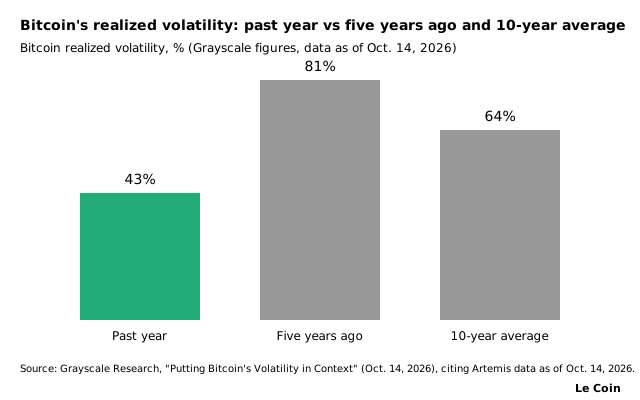
Bitcoin's realized volatility "has declined to 43% over the past year," down from "an average of 64% over the past 10 years and 81% five years ago," Grayscale Research said in a report published Wednesday (source 1). The figures come from data provider Artemis, with data as of Oct. 14, 2026, according to the report's footnote (source 1).
The report, by Zach Pandl, Grayscale's head of research, also says bitcoin's volatility "is now lower than that of 19% of S&P 500 constituents" (source 1). That is Grayscale's comparison; Le Coin has not checked it.
Fig. 1. Bitcoin realized volatility, % (Grayscale figures, data as of Oct. 14, 2026) (Source: Grayscale Research, "Putting Bitcoin's Volatility in Context" (Oct. 14, 2026), citing Artemis data as of Oct. 14, 2026. Chart drawn by Le Coin.)
What the numbers do and don't say
Grayscale does not state how it calculates realized volatility. The report does not say whether the figures are annualized, what price data or sampling interval Artemis used, or what window sits behind the figure for five years ago. The 43% figure covers the past year and the 64% figure is a 10-year average, so the three numbers are not measured over the same period.
What it means
In Le Coin's view, the comparison with five years ago is the clearest part of the claim: on Grayscale's numbers, the past year's 43% is a little over half the 81% recorded five years ago. The comparison with the 10-year average is narrower, and the method is undisclosed, so the figures are best read as Grayscale's own snapshot rather than a settled measure.
Sources
- Grayscale Research, "Putting Bitcoin's Volatility in Context," by Zach Pandl, Oct. 14, 2026, https://www.grayscale.com/the-stack/putting-bitcoin-s-volatility-in-context, accessed 2026-10-15, 4:07 p.m. ET.
Holding the Corner.
Not financial advice.