At a glance
- Many wallets derive every key from one seed: BIP 32 defines deterministic key trees, and BIP 39 turns the seed into words [1][2].
- On Ethereum, ERC-4337 lets an account "supply its own validation logic executed as smart contract code" without consensus changes [4].
- EIP-7702 lets an ordinary Ethereum account point to contract code; it shipped in the Pectra upgrade [5][6].
- The OCC says national banks may provide crypto custody, and in 2025 rescinded the extra approval step it had added in 2021 [7][8].
- On Oct. 1, 2026, the SEC proposed custody rules for advisers and funds; they are a proposal, not law [11].
1. What it is
A wallet holds keys, not coins
A crypto wallet is software or hardware that stores private keys. The coins themselves are entries on a shared ledger. Whoever can sign with the key can move what that key controls. So "who holds the keys" is the central question of this page.
Analogy, not the mechanism itself: the ledger is a public safe-deposit vault, and the private key is the only key to one box. The wallet is the key ring.
Self-custody
In self-custody, the owner keeps the keys. No one else can move the funds, and no one else can recover them if the keys are lost. Bitcoin's wallet standards, described below, were written for this kind of storage.
Custodial accounts
In a custodial arrangement, a third party holds the keys for its customers. Banks, trust companies and exchanges can play this role. The customer relies on the custodian's controls and on the rules that govern it.
Ordinary accounts and smart accounts
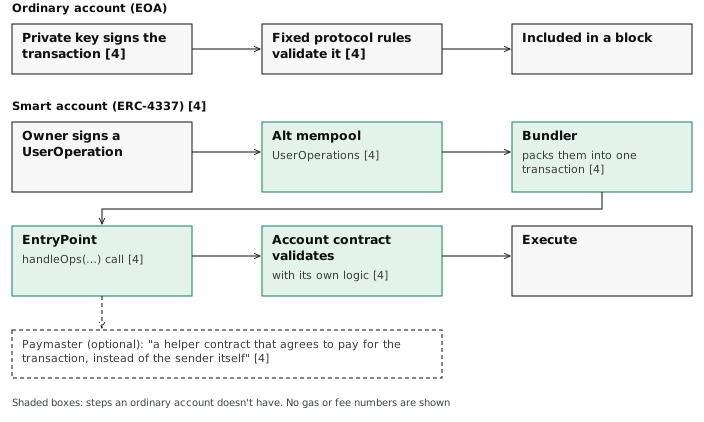
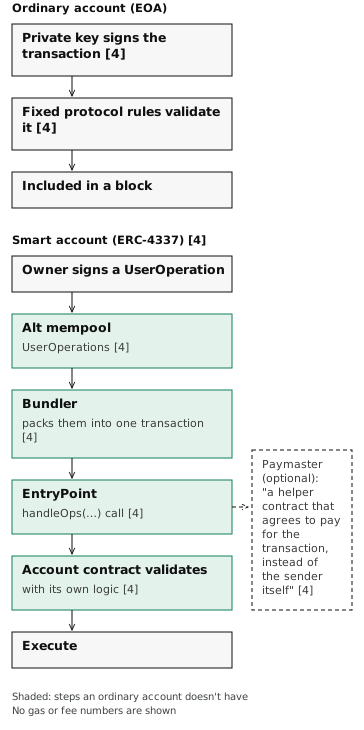
On Ethereum, ERC-4337 describes the starting point: users "could interact with Ethereum only by sending transactions from special accounts controlled by private keys," with validation "entirely enforced by fixed protocol rules" [4]. These are externally owned accounts, or EOAs. A smart account is a contract that sets its own rules for approving a transaction.
Why the distinction matters
The two models carry different risks. Self-custody puts the risk of loss on the owner. Custody puts it on the custodian's systems and on the law that applies when a custodian fails. US regulators have spent the past six years setting who may act as a custodian, which section 3 covers.
2. How it works
One seed, many keys
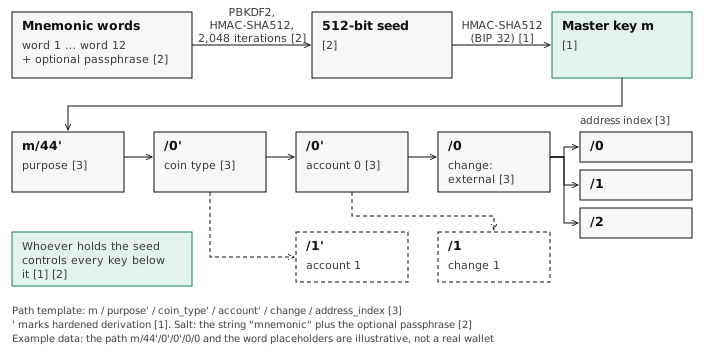
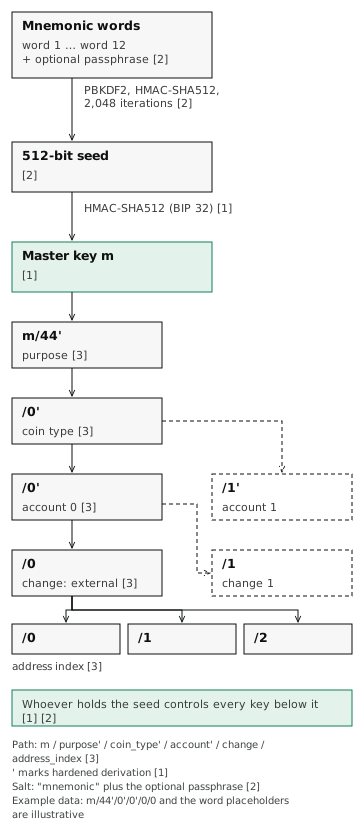
BIP 32, "Hierarchical Deterministic Wallets," describes how a wallet derives a tree of keys "from a single seed" [1]. A user can back up the seed once and recover every key derived from it.
Seed words
BIP 39 turns the seed into "a group of easy to remember words" [2]. It then builds the binary seed with the PBKDF2 function, using the word list as the password and the string "mnemonic" plus an optional passphrase as the salt; "the iteration count is set to 2048 and HMAC-SHA512 is used" [2].
Analogy, not the mechanism itself: the seed words are a master recipe. Anyone who has the recipe can bake every key the wallet will ever use.
A map for accounts
BIP 44, "Multi-Account Hierarchy for Deterministic Wallets," sets a standard path through the key tree: m / purpose' / coin_type' / account' / change / address_index [3]. That lets different wallet apps find the same keys from the same seed.
Smart accounts under ERC-4337
ERC-4337 avoids changing Ethereum's base rules. Users send "UserOperation objects into a separate mempool," and "bundlers package up a set of these objects into a transaction making a handleOps call to a special contract" [4]. That contract is called the EntryPoint. A "paymaster" is "a helper contract that agrees to pay for the transaction, instead of the sender itself" [4].
EIP-7702 delegation
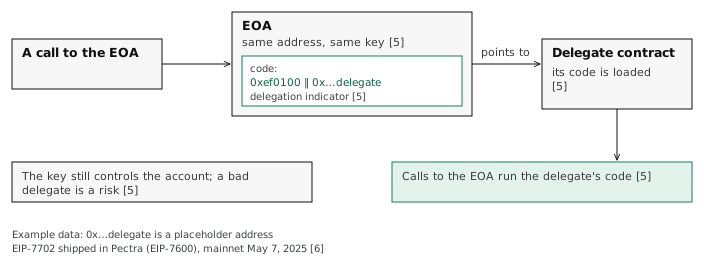
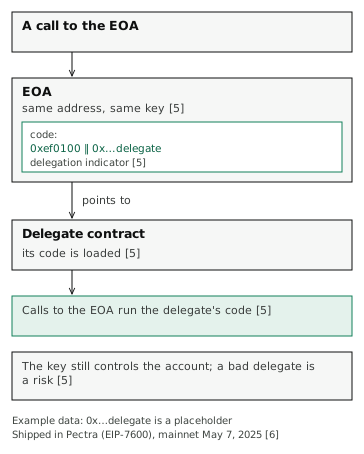
EIP-7702, "Set Code for EOAs," adds a transaction type that lets an ordinary account set code in itself. For each signed authorization, "a delegation indicator (0xef0100 || address) is written to the authorizing account's code," and code-executing operations "must load and execute the code pointed to by the delegation" [5].
Who holds the keys: one table
| Arrangement | Who holds the keys | Rule or standard |
|---|---|---|
| Seed-phrase wallet | The owner | BIP 32, BIP 39 [1][2] |
| ERC-4337 smart account | The owner; account code sets approval rules | ERC-4337 [4] |
| EOA with EIP-7702 delegation | The owner; points to contract code | EIP-7702 [5] |
| National bank custodian | The bank, for customers | OCC IL 1170, IL 1183 [7][8] |
| State trust company, for advisers and funds | The trust company | SEC staff no-action letter [10] |
| Adviser self-custody (proposed) | The adviser, under conditions | SEC's summary of the proposal [12]; not law |
Each row comes from the cited document. The last row describes a rule the SEC has proposed, not one in force.
3. What changed
Banks may custody crypto (2020)
In Interpretive Letter 1170, dated July 22, 2020, the OCC concluded that "a national bank may provide these cryptocurrency custody services on behalf of customers, including by holding the unique cryptographic keys associated with cryptocurrency" [7].
The extra approval step ends (2025)
Interpretive Letter 1179, from Nov. 18, 2021, had set "a supervisory nonobjection process" for banks taking on these activities [8]. On March 7, 2025, Interpretive Letter 1183 rescinded it and "reaffirms that the crypto-asset custody, distributed ledger, and stablecoin activities" in the earlier letters "are permissible" [8]. The OCC said it will examine those activities "as part of its ongoing supervisory process" [8].
Why it mattered: a bank no longer needs the OCC's advance nonobjection before offering crypto custody, though it must still act "in a safe, sound, and fair manner" [8].
SAB 121 withdrawn (Jan. 30, 2025)
Staff Accounting Bulletin No. 122 "rescinds the interpretive guidance" in Topic 5.FF, "Accounting for Obligations to Safeguard Crypto-Assets an Entity Holds for its Platform Users," effective Jan. 30, 2025 [9]. That guidance was known as SAB 121.
State trust companies (Sept. 30, 2025)
On Sept. 30, 2025, SEC staff in the Division of Investment Management said it would not recommend enforcement action against registered advisers and regulated funds that treat qualifying state trust companies as banks for holding crypto assets [10]. The letter sets four conditions [10]:
- Before engaging the trust company and each year after, the adviser or fund has a reasonable basis, "after due inquiry," for believing it "is authorized by the relevant State Banking Authority to provide custody services for Crypto Assets" and "maintains and implements written internal policies and procedures reasonably designed to safeguard Crypto Assets," "addressing, among other topics, private key management and cybersecurity." In making that judgment, the adviser or fund reviews the trust company's most recent annual financial statements and confirms they were audited by an independent public accountant and prepared under US GAAP, the standard US accounting rules. It also reviews the trust company's most recent internal control report (such as a SOC 1 or SOC 2 report) prepared by an independent public accountant in the current or prior calendar year, and confirms that the report contains the accountant's opinion that the controls are suitably designed and operating effectively to meet custody objectives, including safeguarding crypto assets.
- A written custody agreement says the trust company "will not, directly or indirectly, lend, pledge, hypothecate, or rehypothecate any Crypto Assets" without "the prior written consent" of the client or fund, and that the assets "will be segregated from the State Trust Company's assets."
- The adviser or fund discloses "any material risks associated with using State Trust Companies as custodians."
- The adviser or fund reasonably determines that the arrangement "is in the best interest of the RIA Client or Regulated Fund and its shareholders."
The letter adds that it "provides our position on enforcement action only and does not provide any legal conclusions" [10]. It is staff guidance, not a Commission rule.
EIP-7702 ships in Pectra
EIP-7600, the meta-document for Ethereum's Prague/Electra ("Pectra") upgrade, lists EIP-7702 among the included core changes [6]. It gives the mainnet activation as epoch 364,032, at Unix timestamp 1746612311, which is May 7, 2025, at 6:05 a.m. ET [6].
Why it mattered: ERC-4337 lists EIP-7702 among its requirements [4], which ties the smart-account standard to this upgrade.
SEC custody proposal (Oct. 1, 2026)
On Oct. 1, 2026, the SEC proposed new custody rules and amendments under the Investment Advisers Act and the Investment Company Act (Release Nos. IA-7023 and IC-36353; File No. S7-2026-35) [11]. According to the SEC's summary of the proposal, it would "permit advisers and regulated funds to self-custody crypto assets in certain circumstances and subject to conditions" and would "permit advisers and regulated funds to maintain client or regulated fund crypto assets with a state trust company, subject to conditions" [12]. The same summary lists, among the self-custody conditions, that the adviser "determines that a permitted custodian is not available to maintain the crypto asset" [12].
The proposal is not law. Its rules are not in force and could change, or be dropped, before any final vote.
4. What is open
The custody proposal's outcome
The proposing release says it was published in the Federal Register on Oct. 6, 2026, and that "comments should be received on or before December 7, 2026" [11]. The Commission would then decide whether to adopt the rules, change them or drop them.
Staff relief versus a rule
The Sept. 30, 2025 letter is a staff position on enforcement, based on the facts and representations its requester made [10]. Whether the Commission writes the state trust company route into a rule depends on the proposal above.
Losing the seed
The seed-based design cuts both ways. Because every key is derived from one seed [1][2], anyone who copies the seed words can take everything, and an owner who loses them, and holds no backup, cannot recover the keys.
Analogy, not the mechanism itself: it is a house with one master key and no locksmith.
Delegation risk under EIP-7702
Under EIP-7702, an account's code points to whatever contract it has delegated to [5]. The safety of that account then depends on the code at that address. Users who sign a delegation are trusting that contract.
Custodian failure
A custodian's controls protect customers only as far as they work. The no-action letter's conditions, including segregation and limits on lending client assets [10], are written for the case where a custodian runs into trouble. How courts treat customer crypto in a custodian failure is beyond this page's sources.
What this page leaves out
By Learning Hub policy, this dive carries no price, market value or usage figures. It also leaves out multiparty computation (MPC) wallets, which have no single public standard Le Coin has read; and state regimes such as New York's and Wyoming's. Spot bitcoin fund custodians are covered on the Bitcoin page.
Sources
- 1BIP 32, "Hierarchical Deterministic Wallets," commit 927b6de. https://github.com/bitcoin/bips/blob/927b6de9915c9262615a6399de51b200f81e5aa4/bip-0032.mediawiki
- 2BIP 39, "Mnemonic code for generating deterministic keys," commit 927b6de. https://github.com/bitcoin/bips/blob/927b6de9915c9262615a6399de51b200f81e5aa4/bip-0039.mediawiki
- 3BIP 44, "Multi-Account Hierarchy for Deterministic Wallets," commit 927b6de. https://github.com/bitcoin/bips/blob/927b6de9915c9262615a6399de51b200f81e5aa4/bip-0044.mediawiki
- 4ERC-4337, "Account Abstraction Using Alt Mempool." https://eips.ethereum.org/EIPS/eip-4337
- 5EIP-7702, "Set Code for EOAs." https://eips.ethereum.org/EIPS/eip-7702
- 6EIP-7600, "Hardfork Meta - Pectra." https://eips.ethereum.org/EIPS/eip-7600
- 7OCC, Interpretive Letter 1170, July 22, 2020. https://www.occ.gov/topics/charters-and-licensing/interpretations-and-actions/2020/int1170.pdf
- 8OCC, Interpretive Letter 1183, March 7, 2025. https://www.occ.gov/topics/charters-and-licensing/interpretations-and-actions/2025/int1183.pdf
- 9SEC, Staff Accounting Bulletin No. 122. https://www.sec.gov/rules-regulations/staff-guidance/staff-accounting-bulletins/staff-accounting-bulletin-122
- 10SEC Division of Investment Management, no-action letter to Simpson Thacher & Bartlett LLP, Sept. 30, 2025. https://www.sec.gov/rules-regulations/no-action-interpretive-exemptive-letters/division-investment-management-staff-no-action-interpretive-letters/simpsonthacherbartlett093025
- 11SEC, "Adviser and Regulated Fund Custody Rules; Crypto Custody Rules," proposed rule, Release Nos. IA-7023; IC-36353; File No. S7-2026-35. https://www.sec.gov/files/rules/proposed/2026/ia-7023.pdf
- 12SEC, fact sheet, "Investment Adviser and Regulated Fund Custody Rules; Crypto Custody Rules." https://www.sec.gov/files/ia-7023-fact-sheet.pdfHolding the Corner.
Not financial advice.