USDT, the dollar token issued by Tether, is backed by reserves that BDO attested as of June 30, 2026 [1]. The catch for holders is that only Tether's verified customers can hand tokens back for dollars, and only in lots of at least $100,000 [2][3].
A stablecoin is a token meant to hold a fixed value, here one US dollar, that moves on public blockchains the way an email moves on the internet. USDT is the dollar version Tether markets as USD₮. Traders, payment apps and exchanges use it as cash that settles at any hour.
That makes the reserve question practical. If the assets behind USDT fall short or cannot be sold quickly, the people left holding tokens are the ones who cannot redeem directly: everyone who bought on an exchange.
Who issues it and what a holder is promised
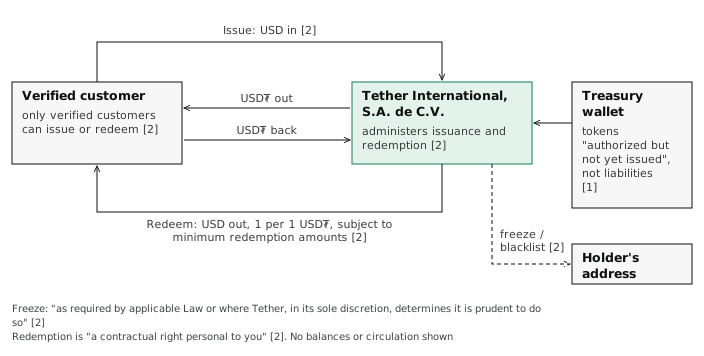
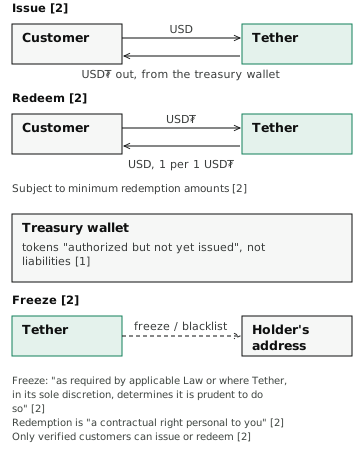
Tether International, S.A. de C.V., an El Salvador company, issues USDT [1]. Its terms set the redemption price at one dollar per token, but only for a "verified customer of Tether," and say the right to redeem "is a contractual right personal to you" [2]. Redemption means returning tokens to the issuer and getting dollars back.
The terms also say the tokens "are not legal tender and are not backed by any Government or protected through any insurance provided by Tether or any of its Affiliates," and are "not subject to Federal Deposit Insurance Corporation or Securities Investor Protection Corporation protections" [2]. That legal limit matters: a USDT balance is a claim on a private company, not a bank deposit.
Tether's fees page sets the floor. The minimum acquisition or redemption is $100,000, redemptions cost the greater of $1,000 or 0.1%, and verification costs $150 [3]. A retail holder with $5,000 of USDT therefore relies on an exchange or another buyer to get out, not on Tether.
In Le Coin's view, the one-dollar promise is real but wholesale. Its strength for small holders depends on the market makers, trading firms that stand ready to buy and sell, who can redeem and who keep the exchange price near a dollar.
How tokens are created and frozen
Tether administers issuance and redemption itself [2]. Tokens sitting in Tether's treasury wallet, the issuer's own holding account, are "authorized but not yet issued" and do not count as liabilities [1]. Some issued tokens are held by Tether itself outside the treasury wallet [1]. Any count of "tokens in circulation" depends on that definition.
Tether can also stop tokens from moving. Its terms let it freeze tokens "as required by applicable Law or where Tether, in its sole discretion, determines it is prudent to do so," and blacklist addresses tied to prohibited use [2]. A blacklist is a list of wallet addresses the token contract refuses to serve.
What backs it, as attested
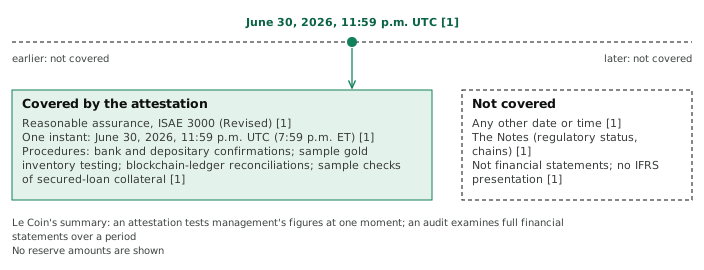
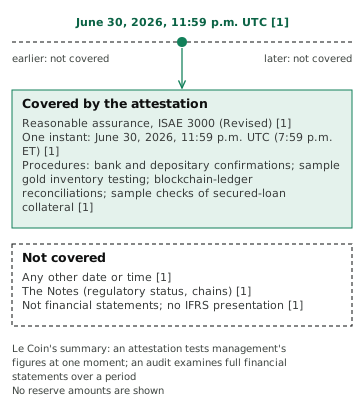
The figures below are Tether's own reserves report, checked by BDO Advisory Services S.r.l. of Milan. BDO's engagement was an attestation, not an audit. An attestation tests whether management's figures are accurate at one moment; an audit examines full financial statements over a period. The report itself says it "does not represent the financial statements of the Company," and BDO says it did not "provide any assurance at any other date or time" [1].
As of June 30, 2026, Tether's reserves report, as attested by BDO, showed reserves of $187.75 billion and liabilities of $183.64 billion, leaving an excess of $4.11 billion [1]. That cushion was $6.34 billion at Dec. 31, 2025, by the company's comparison table in the same report [1].
The table shows where the money sat. Read it for one split: roughly three quarters in short-dated government paper and cash, one quarter in assets whose value can move.
| Reserve category, June 30, 2026 | US$ billions | Share of reserves |
|---|---|---|
| US Treasury bills (weighted average maturity under 90 days) | 114.96 | 61.2% |
| Overnight reverse repos | 18.63 | 9.9% |
| Term reverse repos (average maturity under 90 days) | 6.99 | 3.7% |
| Cash, bank deposits and non-US bills | 0.06 | under 0.1% |
| Subtotal, cash and equivalents | 140.64 | 74.9% |
| Gold bars | 18.84 | 10.0% |
| Secured loans | 13.45 | 7.2% |
| Bitcoin | 5.80 | 3.1% |
| Other investments | 5.24 | 2.8% |
| Public equities | 3.76 | 2.0% |
| Corporate bonds | 0.01 | under 0.1% |
| Total | 187.75 | 100% |
Source: BDO assurance report on Tether International's reserves, as of June 30, 2026 [1]. Shares are Le Coin calculations from BDO's figures; rows may not sum because of rounding.
A reverse repo is a short loan to a dealer secured by Treasury bonds. Secured loans are loans Tether made to borrowers against collateral; BDO says it tested samples of that collateral [1].
In Le Coin's view, the gold, bitcoin and equity holdings are the part to watch. Together with secured loans and other investments they total about $47 billion, more than eleven times the $4.1 billion excess. A sharp fall in those assets could erase the cushion even if the Treasury bills hold.
The report also discloses one pending class action in New York over the 2017 and 2018 drop in the price of bitcoin, with no provision recorded [1].
What US law will require
The GENIUS Act, signed July 18, 2025, is the first federal law for payment stablecoins [4]. It requires a permitted issuer to hold reserves of at least one dollar per token in a set list of assets: cash and Federal Reserve balances, bank demand deposits, Treasury bills, notes or bonds with 93 days or less to maturity, overnight repos and reverse repos backed by Treasuries, government money market funds holding those assets, other similarly liquid federal assets a regulator approves, and tokenized forms of those assets other than the repos [4]. Gold, bitcoin, public equities and secured loans do not appear on that list [4].
The law also requires monthly public reports of reserve composition, a monthly examination by a registered public accounting firm, and monthly certification by the chief executive and chief financial officer [4]. Reserves may not be pledged or reused, with listed exceptions [4].
A foreign issuer can sell into the US only if Treasury finds its home regime comparable, it registers with the Office of the Comptroller of the Currency, it holds enough reserves at US institutions to meet US customers' needs, and its home country is not under comprehensive US sanctions or named by Treasury as a primary money laundering concern [4].
Tether's terms already bar US persons, other than eligible contract participants Tether approves, from holding or using its tokens [2].
In Le Coin's view, the gap between USDT's current mix and the statute's list is the central question for its US future. Whether Tether restructures these reserves, issues a separate US product, or seeks the foreign-issuer route is not settled in the documents reviewed here.
What is not yet known
Whether USDT was fully backed on any date other than June 30, 2026 is not covered by BDO's report [1]. Tether's regulatory status in El Salvador and the list of blockchains it issues on come from the company's notes, which sit outside BDO's assurance [1]. Le Coin has not confirmed whether final GENIUS Act regulations have issued.
The act takes effect on the earlier of 18 months after enactment, which is Jan. 18, 2027, or 120 days after final regulations are issued [4]. From July 18, 2028, it is unlawful for a digital asset service provider to offer or sell a payment stablecoin to a person in the US unless a permitted issuer issued it, subject to the act's exceptions [4].
Sources
- 1BDO Advisory Services S.r.l., "Assurance report according to ISAE 3000R on the Financials Figures and Reserves Report," Tether International, S.A. de C.V., as at June 30, 2026, signed Milan, July 31, 2026. Reserve shares in the table are Le Coin calculations: each category divided by total reserves of US$187,751,426,411. https://assets.ctfassets.net/vyse88cgwfbl/2kYf7r64h3tzwiu6F0CbUB/2997abd2f11ecea74a21528048b50707/Opinion___Report_-_Tether_International_Financial_Figure_30-06-2026.pdf
- 2Tether, "Terms of Service." https://tether.to/en/legal/
- 3Tether, "Fees." https://tether.to/en/fees/
- 4Public Law 119-27, Guiding and Establishing National Innovation for U.S. Stablecoins (GENIUS) Act, 139 Stat. 419. https://www.govinfo.gov/content/pkg/PLAW-119publ27/pdf/PLAW-119publ27.pdfHolding the Corner.
Not financial advice.