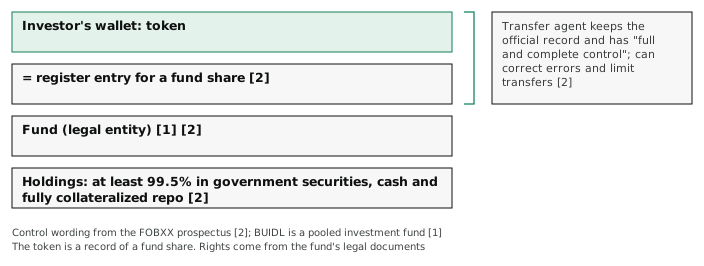
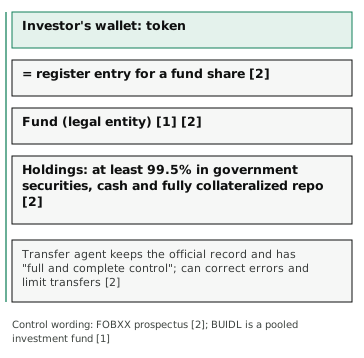
A tokenized Treasury product is usually a fund share, not a Treasury bill. The investor owns an interest in a fund; the fund owns government debt, repurchase agreements and cash; and the record of who owns the shares sits on, or is mirrored to, a blockchain (source 2).
That matters because the token changes the paperwork, not the asset. For business and allocator readers, the useful questions are the old fund questions: what legal wrapper the product uses, who may buy it, who controls the register, and what the documents say can go wrong.
This guide covers three products whose documents Le Coin read: BlackRock's BUIDL, Franklin Templeton's FOBXX and Ondo's OUSG.
At a glance
- The token is the ownership record. The fund behind it holds conventional short-term government assets (source 2).
- Two legal wrappers appear: private funds sold only to wealthy investors under a securities-law exemption (BUIDL, OUSG), and a fund registered with the Securities and Exchange Commission (FOBXX) (sources 1, 2, 4).
- BUIDL's latest Form D amendment, a notice private funds file with the SEC when they sell securities, reports $5,135,523,412 as the total amount sold, from 28 investors (source 1).
- FOBXX's transfer agent, the firm that keeps the official shareholder list, has "unilateral control" over shares on its blockchain-integrated system (source 2).
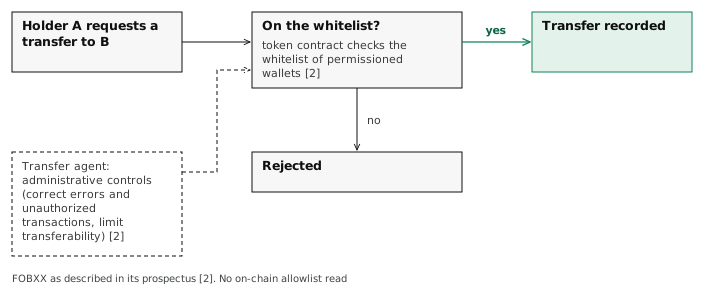
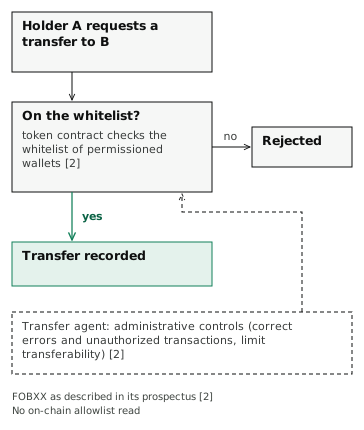
- These are not bearer tokens like Bitcoin. FOBXX shares sit in whitelisted wallets, and its transfer agent can correct errors and limit transfers (source 2).
What it is
Franklin Templeton's prospectus states the idea: "all Fund and shareholder records in the blockchain-integrated system are under the full and complete control of the Fund's transfer agent" (source 2). The same document contrasts its shares with native digital assets such as Bitcoin and Ether, and says the fund "will not invest in any native crypto assets of public permissionless blockchains" (source 2).
In other words, the blockchain is a filing cabinet. It can make records faster to update and easier to move between approved wallets, but the fund's rights and obligations come from its legal documents, not from code.
How it works
The register. FOBXX's record-keeping system is "a permissioned system created by the transfer agent on a public blockchain network," using smart contracts, which are programs that run on a blockchain, to hold "a whitelist of permissioned wallets" alongside administrative controls (source 2). For the Stellar network, the prospectus says this is done through token configuration (source 2).
Who can buy. FOBXX shares are bought through Franklin Templeton's Benji app or its Institutional Web Portal, and the minimum initial purchase for most accounts is $20 (source 2). BUIDL's Form D lists a $100,000 minimum investment (source 1). Ondo says OUSG is sold to "qualified purchasers," a legal category of high-net-worth investors (source 4).
The legal exemptions. BUIDL's Form D claims Rule 506(c), which lets private funds advertise if every buyer is verified as accredited, and the Investment Company Act exemption in Section 3(c)(7), for funds sold only to qualified purchasers (source 1). Ondo's docs say OUSG relies on the same two exemptions, with Ondo I LP as issuer (source 4). FOBXX instead intends to be a "Government money market fund" under Rule 2a-7, the SEC rule for money market funds (source 2).
What the fund holds. FOBXX invests at least 99.5% of its total assets in government securities, cash and repurchase agreements fully collateralized by government securities or cash, and uses amortized cost to seek a stable $1.00 share price (source 2). Ondo says OUSG invests in funds from "BlackRock, Franklin Templeton, WisdomTree, Fidelity, and others, along with bank deposits and USDC" (source 3), which makes it a fund that holds other funds.
Three products, side by side
The table shows the main split: two private funds sold only to qualified purchasers, and one registered fund open to small accounts.
| Product | Legal wrapper | Minimum | Source |
|---|---|---|---|
| BlackRock USD Institutional Digital Liquidity Fund Ltd. (BUIDL) | British Virgin Islands private fund; Rule 506(c); Section 3(c)(7) | $100,000 | 1 |
| Franklin OnChain U.S. Government Money Fund (FOBXX) | SEC-registered government money market fund | $20, most accounts | 2 |
| Ondo OUSG | Private fund (Ondo I LP); Rule 506(c); Section 3(c)(7) | $5,000 instant; $100,000 non-instant | 3, 4 |
BUIDL. The Form D amendment, signed July 23, 2026 and filed with the SEC on July 27, 2026, reports a total amount sold of $5,135,523,412, 28 investors, a first sale on March 4, 2024, and an offering amount of "Indefinite" (source 1). Total amount sold is cumulative sales reported on the filing; it is not the fund's current assets. It lists Securitize Markets, LLC as the sales-compensation recipient (source 1). BlackRock has not published an offering memorandum that Le Coin could read, so this guide does not describe BUIDL's blockchains or dividend mechanics.
FOBXX. Its summary prospectus shows a 0.15% management fee, 0.07% of other expenses, and total annual operating expenses of 0.22%, or 0.20% after a fee waiver that runs until July 31, 2027 (source 2).
OUSG. Ondo describes instant subscriptions and redemptions with a $5,000 minimum, $100,000 and $50,000 minimums for non-instant subscriptions and redemptions, and a 0.15% management fee "waived until January 1, 2027" (source 3), as of Oct. 16, 2026.
Risks the documents name
- Control. The transfer agent "has the ability to correct errors and unauthorized transactions" on FOBXX's system (source 2). That protects investors from mistakes and also means tokens are not bearer assets.
- Technology. "The use of blockchain technology is relatively new and still evolving for mutual funds" (source 2).
- Principal. Even the registered fund says "You could lose money by investing in the Fund," and that it is not insured or guaranteed by the Federal Deposit Insurance Corporation (source 2).
- Layers. In Le Coin's view, a fund of funds such as OUSG adds a second set of managers and counterparties between the investor and the Treasury bill (source 3).
What it means
In Le Coin's view, the label "tokenized Treasuries" describes a delivery method more than an asset class. The protections an investor gets depend on the wrapper, and the wrapper is in the filing, not the token.
In Le Coin's view, size claims deserve care. The only size figure here comes from a Form D, and it measures cumulative sales, so readers comparing products should not treat it as assets under management.
Sources
- 1SEC EDGAR, Form D/A, BlackRock USD Institutional Digital Liquidity Fund Ltd., accession 0002013810-26-000002, signed July 23, 2026, filed July 27, 2026. https://www.sec.gov/Archives/edgar/data/2013810/000201381026000002/primary_doc.xml
- 2SEC EDGAR, Franklin OnChain U.S. Government Money Fund, Summary Prospectus, Aug. 1, 2026 (Form 497K). https://www.sec.gov/Archives/edgar/data/1786958/000165558926001138/c497k.htm
- 3Ondo Finance docs, "OUSG Overview." https://docs.ondo.finance/qualified-access-products/ousg/overview
- 4Ondo Finance docs, "OUSG Regulatory Compliance." https://docs.ondo.finance/qualified-access-products/ousg/regulatory-complianceHolding the Corner.
Not financial advice.