Page record
- Title
- Arbitrum
- Category
- L2
- Version
- v0.3.1
- Date
- Oct. 12, 2026, 10:05 p.m. ET
- Updated
- Oct. 17, 2026, 6:29 p.m. ET
- Status
- Published
- Canon
- This page is canonical. PDF export is a rendering of this page, not a separate document.
- Proof
- Le Coin hashes the page as published. The hash and its OpenTimestamps proof are on the Proof page.
Changelog.
- v0.3.1 (2026-10-17; replaces v0.3.0, publish hash 51501652ac9502f0a764d74cc9840d8efebc3625ff5747d29a4d05e9a276c8cb): added diagrams: how a transaction reaches Ethereum; how a result settles on Ethereum. Body text unchanged.
- v0.3.0 (2026-10-14; replaces v0.2.1, publish hash 82c5c166e4f64ba2bc10a3fdfac668798bdd9dc68a0fc6005ab8b84e5d9f7e58): plain-English rewrite for learners. Adds an "At a glance" block, plain explanations of terms specific to this subject, labeled analogies, and "why it mattered" notes for each upgrade. Sources unchanged. No claim changes.
- v0.2.1 (2026-10-14; replaces v0.2, publish hash 6e13459ff62e871ce4a10445716e4d30f842cfeaa1efaae3bb5272f56bae6d3a): the page record now shows the published status, version, publish date and proof. Body wording: the policy line now names the Learning Hub. No claim changes.
- v0.2 (2026-10-06; replaces v0.1, sha256 1d7b5dd582b2175f15cb72ca4c127e9aad34c0418b6ee6eae952f4a0e289f1ec): narrowed the Offchain Labs line to what the Timeboost page supports, that Offchain Labs developed Timeboost, and noted that Arbitrum One used it until September 2026; cited Robinhood Chain's "Notices & Upgrades" docs page, added as a source, for Robinhood Chain running Arbitrum Nitro; split the attribution in the note on inconsistent docs, so the PGA docs are cited for Timeboost switching off the day PGA activates and the ArbOS 61 notice for the September 23, 2026 date; updated the Learning Hub label.
At a glance
- Arbitrum One is a layer-2 chain that runs transactions off Ethereum and posts them back to Ethereum in batches [1][2].
- A single sequencer orders transactions, but users can force a transaction in through Ethereum after 24 hours [1][3].
- Since September 23, 2026, transactions are ordered by priority fees instead of the Timeboost auction [7][12].
- Withdrawals to Ethereum wait about 6.4 days, the window in which anyone can dispute a claimed result [2][3].
- On October 2, 2026, the Security Council paused new Stylus contract activations and added a settlement guard [14].
1. What it is
A layer 2 for Ethereum
Arbitrum is a family of Ethereum layer-2 (L2) chains and the software that runs them [4][6]. This dive covers Arbitrum One, the main public chain, and the governance and technology shared with Arbitrum Nova [5][6]. The ArbitrumDAO's constitution describes Arbitrum One as "a proper L2 rollup chain" that "derives its security from Ethereum" [6].
What "optimistic rollup" means
Arbitrum One is an optimistic rollup [2]. A rollup bundles many transactions together and records them on Ethereum. It executes transactions off Ethereum, posts them to Ethereum in compressed batches, and assumes the results are correct unless a validator proves otherwise [1][2]. That assumption is the "optimistic" part.
Analogy, not the mechanism itself: it is like a shop that accepts every receipt as correct but keeps them on file for a few days so anyone can contest a wrong one.
Arbitrum Nova settles to Ethereum too, but a Data Availability Committee stores its transaction data instead of Ethereum [6]. That committee is a named group that keeps the data and vouches that it is available.
Other chains on the same software
The same software stack, Nitro, also runs dedicated chains operated by other companies [4][13]. Robinhood Chain is one of them [16]. Its specific setup, including permissioned validators, its own Security Council and compliance filtering, is covered in that dive.
Who controls it
Control of Arbitrum One and Nova is shared between the ArbitrumDAO, whose votes are weighted by the ARB token, and a 12-member Security Council [6]. Offchain Labs developed Timeboost, the ordering policy Arbitrum One used until September 2026 [7][10][12].
2. How it works
The sequencer
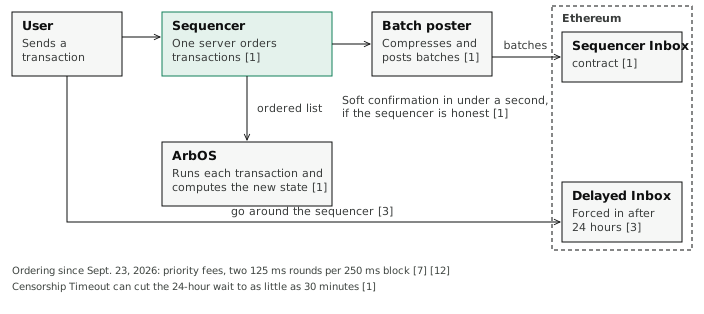
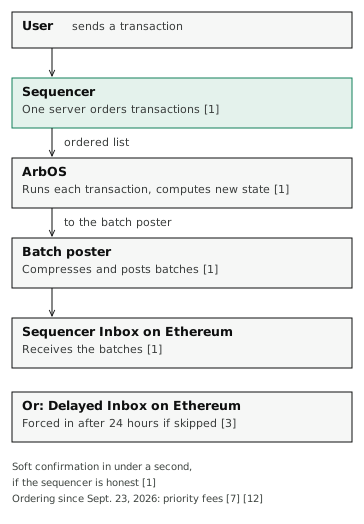
A single sequencer receives, orders and publishes transactions on Arbitrum One [1]. The sequencer is the one server that decides the order of transactions. It hands the ordered list to ArbOS, Arbitrum's execution layer, which runs each transaction and computes the new state [1]. Users get a sub-second "soft" confirmation from the sequencer's feed, which depends on the sequencer behaving honestly [1]. A batch poster then compresses the transactions and posts them to the Sequencer Inbox contract on Ethereum [1].
Going around the sequencer
Users do not have to go through the sequencer [3]. Anyone can submit a transaction through the Delayed Inbox on Ethereum, and if the sequencer does not include it, it can be forced in after 24 hours [3]. A feature called Censorship Timeout is designed to shorten that wait, to as little as 30 minutes, when the sequencer has recently been offline or censoring [1].
Analogy, not the mechanism itself: if the front desk ignores your form, you can drop it in a public box, and after a set wait you can push it through yourself.
How transactions are ordered
Since September 23, 2026, Arbitrum One has ordered transactions with Priority Gas Auctions (PGA) [7][12]. Each 250-millisecond block is split into two 125-millisecond rounds [7]. In each round, waiting transactions are sorted by the priority fee they pay, and transactions left behind get a boost so they are not starved [7]. A priority fee is an extra amount a user pays to be placed earlier. The mempool stays private, so other users cannot see or reorder pending transactions [1].
Fees
Fees are priced in gwei, a fraction of ETH [3][13]. Since ArbOS 61, a BaseFeeManager contract lets Offchain Labs adjust Arbitrum One's minimum L2 base fee between 0.01 and 0.10 gwei, bounds set by the DAO [13]. The base fee is the standard charge every transaction pays before any priority fee. That authority expires two years after activation, and the DAO can remove it sooner [13]. Under PGA, 97% of priority fees go to the DAO treasury and 3% to the Arbitrum Developer Guild [7].
Settlement: BoLD
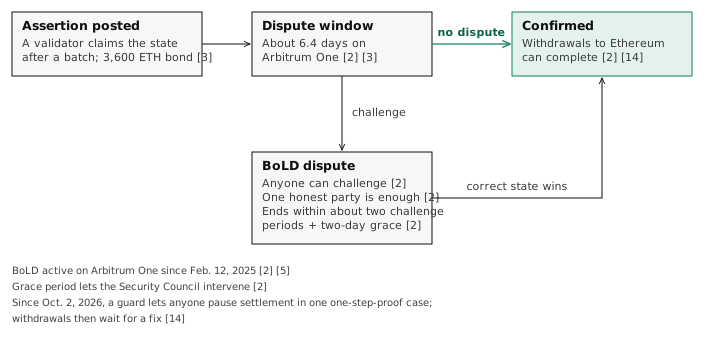
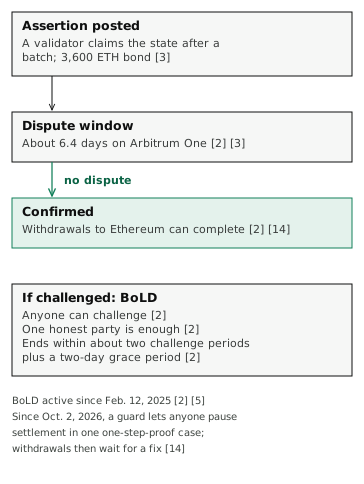
Settlement is how Arbitrum's results become final on Ethereum. Validators post "assertions" to Ethereum, claiming what Arbitrum's state is after a batch of transactions [2]. If nobody disputes an assertion within the dispute window, about 6.4 days on Arbitrum One, it is confirmed [2][3]. Withdrawals to Ethereum wait for this confirmation [2][14].
Disputes are settled by BoLD (Bounded Liquidity Delay), active on Arbitrum One since February 12, 2025 [2][5]. Under BoLD, anyone can validate and challenge, not just an allowlist [2]. A single honest party is enough to defend the correct state [2]. Disputes end within a fixed time: about two challenge periods, plus a two-day grace period for the Security Council to intervene [2]. Posting an assertion on Arbitrum One requires a 3,600 ETH bond [3].
Stylus
Besides the EVM, Arbitrum supports Stylus contracts written in languages that compile to WebAssembly, such as Rust [15]. WebAssembly is a common low-level format that many programming languages can be turned into. A Stylus contract has to be "activated" before it can be called, and an activation lasts 365 days by default [14]. New activations are currently paused (see What changed) [14].
Governance
The ArbitrumDAO and the Security Council both hold "chain owner" powers over Arbitrum One and Nova [6]. Changes to chain software, called ArbOS upgrades, are Arbitrum's equivalent of a hard fork and need a Constitutional proposal (AIP) to pass [4][5][6]. A Constitutional AIP needs more votes for than against, plus a quorum tied to delegated tokens [6]. It then passes through waiting periods on Arbitrum and Ethereum, so users who object have time to withdraw [6]. The full process normally takes at least 42 days [6].
The Security Council
The Security Council has 12 members in two elected cohorts of six [6]. It can act without delay in a security emergency, and it can approve routine changes that then go through the normal waiting periods [6]. Both kinds of action need 9 of the 12 signatures [6]. After an emergency action it must publish a transparency report [6].
3. What changed
Timeline
| Date | Event | Source |
|---|---|---|
| Mar 14, 2024 | ArbOS 20 "Atlas" | [5] |
| Sep 3, 2024 | ArbOS 31 "Bianca" | [5] |
| Feb 12, 2025 | BoLD activated: permissionless validation | [5] |
| Apr 2025 | Timeboost ordering starts on Arbitrum One | [7] |
| Jun 17, 2025 | ArbOS 40 "Callisto" | [5] |
| Jan 8, 2026 | ArbOS 51 "Dia": Fusaka EVM changes, 32M per-transaction gas cap | [5][11] |
| Aug 20, 2026 | ArbOS 61 "Elara": BaseFeeManager, larger Stylus contracts | [5][12][13] |
| Sep 4, 2026 | DAO vote on PGA and Fast Feed closes | [9] |
| Sep 23, 2026 | PGA and priority fees live on Arbitrum One; Timeboost retired | [7][12] |
| Oct 2, 2026 | Security Council emergency action: BoLD guard, Stylus pause | [14] |
BoLD (February 12, 2025)
What changed. BoLD was activated on Arbitrum One, with permissionless validation [5]. Under it, anyone can validate and challenge, not just an allowlist [2].
Why it mattered. Checking the chain no longer depends on a fixed list of approved validators, and a single honest party is enough to defend the correct state [2].
ArbOS 51 "Dia" (January 8, 2026)
What changed. Dia brought Ethereum's Fusaka changes to Arbitrum, including the secp256r1 precompile [11]. A precompile is a built-in function contracts can call cheaply, and secp256r1 is a widely used signature type. It set a per-transaction gas cap of 32 million on Arbitrum One and Nova, double Ethereum's 16 million, matching the block gas limit [11].
Why it mattered. Builders got Fusaka's EVM changes, and a single transaction may use up to the full block gas limit [11].
ArbOS 61 "Elara" (August 20, 2026)
What changed. Elara added the BaseFeeManager and raised the Stylus contract size limit from 24 KB to 96 KB [12][13]. It also shipped optional features for dedicated chains: compliance filtering, priority fees and an alternative data-availability API [12][13]. Compliance filtering and the alternative data API are disabled on Arbitrum One and Nova [12]. ArbOS 60 was skipped on mainnet because of gas-refund bugs found on testnet [12].
Why it mattered. Stylus builders can deploy larger contracts, and Offchain Labs gained limited, time-bound power over the minimum base fee [12][13].
Timeboost to PGA (Sept. 23, 2026)
What changed. Timeboost, used since April 2025, auctioned a 60-second "express lane" to one bidder at a time and delayed everyone else by 200 milliseconds [7]. Arbitrum's docs say the auction had a high barrier to entry and did not suit latency-sensitive applications [7]. PGA replaces it with per-transaction priority fees [7][8]. A paid "Fast Feed" now streams each transaction as soon as the sequencer orders it [1][8].
Analogy, not the mechanism itself: Timeboost was like renting the only express checkout lane for a minute; PGA is like letting each shopper tip to move up the line.
Why it mattered. Instead of one auction winner getting a head start, any user can pay a priority fee on an individual transaction [7][8].
Emergency action (October 2, 2026)
What changed. The Security Council made two changes [14]. First, it added a guard that lets anyone pause Arbitrum One's settlement on Ethereum if two conflicting answers both pass a level of the one-step proof where only one should [14]. A one-step proof is the final stage of a dispute, where a single disputed computing step is checked on Ethereum. If that happens, the chain keeps running, but unconfirmed withdrawals to Ethereum wait until the Council deploys a fix [14]. Second, it paused activation of new Stylus contracts on Arbitrum One and Nova [14]. The Council cited a rise in AI-assisted attacks on hand-crafted WebAssembly programs [14]. It says known Stylus bugs affect chain liveness and have not put user funds at risk [14]. Liveness means the chain keeps running and processing transactions.
Why it mattered. Builders cannot activate new Stylus contracts for now, and in the guarded case, withdrawals to Ethereum would wait for a fix [14].
ZK proving, announced
What changed. On August 20, 2026, Arbitrum said it is adding zero-knowledge proofs to BoLD [15]. A zero-knowledge proof is a compact cryptographic proof that a computation was done correctly. An assertion could then be confirmed once a valid proof lands and a new Fast Confirmation Committee attests to it, instead of waiting out the challenge window [15]. If no proof arrives, settlement works as it does today [15]. The post describes milestones, not a live feature [15].
Why it matters. Nothing has changed for users yet; the post describes milestones, not a live feature [15].
4. What is open
One sequencer
Ordering on Arbitrum One depends on a single sequencer [1]. Force inclusion through the Delayed Inbox limits how long it can exclude a transaction, but not how it orders transactions in the meantime [1][3]. Arbitrum's docs describe decentralized, committee-based sequencing as a long-term goal with no date [1].
Security Council power
Nine of twelve Council members can upgrade the chain with no delay in an emergency [6]. The October 2 action shows those powers in use [14]. The DAO can limit or remove them through a Constitutional AIP [6].
The new settlement pause
The October 2 guard lets anyone halt settlement to Ethereum under a specific, publicly checkable condition [14]. It is meant to stop a class of one-step-proof attacks [14]. How it interacts with BoLD's fixed dispute deadlines, and how often it might be triggered, is not described in the report.
When will Stylus reopen?
The Arbitrum Foundation says it will work with the DAO on when and how to reopen Stylus activations, "while restricting hand-crafted WASM programs" [14]. Existing Stylus contracts keep running until their activation expires, and can be renewed [14]. No timeline has been published.
Withdrawal time
Withdrawals to Ethereum wait about 6.4 days for the dispute window [3]. ZK proving could cut that to hours, by Arbitrum's description, but it is not live and its committee design is not yet specified in docs we reviewed [15].
Base-fee authority
Offchain Labs can move the minimum base fee within DAO-set bounds for two years [13]. Arbitrum says the change "does not automatically increase fees" [13]. How and when the authority will be used is not set out in advance [13].
Small inconsistencies in the docs
Arbitrum's Timeboost page still says Timeboost is "currently live on Arbitrum One" [10]. The PGA docs say Timeboost is switched off on the day PGA activates [7], and the ArbOS 61 notice says PGA has been on since September 23, 2026 [12]. This page follows the newer notices.
What this page leaves out
By Learning Hub policy, this dive carries no price, market value, fee-revenue or usage-volume figures. Those go stale, and News covers them.
Sources
- 1Arbitrum Docs, "The Sequencer and censorship resistance." https://docs.arbitrum.io/how-arbitrum-works/deep-dives/sequencer
- 2Arbitrum Docs, "Overview of BoLD." https://docs.arbitrum.io/how-arbitrum-works/bold/gentle-introduction
- 3Arbitrum Docs, "Chain parameters." https://docs.arbitrum.io/arbitrum-essentials/reference/chain-params
- 4Arbitrum Docs, "ArbOS software releases: Overview." https://docs.arbitrum.io/run-arbitrum-node/arbos-releases/overview
- 5Arbitrum DAO Governance Docs, "Network upgrades" (activation table). https://docs.arbitrum.foundation/network-upgrades
- 6Arbitrum DAO Governance Docs, "The Amended Constitution of the ArbitrumDAO." https://docs.arbitrum.foundation/dao-constitution
- 7Arbitrum Docs, "Introduction to PGA (Priority Gas Auctions)." https://docs.arbitrum.io/how-arbitrum-works/priority-gas-auction/pga
- 8Arbitrum Blog, "How to Compete for Transaction Priority on Arbitrum" (September 24, 2026). https://blog.arbitrum.io/competing-for-transaction-priority-on-arbitrum/
- 9Arbitrum DAO Forum, "[Constitutional] AIP: Transition Arbitrum One ordering policy to Priority Gas Auctions (PGA)," and "Rewarding Active Delegates – September 2026 Results" (records the vote close of September 4, 2026). https://forum.arbitrum.foundation/t/constitutional-aip-transition-arbitrum-one-ordering-policy-to-priority-gas-auctions-pga/30942 and https://forum.arbitrum.foundation/t/rewarding-active-delegates-september-2026-results/31523
- 10Arbitrum Docs, "How Timeboost works." https://docs.arbitrum.io/how-arbitrum-works/timeboost/gentle-introduction
- 11Arbitrum Docs, "ArbOS 51 Dia." https://docs.arbitrum.io/run-arbitrum-node/arbos-releases/arbos51
- 12Arbitrum Docs, "Upgrade notice for ArbOS 61." https://docs.arbitrum.io/notices/arbos61-upgrade-notice
- 13Arbitrum Blog, "ArbOS Elara: Compliance Filtering, Priority Fee Support" (August 20, 2026). https://blog.arbitrum.io/arbos-elara/
- 14Arbitrum DAO Forum, "Security Council Emergency Action – 2/10/2026" (posted October 2, 2026), and Arbitrum Docs, "Temporary pause on new Stylus activations." https://forum.arbitrum.foundation/t/security-council-emergency-action-2-10-2026/31530 and https://docs.arbitrum.io/notices/stylus-activation-pause-notice
- 15Arbitrum Blog, "ZK Settlement is Coming to Arbitrum" (August 20, 2026). https://blog.arbitrum.io/zk-settlement-is-coming/
- 16Robinhood Chain Docs, "Notices & Upgrades." https://docs.robinhood.com/chain/notices-and-upgrades/Holding the Corner.
Not financial advice.