Research and analysis only, not investment, financial, legal or tax advice or a recommendation to buy, sell or hold any asset. Full disclosure at the end.
The rules that now let crypto firms operate more freely in the U.S. rest mostly on agency decisions that a new administration can undo, so the Nov. 3 midterms and the 2028 election will decide how long they last. At 4:45 p.m. ET on Oct. 22, 2026, Kalshi traders priced Democrats at 91.3% to win the House, a market price and not a forecast [4].
Key findings
- The Clarity Act passed the House 294–134 but failed a Senate cloture vote 49–50 on Sep. 15, 2026, with no Democratic yes votes [1][16]. Kalshi prices it becoming law before Jan. 1, 2027 at 5.8% [4].
- Without a statute, current crypto policy rests on SEC and CFTC interpretations, proposals and staff statements that a future commission can revise [6]–[15].
- Four crypto-funded super PACs spent about $142.7M on independent expenditures this cycle through Oct. 21 (Le Coin sum). The largest target is Ohio's Senate race, where Kalshi favors the candidate the PACs oppose [4][5].
- Seven periods of party control since 2013 show no consistent pattern in crypto prices by party [20].
Terms used throughout.
- Kalshi: a CFTC-regulated exchange where traders buy $1 contracts that pay out if an event happens. A 69-cent price reads loosely as a 69% market-implied chance. Prices move with money and liquidity, and thin markets can mislead.
- Super PAC: a committee that may raise and spend unlimited sums but may not coordinate with candidates. Its ad spending for or against a candidate is an "independent expenditure."
- SEC and CFTC: the Securities and Exchange Commission oversees securities, such as stocks and investment contracts. The Commodity Futures Trading Commission oversees commodities and derivatives markets.
- Cloture: the Senate's vote to end debate. It needs 60 votes.
About the Kalshi figures. Prices are from a refresh at 4:45 p.m. ET Oct. 22, 2026. An earlier snapshot at 4:35 p.m. ET differed by at most 1 point on any market cited; the table below lists every change. Price history uses daily candles pulled at 4:36 p.m. ET [4].
| Market |
4:35 p.m. ET |
4:45 p.m. ET |
| House 2026, Democrats |
91.4% |
91.3% |
| Ohio Senate, Brown / Husted |
69% / 31% |
68% / 32% |
| Nebraska Senate, Ricketts |
76% |
75% |
| 2028 Democratic nominee: Newsom / Harris / Beshear |
14% / 7.2% / 5% |
15% / 7.5% / 5.7% |
| 2028 winner, Rubio |
10% |
9.7% |
All other cited markets were unchanged.
1. Current baseline: the Clarity Act and agency posture
What the bill is. The Digital Asset Market Clarity Act (H.R. 3633), usually called the Clarity Act, is a "market structure" bill: it decides which regulator oversees which crypto activity, dividing oversight between the SEC and the CFTC. The Senate's cloture motion describes it as a bill "to provide for a system of regulation of the offer and sale of digital commodities by the Securities and Exchange Commission and the Commodity Futures Trading Commission." The motion says it would also bar Federal Reserve banks from offering certain products directly to individuals, and prohibit using a central bank digital currency for monetary policy [2].
Where it stands (confirmed).
- The House passed H.R. 3633 on Jul. 17, 2025, 294–134 (Roll no. 199). All 216 Republicans voted yes; Democrats split 78 yes and 134 no [3][16].
- The Senate received it on Sep. 18, 2025 and referred it to the Banking Committee [3].
- Banking reported it on Jun. 1, 2026 with a full-text substitute amendment (Calendar No. 423) [3].
- There is no separate Senate Clarity bill number; Senate Banking amended H.R. 3633 itself. The Senate Agriculture Committee's own bill is S. 3755, the Digital Commodity Intermediaries Act [34].
- On Sep. 15, 2026, cloture on the motion to proceed failed 49–50 (Record Vote No. 234) [1][2].
- The 49 yeas were all Republicans.
- The 50 nays were 44 Democrats, 2 independents and 4 Republicans: Collins, Hawley, Moran and Tillis.
- Coons did not vote [1].
- Sen. Tillis then entered a motion to reconsider, which keeps a re-vote possible [2]. Congress.gov shows no later floor action as of Oct. 22 [3].
Why it stalled. Senators' floor remarks on Sep. 15 give their stated reasons. These are attributed claims, not findings.
- Sen. Warren (D-MA) argued that new ethics provisions, which she said Republicans negotiated with the White House, would not stop the President from profiting from crypto. She also cited law-enforcement, bank-risk and state-preemption concerns [2, S4704–S4705].
- Sen. Lummis (R-WY) said "Democrats secured 126 separate concessions" and that the final text "reflects substantially all of the Tillis-Gallego framework" on ethics [2, S4705].
- Sen. Moreno (R-OH) said the bill "started as 300 pages" and "is now over 600 pages," and asked for a floor debate, citing law enforcement as one point to argue [2, S4703].
The four Republican no votes gave no reasons on the pages reviewed, so their motives are unverified.
Pathways (scenarios, not forecasts).
- Lame duck: the Senate could take up the motion to reconsider.
- Reintroduction: the 119th Congress runs 2025–2026 [18]. Unenacted bills die when it ends on Jan. 3, 2027, the date the 20th Amendment sets for the next Congress to assemble [19]. A bill would then have to be reintroduced in the 120th Congress.
- Agency action: the agencies keep acting without a statute (below).
What Kalshi prices. Each contract asks whether a crypto market-structure bill becomes law before a stated date. Under the contract rules, a qualifying bill is defined by its content, not its name. It must set a comprehensive framework, divide authority among agencies such as the SEC and CFTC, and define when digital assets are securities or commodities. Stablecoin-only bills do not count, and the rules name the Clarity Act and FIT21 as examples [4].
| Becomes law before |
Price, 4:45 p.m. ET |
Bid / ask |
Open interest (contracts) |
| Dec. 1, 2026 |
2% |
1 / 2 |
160,793 |
| Jan. 1, 2027 |
5.8% |
5.5 / 5.8 |
590,941 |
| Jul. 1, 2027 |
17% |
14 / 19 |
33,330 |
| Jan. 1, 2028 |
26% |
23 / 26 |
58,608 |
The later contracts are thin, with spreads of 3–5 points, so read them loosely.
- The "before Jan. 1, 2027" contract closed at 17% on Sep. 14 and at 8.4% on Sep. 15.
- The "before Jan. 1, 2028" contract fell from 51% to 22% over the same two days. It has closed between 16% and 34% since (Figure 1) [4].
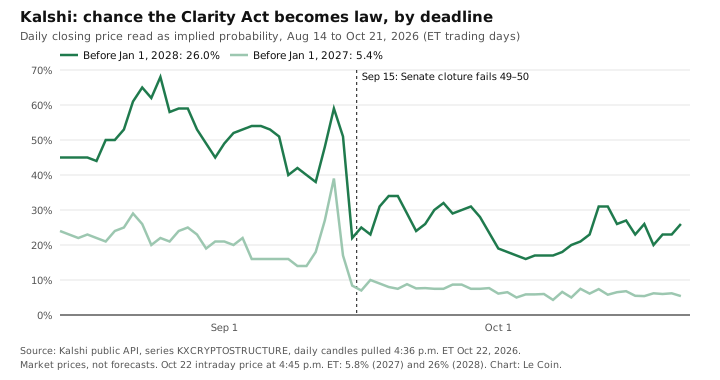 Figure 1. Kalshi Clarity Act contracts, daily closes, Aug. 14 to Oct. 21, 2026. Source: Kalshi public API [4].
Agency posture without a statute. The durability column is Le Coin's analysis of each action's legal form, not a legal finding.
| Date |
Action |
Durability (Le Coin analysis) |
| Jan. 21, 2025 |
SEC forms its Crypto Task Force [6] |
Reversible at will |
| Jan. 23, 2025 |
SEC staff bulletin SAB 122 rescinds SAB 121 on custody accounting [7] |
Staff guidance |
| Feb. 27, 2025 |
SEC dismisses its civil case against Coinbase [8] |
Case-specific |
| Mar. 20 and Apr. 4, 2025 |
SEC Corporation Finance staff statements on proof-of-work mining and stablecoins [9][10] |
Staff views; they do not bind the Commission |
| Jul. 31, 2025 |
Chair Atkins launches "Project Crypto" in a speech [11] |
No legal effect |
| Aug. 4, 2025 |
CFTC Listed Spot Crypto Trading Initiative [12] |
Reversible |
| Mar. 23, 2026 |
SEC interpretation, with CFTC guidance, sorting tokens into five categories (91 FR 13714) [13] |
Firmer; a future Commission can withdraw it |
| Aug. 21, 2026 |
SEC proposes "Regulation Crypto Assets" (91 FR 54510); comments closed Oct. 20 [14] |
Proposal only |
| Oct. 13, 2026 |
CFTC advance notice on crypto asset transactions and markets (RIN 3038-AF80); comments due Dec. 14 [15] |
Earliest rulemaking stage |
Stablecoins are the exception: there is a statute. The GENIUS Act (S. 1582) passed the Senate 68–30 on Jun. 17, 2025 [17] and was signed into law on Jul. 18, 2025, as Public Law 119-27 [33]. The OCC's implementing rule (FR 2026-21706) takes effect Jan. 18, 2027 [22].
2. Candidate and party positions
How the races were picked. We ranked candidates by crypto super PAC spending, not reputation (section 3).
How records are described. Sections 2.1–2.4 use recorded votes:
- House Roll no. 199 on Clarity [16]
- Senate Record Vote 318 on GENIUS passage [17]
- Senate Record Vote 234 on Clarity cloture [1]
Where no vote or official statement was found, we write "stance not verified." The roster (section 2.5 and Appendix: Roster sources) also uses committee actions and a person's own dated statements or signed official actions. No interviews or secondhand summaries are used.
2.1 The 2026 races the crypto PACs spend on most
| Race |
PAC spending (Le Coin sums [5]) |
Recorded votes |
Kalshi, 4:45 p.m. ET [4] |
| Ohio Senate special: Jon Husted (R, incumbent) vs. Sherrod Brown (D) |
About $36.3M supporting Husted and $16.4M opposing Brown, nearly all dated Sep. 22–Oct. 19 |
Husted: Yea on GENIUS and on Clarity cloture [1][17]. Brown: no vote in the 119th Congress; his Sep. 24, 2026 campaign statement says Husted is "backed by billionaires, cryptocurrency, and dark money from out of state" (Appendix: Roster sources) |
Brown 68%, Husted 32%. Brown was 54% at the Sep. 14 close |
| Nebraska Senate: Pete Ricketts (R, incumbent) vs. Dan Osborn (I) |
About $6.7M opposing Osborn, latest Oct. 13 |
Ricketts: Yea on GENIUS and cloture [1][17]. Osborn: stance not verified |
Ricketts 75%, Osborn 25%. Ricketts was 70% on Aug. 15 |
| Alabama Senate: Barry Moore (R) |
About $12.2M supporting, all by Jun. 16 |
Moore (as a House member): Yea on Clarity [16] |
Moore 98.9%. Thin: about 2,200 contracts open |
| Illinois Senate: Juliana Stratton (D) |
About $10.1M opposing, in the March primary |
No federal votes; stance not verified |
Stratton 99%. Thin |
| Kentucky Senate: Andy Barr (R) |
About $7.2M supporting, by May 12 |
Barr: Yea on Clarity [16] |
No open Kalshi market |
Ohio is the race to watch. It is the largest single target. It is also the only big crypto-PAC general-election race with a deep Kalshi market: about 2.8M contracts open on each side. The odds have moved against the PAC-backed candidate while the spending rose. Le Coin has not identified the cause, and timing alone does not show whether the ads worked.
House races.
- Protect Progress spent mainly in Democratic primaries, supporting:
- Christian Menefee (TX-18): $6.47M
- Adrian Boafo (MD-05): $5.26M
- Jasmine Clark (GA-13): $4.21M
- Fairshake's October buys are six roughly $1.02M support buys. All six members voted Yea on Clarity [16]:
- Republicans: Bryan Steil (WI), French Hill (AR), Bill Huizenga (MI)
- Democrats: Steven Horsford (NV), Derek Tran (CA), Janelle Bynum (OR)
- House-race odds were not pulled from Kalshi.
2.2 The 2028 fields
| Kalshi market, 4:45 p.m. ET [4] |
Leading prices |
Liquidity |
| Democratic nominee |
Jon Ossoff 16%, Gavin Newsom 15%, Alexandria Ocasio-Cortez 14%, Kamala Harris 7.5%, Andy Beshear 5.7% |
Deep: about 4.7M–5.2M contracts open per leader |
| Republican nominee |
J.D. Vance 41%, Marco Rubio 18%, Ron DeSantis 4.8% |
About 1.9M–2.6M open |
| Winning party |
Democrats 59%, Republicans 40% |
Thin: about 113K–160K open |
| Winner, by person |
Vance 21%, Newsom 13%, Rubio 9.7%, Ocasio-Cortez 9.3%, Ossoff 9.3% |
About 2.6M open per leader |
No Democrat is above 20%. Vance has ranged 41–46% in the Republican market since mid-August. These markets settle more than two years out.
Recorded crypto votes of 2028 names:
- Ossoff (D-GA): Yea on GENIUS and Nay on Clarity cloture [1][17]. Why he voted Nay on cloture is not verified.
- Ocasio-Cortez (D-NY): Nay on Clarity [16].
- Mark Kelly (D-AZ): did not vote on GENIUS; Nay on cloture [1][17].
- Rubio, Harris, Beshear and others: stance not verified. Vance, Newsom and DeSantis cast no recorded vote on these bills in the 119th Congress; Appendix: Roster sources lists at least one dated action for each, and this report does not characterize their overall crypto stances.
2.3 How the parties differ, on the record
- Republicans have voted as a bloc on market structure. All 216 House Republicans backed Clarity, and 49 of 53 Senate Republicans backed cloture.
- Hawley also voted Nay on GENIUS.
- Tillis's Nay came with a motion to reconsider, a procedural step that does not show his view on the merits [1][2][16][17].
- Democrats split by bill.
- GENIUS: passed 68–30. Democratic yes votes included Ossoff, Ruben Gallego (AZ), Kirsten Gillibrand (NY), Adam Schiff (CA), Cory Booker (NJ), Andy Kim (NJ), Elissa Slotkin (MI) and John Fetterman (PA) [17].
- Clarity in the House: 78 yes and 134 no [16].
- Clarity cloture in the Senate: zero yes votes [1].
Stablecoins drew bipartisan support; Senate market structure did not.
2.4 Yes and no votes on the record
Voted yes on one or both bills, or moved them forward:
- Sen. Cynthia Lummis (R-WY): Yea on GENIUS and cloture. She released the merged Clarity text on Jul. 22, 2026 [1][17][31].
- Rep. French Hill (R-AR): Yea on Clarity [16].
- Sen. Tim Scott (R-SC): reported H.R. 3633 from Banking [3].
- Democrats: the 78 Democratic yes votes on Clarity, including Ritchie Torres (NY) and Josh Gottheimer (NJ), and the Democratic yes votes on GENIUS [16][17].
Voted no on one or both bills:
- Sen. Elizabeth Warren (D-MA): Nay on GENIUS and cloture [1][17].
- Rep. Maxine Waters (D-CA): Nay on Clarity [16].
- Sens. Bernie Sanders (I-VT), Chris Murphy (D-CT), Jeff Merkley (D-OR) and Amy Klobuchar (D-MN): Nay on GENIUS [17].
- Republicans: Sen. Josh Hawley (R-MO) voted Nay on both. Sen. Rand Paul (R-KY) voted Nay on GENIUS but Yea on cloture [1][17].
A single vote can reflect procedure, timing or bill text rather than a view on crypto.
2.5 Roster: recorded actions on digital-asset legislation
This roster records what each person did or said. It does not rate them, and it endorses no one.
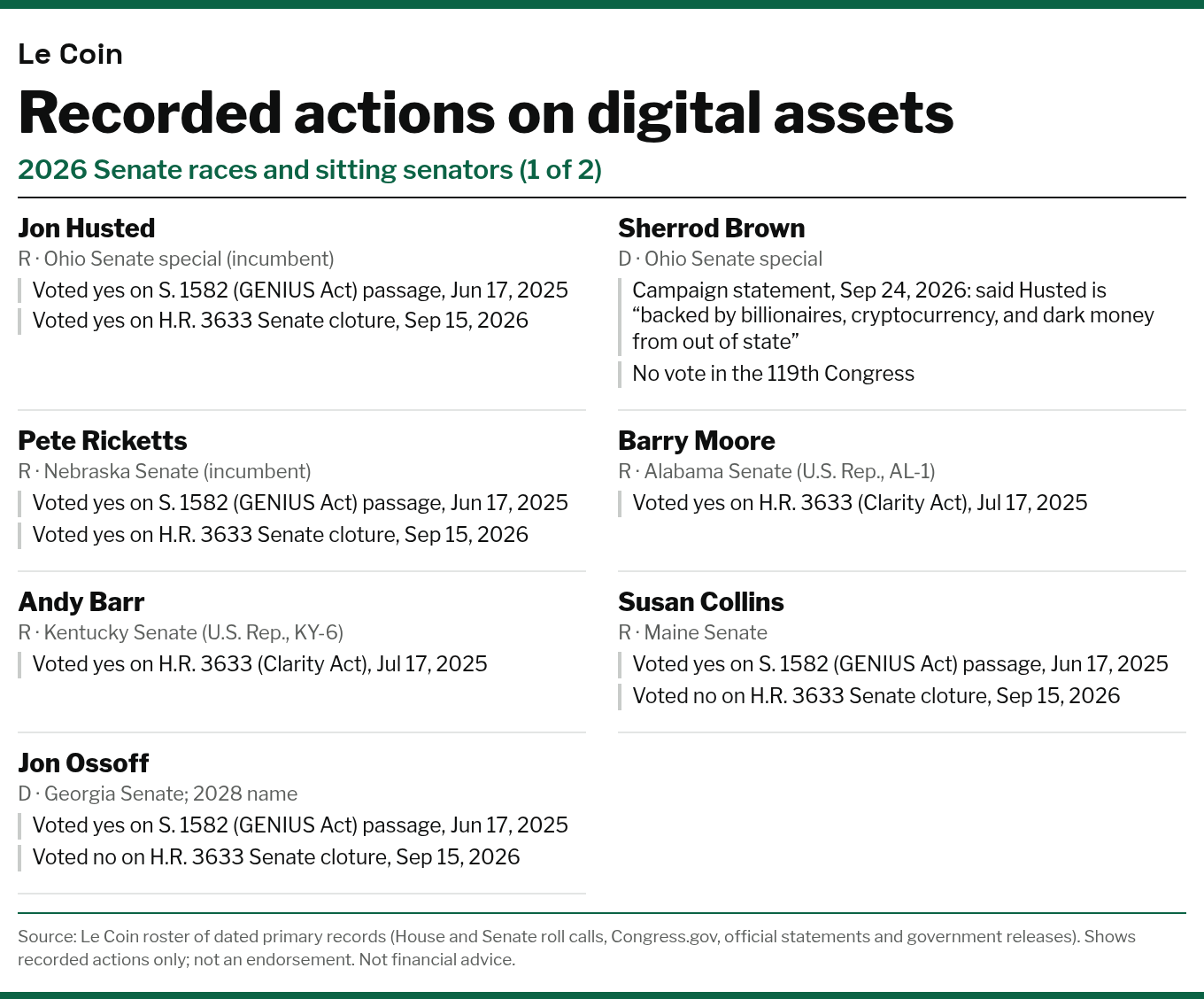
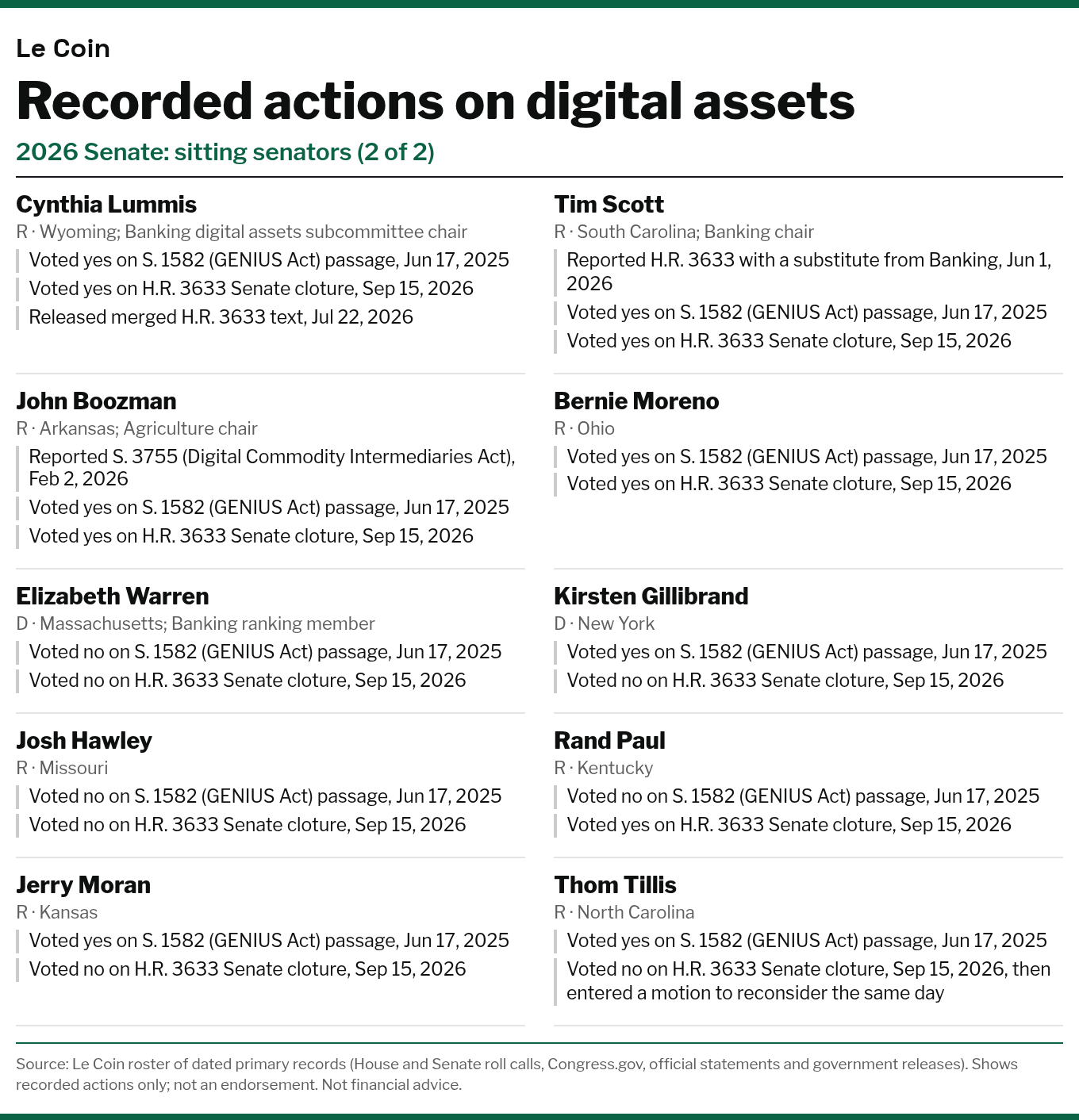
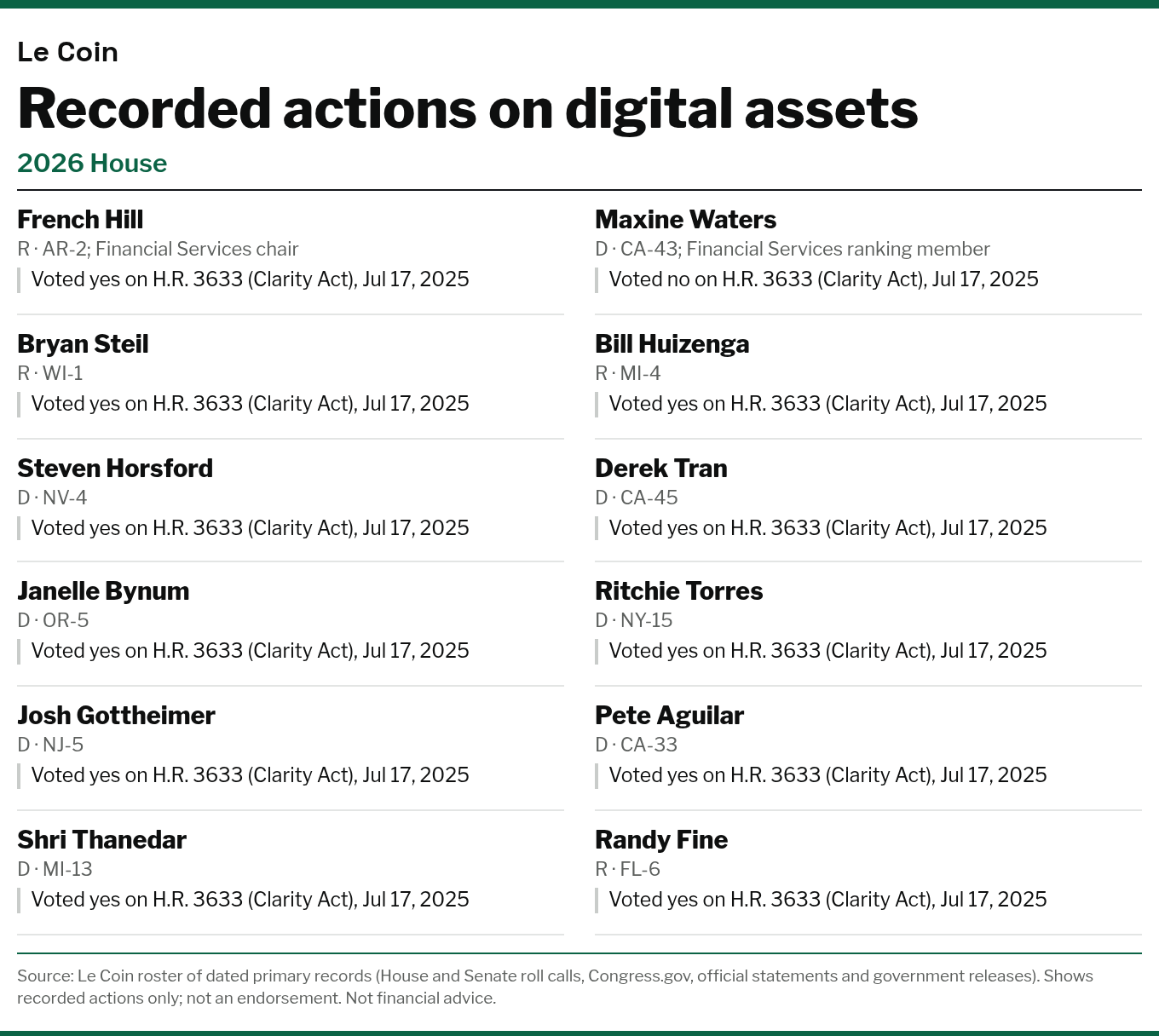
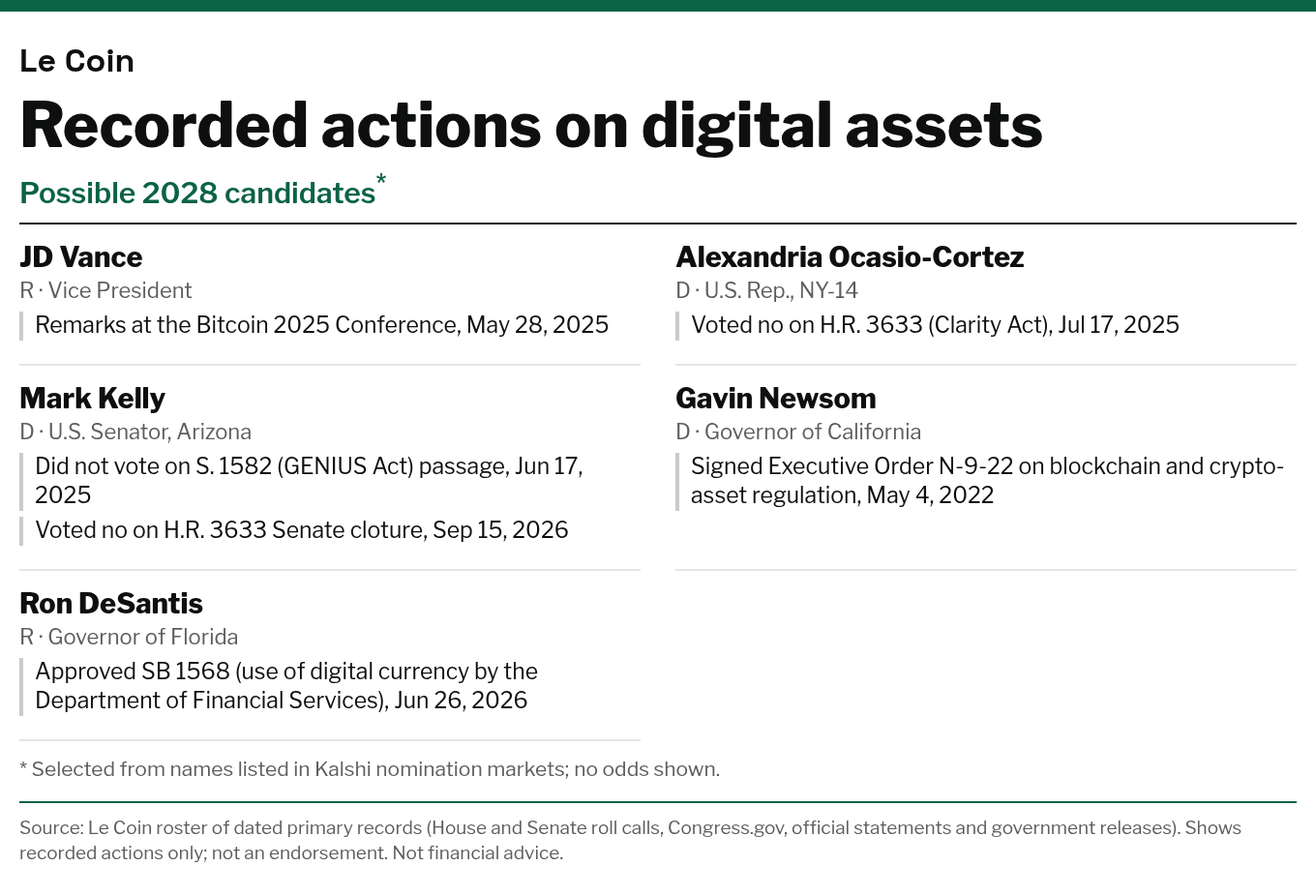
The full roster, with each entry's dated sources, is in Appendix: Roster sources.
3. Crypto PAC funding
Figures are for the 2026 cycle through Sep. 30, 2026, from FEC filings pulled at 4:33–4:34 p.m. ET Oct. 22 [5].
| Committee (FEC ID) |
Receipts |
Independent expenditures |
Cash on hand |
| Fairshake (C00835959) |
$138.24M |
$13.30M |
$83.92M |
| Defend American Jobs (C00836221) |
$62.79M |
$56.86M |
$5.56M |
| Protect Progress (C00848440) |
$33.82M |
$27.65M |
$6.16M |
| Digital Freedom Fund (C00911610) |
$33.93M |
$3.39M |
$8.10M |
How the committees relate. The FEC lists all four as separately registered committees, and Fairshake and Protect Progress list the same treasurer. The filings show the money link:
- Fairshake sent $37M to Defend American Jobs in six transfers, Jan. 16, 2025 to Jul. 13, 2026. Defend American Jobs labels them "transfer from affiliated committee."
- Fairshake sent $33M to Protect Progress in six transfers, Feb. 9 to Aug. 7, 2026.
Both are Le Coin sums of the recipients' itemized receipts [5]. Fairshake's own summary reports $94.5M in transfers to affiliated committees; the $24.5M difference is unreconciled. Because of these transfers, the committees' receipts must not be added together.
Largest itemized donors, 2026 cycle [5]:
- Fairshake:
- Ripple Labs: $48M
- Coinbase: $25M
- AH Capital Management (a16z): $23.8M, attributed half each to Marc Andreessen and Ben Horowitz
- Digital Currency Group: $1M
- Uniswap Labs: about $1M
- Protect Progress and Defend American Jobs: $250,000 from Ripple and $100,000 from a16z each.
- Digital Freedom Fund: Winklevoss Capital Fund gave about $21.29M in bitcoin, 188.45 BTC in total, which the filings describe as "not liquidated." Payward (Kraken) gave $1M.
Beyond contributions, Fairshake reports about $38.6M in other receipts, mostly bitcoin sold through Coinbase Commerce (Le Coin sum).
Top 10 candidates by independent expenditures, all four PACs (Le Coin sums, about ±1–2%) [5]:
| Candidate |
Race |
For / against |
Amount |
PAC(s) |
| Jon Husted (R) |
OH Senate |
For |
$36.26M |
DAJ, DFF |
| Sherrod Brown (D) |
OH Senate |
Against |
$16.40M |
DAJ, DFF |
| Barry Moore (R) |
AL Senate |
For |
$12.24M |
DAJ |
| Juliana Stratton (D) |
IL Senate |
Against |
$10.12M |
Fairshake, PP |
| Andy Barr (R) |
KY Senate |
For |
$7.17M |
DAJ |
| Dan Osborn (I) |
NE Senate |
Against |
$6.72M |
DAJ |
| Christian Menefee (D) |
TX-18 |
For |
$6.47M |
PP |
| Adrian Boafo (D) |
MD-05 |
For |
$5.26M |
PP |
| Jasmine Clark (D) |
GA-13 |
For |
$4.21M |
PP |
| La Shawn Ford (D) |
IL-07 |
Against |
$2.48M |
Fairshake |
DAJ is Defend American Jobs, PP is Protect Progress and DFF is Digital Freedom Fund.
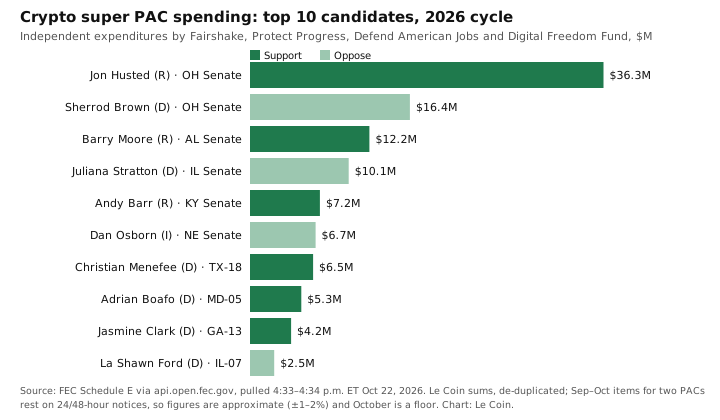 Figure 2. Top 10 candidates by crypto super PAC independent expenditures, 2026 cycle. Source: FEC [5].
Party tilt.
- Protect Progress spends for Democrats, almost entirely in primaries.
- Defend American Jobs spends for Republicans ($67.5M) and against their Democratic or independent opponents.
- Fairshake's largest outlay went against Democrats in Illinois's March primaries. Its October buys support three Republicans and three Democrats.
Le Coin sums [5].
After Sep. 15.
- Totals: the four PACs spent $73.46M through Sep. 15 and $69.29M from Sep. 16 to Oct. 21.
- Where it went: the money moved from primaries to general elections, led by Defend American Jobs in Ohio and Nebraska ($54.6M after Sep. 15). Digital Freedom Fund made its first independent expenditure on Sep. 28.
- Motive: general-election spending normally rises in late September, so the motive, and any link to the cloture vote, is unverified.
- October figures: they rest on 24- and 48-hour notices, which can be filed late or amended, so they are a floor [5].
4. Midterm scenarios
| Kalshi market [4] |
Price, 4:45 p.m. ET |
Open interest |
Since mid-September |
| House 2026: Democrats |
91.3% |
14.4M |
86% at the Sep. 15 close |
| Senate 2026: Democrats |
69% |
4.1M |
52% at the Sep. 14 close |
| Clarity law before Jan. 1, 2027 |
5.8% |
591K |
17% at the Sep. 14 close |
| Clarity law before Jan. 1, 2028 |
26% |
59K (thin) |
51% at the Sep. 14 close |
Why we do not multiply. Kalshi prices each chamber separately. Multiplying them to get "Democrats win both" assumes the races are independent, and they are not, so this report gives no combined probability.
What the prices say.
- Traders price a Democratic House at 91.3% and lean toward a Democratic Senate, less firmly.
- Scenarios with a Republican House sit at the low end of the market's range.
- Le Coin has not found a sourced cause for the Senate move since mid-September.
Committees today. Committees write the bills, and the majority picks every chair. Current leadership, from the committees' pages accessed 4:46 p.m. ET Oct. 22:
| Committee |
Chair |
Ranking member |
Source |
| Senate Banking |
Sen. Tim Scott (R-SC) |
Sen. Elizabeth Warren (D-MA) |
[23] |
| Senate Agriculture |
Sen. John Boozman (R-AR) |
Sen. Amy Klobuchar (D-MN) |
[24] |
| House Financial Services |
Rep. French Hill (R-AR) |
Rep. Maxine Waters (D-CA) |
[25] |
| House Agriculture |
Not verified (the committee page did not load) |
Not verified |
n/a |
Who holds these seats in 2027 is unknown. Seniority, party conference rules and the election results decide it.
Two facts carry into every scenario.
- H.R. 3633 dies on Jan. 3, 2027 unless it is enacted [18][19].
- Passage still takes 60 Senate votes. The September cloture vote failed with zero Democratic yes votes [1]. Kalshi seat-count markets were not pulled, so whether either party could reach 60 is not priced here.
Scenario A: Democrats win both chambers
- Committees: Democrats would chair all four committees.
- Market structure: a bill would be rewritten under Democratic chairs. House Democrats split 78–134 on Clarity, and Senate Democrats gave zero cloture votes, so a bill could still pass but would likely look different. Le Coin's view, inferred from votes rather than sourced positions: a slower, renegotiated process, with ethics and consumer terms central, as Sen. Warren's floor remarks suggest [2].
- Stablecoins: GENIUS is law. Changes would come through oversight or amendment; repeal would need a presidential signature.
- Bipartisanship: required in the Senate, and the president keeps the veto.
Scenario B: Republican Senate, Democratic House
- Committees: the Senate gavels stay with the authors of the September text, and the House gavels flip.
- Market structure: a revived Senate text would need Democratic votes for cloture and then a Democratic House. Le Coin's view: this setup favors narrow, bipartisan pieces over one full market-structure bill.
Scenario C: Republicans hold both chambers
- Likelihood on current prices: low. The Republican House contract trades at 8.6% [4].
- Committees: current leadership largely continues.
- Market structure: the September failure still binds. 49 Republicans were not enough, and four voted no. Unless the filibuster changes, which nothing in the record shows, passage needs Democrats.
Scenario D: narrow or contested outcomes
- Committees: one- or two-seat margins mean thin committee ratios.
- Market structure: single senators decide any revival, such as the four Republicans who voted no or the Democrats who backed GENIUS. Their current positions are not verified.
- Lame duck: the period from Nov. 3 to Jan. 3 is the last window for H.R. 3633 itself, priced at 5.8% [4].
5. 2029 and later: outlook scenarios
These scenarios are conditional, not forecasts. Kalshi at 4:45 p.m. ET:
- 2028 winning party: Democrats 59%, Republicans 40%.
- Republican nomination: Vance 41%, Rubio 18%.
- Democratic nomination: Ossoff 16%, Newsom 15%, Ocasio-Cortez 14% [4].
Statute vs. agency action. Most items in the section 1 agency table are staff guidance, interpretations or proposals.
- Guidance and interpretations: a new SEC or CFTC majority could withdraw them.
- Final rules: undoing one usually takes new notice-and-comment rulemaking.
- Laws: a law changes only through Congress.
Without a market-structure statute, the 2029 commission majorities set the rules.
Scenario A: a Democratic president.
- Agency leadership: a new administration names new SEC and CFTC chairs.
- Most exposed: staff statements, the token-category interpretation and any unfinished proposals.
- Priorities: floor remarks show what some Democratic senators prioritized in 2026: ethics, illicit finance and state enforcement [2]. That suggests, but does not prove, a future administration's priorities.
- HYPE (the token of the Hyperliquid derivatives exchange): the exposure is regulatory. A stricter CFTC chair could raise questions about U.S. access to perpetual futures traded offshore. Perpetual futures are derivatives with no expiry date. Hyperliquid's current U.S.-access terms are unverified.
Scenario B: a Republican president. In Le Coin's view, the current approach would likely continue: interpretations, Regulation Crypto Assets and the CFTC rulemaking. None of these is law, so the next turnover in agency control remains a risk.
Unified vs. split government. A statute needs 60 Senate votes for cloture, or a rules change, under either party. The 49–50 vote shows the 2026 margin [1].
6. Historical price context: no consistent pattern by party
Since 2013, crypto prices have risen and fallen sharply under every combination of party control in Washington, and the record shows no consistent pattern by party. Over seven periods since 2013, results varied widely within each party's terms. The sample is too small, and too shaped by market cycles, to attribute returns to party control.
How the periods are drawn
Data: CoinMarketCap daily closes (the 23:59:59 UTC bar) for bitcoin (BTC), ether (ETH), XRP and litecoin (LTC) [20].
- Coverage: BTC and LTC run from Apr. 29, 2013 to Oct. 21, 2026. XRP starts Aug. 4, 2013, and ETH starts Aug. 7, 2015.
- Why these four: newer tokens such as SOL and HYPE cover only one or two periods, so they are left out.
Periods: each one starts when control changes: the White House on Jan. 20 and Congress on Jan. 3 of odd years.
- "Unified" means one party holds the White House and both chambers.
- "Split" covers every other arrangement.
Measures:
- CAGR (compound annual growth rate) converts a period's total return into a yearly rate.
- Annualized volatility measures how widely daily prices swung, scaled to a 365-day year.
- Max drawdown is the largest fall from a peak close to a later low close.
Bitcoin, period by period
| Period |
White House |
Congress |
Total return |
CAGR |
Ann. volatility |
Max drawdown |
| Apr 29, 2013 – Jan 3, 2015 |
Obama (D) |
R House / D Senate |
+94.5% |
+48.5% |
100.5% |
-75.6% |
| Jan 3, 2015 – Jan 20, 2017 |
Obama (D) |
R both |
+218.4% |
+76.0% |
62.1% |
-39.5% |
| Jan 20, 2017 – Jan 3, 2019 |
Trump I (R) |
R both (unified) |
+328.7% |
+110.7% |
87.7% |
-83.4% |
| Jan 3, 2019 – Jan 20, 2021 |
Trump I (R) |
D House / R Senate |
+826.5% |
+196.3% |
73.0% |
-61.8% |
| Jan 20, 2021 – Jan 3, 2023 |
Biden (D) |
D both (unified) |
-53.1% |
-32.1% |
71.8% |
-76.6% |
| Jan 3, 2023 – Jan 20, 2025 |
Biden (D) |
R House / D Senate |
+511.6% |
+142.0% |
48.5% |
-26.2% |
| Jan 20, 2025 – Oct 21, 2026 (ongoing) |
Trump II (R) |
R both (unified) |
-17.6% |
-10.5% |
43.2% |
-53.1% |
Data: CoinMarketCap, daily closes (UTC), accessed 4:33 p.m. ET Oct. 22, 2026 [20].
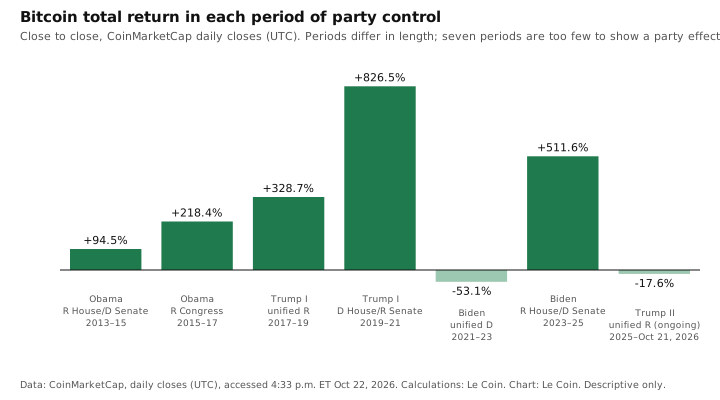 Figure 3. Bitcoin total return by period of party control. Data: CoinMarketCap [20]; calculations Le Coin.
What the bitcoin record shows.
- Within Biden's term: bitcoin fell 53.1% under unified Democratic control, then rose 511.6% once Republicans took the House.
- Within Trump's terms: it rose 826.5% in the 2019–21 split period and is down 17.6% so far in Trump II.
- Drawdowns: every period after 2013 included a drawdown of at least 26%. The two deepest, -83.4% and -76.6%, came under unified Republican and unified Democratic control.
The other assets point in different directions
The ether, XRP and litecoin tables are in the appendix (Figure 4).
- Ether: its worst full period was a 12.1% fall in Biden's unified years; its best was a 1,306.9% gain in Trump I's unified years.
- XRP: fell 69.8% in Obama's second period and gained 5,296.4% in the next.
- Litecoin: fell in three of its seven periods, under both parties.
Pooled daily returns. Pooling each group's daily returns gives a second view, and it does not line up either.
- Bitcoin: split-government days show a higher annualized mean log return than unified days (+74.8% vs. +8.9%).
- XRP: the ranking reverses (unified +58.6%, split +28.2%).
In Le Coin's view, figures that flip rank from one asset to the next are what noise looks like [20].
Why the record cannot carry a party conclusion
- Tiny samples. Seven periods: three unified and four split.
- Cycles and macro dominate. Each period's return mostly reflects where it fell in halving and liquidity cycles. These include easing in 2017 and 2020–21, tightening in 2022, the FTX collapse in late 2022 and the spot bitcoin ETF approvals in 2024.
- Start dates matter. Moving a boundary by a few weeks can flip a sign.
- Policy acts with lags.
- Survivorship. Assets with long histories are the ones that survived.
- Trump II is ongoing, at 639 days through Oct. 21, 2026.
- No inference. Nothing here supports a claim that crypto does better under either party.
7. Additional factors: interplay, states, international and asset categories
7.1 The midterms set the 2028 starting line
- No law in 2027–28: the 2028 winner inherits rules made almost entirely by agencies, which a new SEC or CFTC can revise.
- A law passes: the next president administers it but cannot unwind it alone.
This structural point is the main link between the two elections.
The two elections are priced separately.
- At 4:45 p.m. ET, Kalshi priced Democrats at 91.3% for the House, 69% for the Senate and 59% for the 2028 presidency [4].
- The thin 2028 party market has closed between 57% and 60% since mid-August.
- It did not move when the Senate market rose after Sep. 14.
Votes as campaign material. Ossoff leads the Democratic nomination market and has a split record: yes on GENIUS, no on Clarity cloture [1][17]. How that record plays in 2028 is not verified.
7.2 If federal rules stay fragmented: the states
The GENIUS Act already sets a federal–state split for stablecoins. Its enrolled text allows a "State qualified payment stablecoin issuer" with outstanding issuance of not more than $10 billion to opt for regulation under a state regime. That regime must be "substantially similar to the Federal regulatory framework," under principles the Treasury sets by rulemaking. A state-chartered issuer that passes $10 billion must move to the federal framework within 360 days [21].
State examples, from state primaries:
- Wyoming: chartered special purpose depository institutions (SPDIs) under a 2019 law. These are crypto-focused banks mainly engaged in custody. The state Banking Board has approved four SPDI charters, per the Division of Banking [29].
- Texas: enacted SB 21, creating the Texas Strategic Bitcoin Reserve under the comptroller. It was signed by the governor on Jun. 20, 2025 and effective immediately, per Texas Legislature Online [30].
The SEC proposal could narrow state room. Its proposed Regulation Crypto Assets includes state preemption, per the SEC's release [14]. It is a proposal, not a rule.
7.3 International competition
Other jurisdictions run licensing regimes while the U.S. market-structure statute is stalled:
- United Kingdom: the Financial Conduct Authority published final cryptoasset rules on Jun. 30, 2026. They apply to cryptoasset firms granted permission to operate under FSMA on or after Oct. 25, 2027 [26].
- Hong Kong: the Securities and Futures Commission lists 13 licensed virtual asset trading platforms, the most recent licensed May 18, 2026 [27].
- Dubai: the Virtual Assets Regulatory Authority (VARA) describes itself as the authority regulating virtual assets across Dubai's free zones and mainland, except the Dubai International Financial Centre [28].
The EU's MiCA regulation and Singapore's MAS regime are not covered, because their primary pages did not load in this pass.
Le Coin's view: a fragmented U.S. regime gives firms reasons to book activity abroad. Whether that is happening at scale is not measured here.
7.4 Different assets, different exposure
The SEC's March 2026 interpretation sorts tokens into five categories: digital commodities, digital collectibles, digital tools, stablecoins and digital securities [13].
| Category |
What anchors it now |
Most exposed to (Le Coin analysis) |
| Stablecoins |
Statute (GENIUS) plus the OCC rule [21][22] |
Implementation and oversight |
| Digital commodities |
SEC interpretation; CFTC initiatives [12][13] |
A future SEC withdrawing the interpretation; CFTC leadership |
| Tokens that could be investment contracts |
Proposed Regulation Crypto Assets [14] |
The proposal stalling or being withdrawn |
| Trading venues and DeFi front-ends |
No statute; CFTC advance notice [15] |
CFTC chair and priorities |
Spot ETFs are not analyzed in this report.
7.5 Uncertainty ranges
- Kalshi prices have spreads. At 4:45 p.m. ET, the Senate Democratic contract was bid 68% and asked 69%, while the Clarity "before Jan. 1, 2028" contract was bid 23% and asked 26% [4].
- FEC sums are approximate. Candidate totals are accurate to about ±1–2%, and October figures are a floor [5].
- Price history carries no party signal (section 6).
8. Key Uncertainties and Monitoring Points
| # |
Uncertainty |
Known now |
Not known |
What to watch |
| 1 |
Lame-duck revival of H.R. 3633 |
Cloture failed 49–50; a motion to reconsider is pending [1][2]. Kalshi: 5.8% for a law before Jan. 1, 2027 [4] |
Whether leaders schedule a re-vote |
The Senate cloture list [32]; the Congressional Record after Nov. 3 |
| 2 |
Senate control |
Kalshi Democrats 69%, from 52% at the Sep. 14 close [4] |
The cause of the move; seat margins |
Results on Nov. 3; seat-count markets |
| 3 |
House control |
Kalshi Democrats 91.3% [4] |
The margin, which sets committee ratios |
Results; rosters when the next Congress assembles Jan. 3, 2027 [19] |
| 4 |
Committee leadership in 2027 |
Current chairs and ranking members [23]–[25] |
2027 chairs; House Agriculture leadership not verified |
Party steering announcements |
| 5 |
Whether a successor bill counts for Kalshi |
The rules define a qualifying bill by its content [4] |
How Kalshi would rule on a specific text |
Kalshi rulings; new bill text |
| 6 |
Durability of agency action |
Interpretation in force; rule proposed; CFTC at the advance-notice stage [13]–[15] |
Final SEC rule timing; withdrawals by a future commission |
The SEC rule calendar; CFTC comments close Dec. 14, 2026 |
| 7 |
PAC spending after Sep. 15 |
$73.46M before, $69.29M after (Le Coin sums) [5] |
Motive; late filings |
FEC notices through Nov. 3 |
| 8 |
Ohio Senate |
Largest PAC target; Kalshi Brown 68% [4][5] |
Effect of the spending |
Results, Nov. 3 |
| 9 |
Unprocessed FEC data |
DAJ's September and DFF's Q3 detail rest on fast-filed notices [5] |
DFF's $11.44M in other receipts; a $100K contribution gap; Fairshake's $24.5M transfer gap |
An FEC re-pull |
| 10 |
2028 stances |
Kalshi field prices [4] |
Crypto stances of Rubio, Harris, Beshear and others |
Votes and official statements |
| 11 |
HYPE under a stricter CFTC |
Section 5 analysis |
Hyperliquid's U.S.-access terms |
A Hyperliquid primary; CFTC actions |
| 12 |
Price history and party |
No consistent pattern in seven periods [20] |
Any causal link |
Not resolvable with this sample |
What we could not verify
- The motives behind the four Republican no votes and Ossoff's cloture vote.
- The cause of the Senate odds shift since mid-September.
- Any causal link between PAC spending and the cloture vote, and whether the Ohio ads worked.
- The crypto stances of Osborn, Stratton, Rubio, Harris and Beshear. Brown, Vance, Newsom and DeSantis have dated actions in Appendix: Roster sources, but their overall stances are not characterized.
- The 2027 committee chairs, and House Agriculture's current leadership (page did not load).
- MiCA (EUR-Lex returned no content) and Singapore's MAS regime (page returned 404).
- Hyperliquid's U.S.-access terms.
- Fairshake's $24.5M transfer gap, DFF's $11.44M other receipts and its $100K contribution gap.
- Kalshi seat-count and House-race markets (not pulled).
- Spot ETF exposure (not analyzed).
Methodology note
- Kalshi: prices are last-traded prices from Kalshi's public API, read as implied probabilities. The check was at 4:45 p.m. ET Oct. 22, 2026; daily history comes from candles pulled at 4:36 p.m. ET, and each daily candle ends at midnight ET [4].
- FEC: figures come from api.open.fec.gov (pulled 4:33–4:34 p.m. ET Oct. 22).
- Candidate totals are Le Coin sums of Schedule E line items, de-duplicated by transaction ID with memo items excluded.
- We used periodic-report items where the FEC has processed them and 24/48-hour notices for later periods [5].
- Prices: CoinMarketCap daily closes, with returns and volatility calculated by Le Coin [20].
- Roll calls: from the House Clerk and Senate LIS XML [1][16][17].
- Durability labels and scenario descriptions: Le Coin's analysis. No probabilities are assigned to bills.
Appendix: ETH, XRP and LTC by period
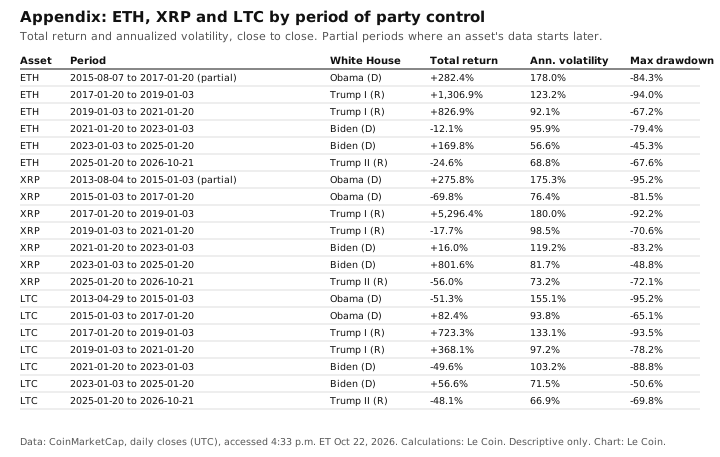 Figure 4. Total return, annualized volatility and max drawdown by period. Data: CoinMarketCap [20]; calculations Le Coin.
Appendix: Roster sources
Criteria, the same for every party: an entry appears only with at least one dated primary source (a recorded vote, a committee action, or the person's own statement or signed official action), and it describes only that action; no advocacy-group ratings are used.
Votes used (accessed 4:31–4:38 p.m. ET Oct. 22, 2026) [1][16][17]:
- H.R. 3633, House passage (Clarity Act): Jul 17, 2025, Roll no. 199, 294–134. https://clerk.house.gov/evs/2025/roll199.xml
- S. 1582, Senate passage (GENIUS Act, stablecoins): Jun 17, 2025, Record Vote 318, 68–30. https://www.senate.gov/legislative/LIS/roll_call_votes/vote1191/vote_119_1_00318.xml
- H.R. 3633, Senate cloture on the motion to proceed: Sep 15, 2026, Record Vote 234, 49–50 (failed; needed 60). https://www.senate.gov/legislative/LIS/roll_call_votes/vote1192/vote_119_2_00234.xml
PAC money = crypto super PAC independent expenditures (Fairshake, Protect Progress, Defend American Jobs, Digital Freedom Fund). FEC Schedule E, our sums, pulled 4:33–4:34 p.m. ET Oct 22. "None found" means none in the top items we summed; this is not proof of zero.
2026 Senate
| Name |
Party, race |
Recorded actions (dated primary) |
Crypto PAC IEs (FEC) |
| Jon Husted |
R, OH Senate special (incumbent) |
Voted yes on S. 1582 passage, Jun 17, 2025 (RV 318). Voted yes on H.R. 3633 cloture, Sep 15, 2026 (RV 234) |
$36.26M support (DAJ $33.78M, DFF $2.48M) |
| Sherrod Brown |
D, OH Senate special |
Campaign statement, Sep 24, 2026: Husted is "backed by billionaires, cryptocurrency, and dark money from out of state" (https://www.sherrodbrown.com/2026/09/24/sherrod-brown-holds-cleveland-for-sherrod-kick-off-event/). No vote in the 119th Congress |
$16.40M oppose (DAJ $12.89M, DFF $3.51M) |
| Pete Ricketts |
R, NE Senate (incumbent) |
Yes on S. 1582 (RV 318). Yes on H.R. 3633 cloture (RV 234) |
Opponent Osborn: $6.72M oppose (DAJ) |
| Barry Moore |
R, AL Senate (U.S. Rep., AL-1) |
Voted yes on H.R. 3633, Jul 17, 2025 (Roll 199) |
$12.24M support (DAJ) |
| Andy Barr |
R, KY Senate (U.S. Rep., KY-6) |
Yes on H.R. 3633 (Roll 199) |
$7.17M support (DAJ) |
| Cynthia Lummis |
R, WY |
Yes on S. 1582 (RV 318). Yes on H.R. 3633 cloture (RV 234). Released merged H.R. 3633 text, Jul 22, 2026 (https://www.lummis.senate.gov/press-releases/lummis-releases-updated-clarity-act-text/) |
None found |
| Tim Scott |
R, SC (Banking chair) |
Reported H.R. 3633 with a substitute from Banking, Jun 1, 2026 (Congress.gov actions) [3]. Yes on RV 318 and RV 234 |
None found |
| John Boozman |
R, AR (Agriculture chair) |
Reported S. 3755, Digital Commodity Intermediaries Act, Feb 2, 2026 (https://www.congress.gov/bill/119th-congress/senate-bill/3755). Yes on RV 318 and RV 234 |
None found |
| Bernie Moreno |
R, OH |
Yes on RV 318 and RV 234 |
None found |
| Elizabeth Warren |
D, MA (Banking ranking member) |
Voted no on S. 1582 (RV 318). No on H.R. 3633 cloture (RV 234) |
None found |
| Kirsten Gillibrand |
D, NY |
Yes on S. 1582 (RV 318). No on H.R. 3633 cloture (RV 234) |
None found |
| Josh Hawley |
R, MO |
No on RV 318. No on RV 234 |
None found |
| Rand Paul |
R, KY |
No on RV 318. Yes on RV 234 |
None found |
| Susan Collins |
R, ME |
Yes on RV 318. No on RV 234 |
None found |
| Jerry Moran |
R, KS |
Yes on RV 318. No on RV 234 |
None found |
| Thom Tillis |
R, NC |
Yes on RV 318. No on RV 234, then entered a motion to reconsider the same day (Congress.gov, Sep 15, 2026) [3] |
None found |
2026 House
| Name |
Party, district |
Recorded actions |
Crypto PAC IEs (FEC) |
| French Hill |
R, AR-2 (Financial Services chair) |
Yes on H.R. 3633 (Roll 199) |
~$1.02M support (Fairshake, Oct 2026) |
| Maxine Waters |
D, CA-43 (Financial Services ranking member) |
No on H.R. 3633 (Roll 199) |
None found |
| Bryan Steil |
R, WI-1 |
Yes (Roll 199) |
~$1.02M support (Fairshake, Oct) |
| Bill Huizenga |
R, MI-4 |
Yes (Roll 199) |
~$1.02M support (Fairshake, Oct) |
| Steven Horsford |
D, NV-4 |
Yes (Roll 199) |
~$1.02M support (Fairshake, Oct) |
| Derek Tran |
D, CA-45 |
Yes (Roll 199) |
~$1.02M support (Fairshake, Oct) |
| Janelle Bynum |
D, OR-5 |
Yes (Roll 199) |
~$1.02M support (Fairshake, Oct) |
| Ritchie Torres |
D, NY-15 |
Yes (Roll 199) |
$1.42M support (PP) |
| Josh Gottheimer |
D, NJ-5 |
Yes (Roll 199) |
~$0.51M support (PP) |
| Pete Aguilar |
D, CA-33 |
Yes (Roll 199) |
~$0.51M support (PP) |
| Shri Thanedar |
D, MI-13 |
Yes (Roll 199) |
$1.76M support (PP) |
| Randy Fine |
R, FL-6 |
Yes (Roll 199) |
$1.67M support (DAJ) |
2028 names (Kalshi nomination markets)
| Name |
Party, role |
Recorded actions |
Crypto PAC IEs |
| J.D. Vance |
R, Vice President |
Remarks at the Bitcoin 2025 Conference, May 28, 2025 (White House video, https://www.whitehouse.gov/videos/vice-president-jd-vance-delivers-remarks-at-bitcoin-2025-conference/) |
n/a |
| Jon Ossoff |
D, U.S. Senator (GA) |
Yes on S. 1582 (RV 318). No on H.R. 3633 cloture (RV 234) |
None found |
| Alexandria Ocasio-Cortez |
D, U.S. Rep., NY-14 |
No on H.R. 3633 (Roll 199) |
None found |
| Mark Kelly |
D, U.S. Senator (AZ) |
Did not vote on S. 1582 (RV 318). No on H.R. 3633 cloture (RV 234) |
None found |
| Gavin Newsom |
D, Governor of California |
Signed Executive Order N-9-22 on blockchain and crypto-asset regulation, May 4, 2022 (https://www.gov.ca.gov/2022/05/04/governor-newsom-signs-blockchain-executive-order-to-spur-responsible-web3-innovation-grow-jobs-and-protect-consumers/) |
n/a |
| Ron DeSantis |
R, Governor of Florida |
Approved SB 1568, "Use of Digital Currency by the Department of Financial Services", Jun 26, 2026, Ch. 2026-175 (https://www.flhouse.gov/Sections/Bills/billsdetail.aspx?BillId=84061&SessionId=113). Approved HB 175, "Payment Stablecoin", Jun 29, 2026, Ch. 2026-176 (https://www.flsenate.gov/Session/Bill/2026/175) |
n/a |
Notes
- Counts: 34 entries. 26 rest on votes only. Lummis, Scott, Boozman and Tillis add a committee action, procedural motion or text release. Brown's entry is his own campaign statement, Vance's an official speech, and Newsom's and DeSantis's signed state actions.
- What the record shows: every listed House Republican voted yes on Roll 199. Senate Republicans split on S. 1582 (Hawley and Paul no) and on cloture (Collins, Hawley, Moran and Tillis no). No Senate Democrat voted yes on cloture, 18 Senate Democrats voted yes on S. 1582, and 78 House Democrats voted yes on Roll 199 [1][16][17].
- A single vote can reflect procedure, timing or bill text rather than a general view. Tillis's motion to reconsider is a procedural step.
- Sources checked against the page: Brown, Vance, Newsom, DeSantis, Lummis's text release and S. 3755 (accessed about 5:00–5:10 p.m. ET Oct. 22, 2026). The Newsom order dates from 2022; it is the most recent primary action found.
Sources and citations
- U.S. Senate, Roll Call Vote 119th Congress, 2nd Session, No. 234, Sep. 15, 2026, https://www.senate.gov/legislative/LIS/roll_call_votes/vote1192/vote_119_2_00234.xml, accessed Oct. 22, 2026, 4:31 p.m. ET.
- Congressional Record, Vol. 172, No. 145, Sep. 15, 2026, S4703–S4706, https://www.govinfo.gov/content/pkg/CREC-2026-09-15/html/CREC-2026-09-15-pt1-PgS4704-4.htm, accessed Oct. 22, 2026, 4:34 p.m. ET.
- Congress.gov, H.R. 3633 all actions (via API), https://www.congress.gov/bill/119th-congress/house-bill/3633/all-actions, accessed Oct. 22, 2026, 4:31 p.m. ET.
- Kalshi Trade API v2, markets CONTROLH, CONTROLS, KXCRYPTOSTRUCTURE, SENATEOHS, SENATENE, SENATEAL, SENATEIL, KXPRESNOMD, KXPRESNOMR, KXPRESPARTY, KXPRESPERSON, https://api.elections.kalshi.com/trade-api/v2/, checked Oct. 22, 2026, 4:45 p.m. ET (earlier snapshot 4:35 p.m. ET; daily candles 4:36 p.m. ET; contract rules read 4:33 p.m. ET).
- Federal Election Commission, totals, Schedule A and Schedule E (including 24/48-hour notices) for C00835959, C00848440, C00836221 and C00911610, 2026 cycle, https://api.open.fec.gov/v1/, accessed Oct. 22, 2026, 4:33–4:34 p.m. ET.
- SEC press release 2025-30, https://www.sec.gov/newsroom/press-releases/2025-30, accessed Oct. 22, 2026, 4:36 p.m. ET.
- SEC, Staff Accounting Bulletin No. 122, https://www.sec.gov/rules-regulations/staff-guidance/staff-accounting-bulletins/staff-accounting-bulletin-122, accessed Oct. 22, 2026, 4:36 p.m. ET.
- SEC press release 2025-47, https://www.sec.gov/newsroom/press-releases/2025-47, accessed Oct. 22, 2026, 4:36 p.m. ET.
- SEC Corporation Finance, Statement on Certain Proof-of-Work Mining Activities, https://www.sec.gov/newsroom/speeches-statements/statement-certain-proof-work-mining-activities-032025, accessed Oct. 22, 2026, 4:36 p.m. ET.
- SEC Corporation Finance, Statement on Stablecoins, https://www.sec.gov/newsroom/speeches-statements/statement-stablecoins-040425, accessed Oct. 22, 2026, 4:36 p.m. ET.
- SEC Chair Atkins, "American Leadership in the Digital Finance Revolution," https://www.sec.gov/newsroom/speeches-statements/atkins-digital-finance-revolution-073125, accessed Oct. 22, 2026, 4:36 p.m. ET.
- CFTC press release 9105-25, https://www.cftc.gov/PressRoom/PressReleases/9105-25, accessed Oct. 22, 2026, 4:36 p.m. ET.
- SEC/CFTC, 91 FR 13714 (Mar. 23, 2026), https://www.federalregister.gov/documents/2026/03/23/2026-05635/application-of-the-federal-securities-laws-to-certain-types-of-crypto-assets-and-certain, accessed Oct. 22, 2026, 4:37 p.m. ET.
- SEC, Regulation Crypto Assets, 91 FR 54510 (Aug. 21, 2026), https://www.federalregister.gov/documents/2026/08/21/2026-17183/regulation-crypto-assets, accessed Oct. 22, 2026, 4:37 p.m. ET.
- CFTC, ANPRM, RIN 3038-AF80, 91 FR 64811 (Oct. 13, 2026), https://www.govinfo.gov/content/pkg/FR-2026-10-13/html/2026-20888.htm, accessed Oct. 22, 2026, 4:36 p.m. ET.
- Clerk of the U.S. House, Roll Call 199, Jul. 17, 2025 (H.R. 3633, on passage), https://clerk.house.gov/evs/2025/roll199.xml, accessed Oct. 22, 2026, 4:38 p.m. ET.
- U.S. Senate, Roll Call Vote 119th Congress, 1st Session, No. 318, Jun. 17, 2025 (S. 1582, on passage), https://www.senate.gov/legislative/LIS/roll_call_votes/vote1191/vote_119_1_00318.xml, accessed Oct. 22, 2026, 4:38 p.m. ET.
- Congress.gov API, 119th Congress (start year 2025, end year 2026), https://api.congress.gov/v3/congress/119, accessed Oct. 22, 2026, 4:46 p.m. ET.
- U.S. Constitution, 20th Amendment, Section 2, National Archives, https://www.archives.gov/founding-docs/amendments-11-27, accessed Oct. 22, 2026, 4:38 p.m. ET.
- CoinMarketCap, daily OHLCV history, USD, daily closes (UTC), https://coinmarketcap.com, accessed Oct. 22, 2026, 4:33 p.m. ET. Calculations are Le Coin's.
- GENIUS Act, S. 1582, enrolled bill text, GovInfo, https://www.govinfo.gov/content/pkg/BILLS-119s1582enr/html/BILLS-119s1582enr.htm, accessed Oct. 22, 2026, 4:46 p.m. ET.
- Office of the Comptroller of the Currency, final rule implementing the GENIUS Act, FR 2026-21706 (public inspection Oct. 22, 2026; effective Jan. 18, 2027), https://www.federalregister.gov/public-inspection/current, accessed Oct. 22, 2026.
- Senate Committee on Banking, Housing, and Urban Affairs, Membership, https://www.banking.senate.gov/about/membership, accessed Oct. 22, 2026, 4:46 p.m. ET.
- Senate Committee on Agriculture, Nutrition, and Forestry, Membership, https://www.agriculture.senate.gov/about/membership, accessed Oct. 22, 2026, 4:46 p.m. ET.
- House Committee on Financial Services, Committee Members, https://financialservices.house.gov/about/members.htm, accessed Oct. 22, 2026, 4:46 p.m. ET.
- Financial Conduct Authority, "Cryptoassets: our work" (last updated Jun. 30, 2026), https://www.fca.org.uk/firms/cryptoassets, accessed Oct. 22, 2026, 4:46 p.m. ET.
- Securities and Futures Commission, Lists of virtual asset trading platforms, https://www.sfc.hk/en/Welcome-to-the-Fintech-Contact-Point/Virtual-assets/Virtual-asset-trading-platforms-operators/Lists-of-virtual-asset-trading-platforms, accessed Oct. 22, 2026, 4:46 p.m. ET.
- Virtual Assets Regulatory Authority (Dubai), home page, https://www.vara.ae/en/, accessed Oct. 22, 2026, 4:46 p.m. ET.
- Wyoming Division of Banking, Special Purpose Depository Institutions, https://wyomingbankingdivision.wyo.gov/banks-and-trust-companies/special-purpose-depository-institutions, accessed Oct. 22, 2026, 4:46 p.m. ET.
- Texas Legislature Online, SB 21 (89R) history, https://capitol.texas.gov/BillLookup/History.aspx?LegSess=89R&Bill=SB21, accessed Oct. 22, 2026, 4:47 p.m. ET.
- Office of Sen. Cynthia Lummis, "Lummis releases updated Clarity Act text" (Jul. 22, 2026), https://www.lummis.senate.gov/press-releases/lummis-releases-updated-clarity-act-text/, accessed Oct. 22, 2026, about 4:30 p.m. ET.
- U.S. Senate, Cloture Motions, 119th Congress, https://www.senate.gov/legislative/cloture/119.htm, accessed Oct. 22, 2026, about 4:31 p.m. ET.
- Public Law 119-27 (GENIUS Act, S. 1582), GovInfo, https://www.govinfo.gov/app/details/PLAW-119publ27, accessed Oct. 22, 2026, 5:05 p.m. ET.
- Congress.gov, S. 3755 all actions (via API), https://www.congress.gov/bill/119th-congress/senate-bill/3755/all-actions, accessed Oct. 22, 2026, 5:03 p.m. ET.
Disclosure
Le Coin's Analysis reports are research and analysis only. They are not investment, financial, legal or tax advice, and nothing in them is a recommendation to buy, sell or hold any asset. Information may change and may be incomplete. Prediction-market odds, such as Kalshi's, are market prices, not forecasts or guarantees. Past performance does not predict future results. Do your own research, or consult a licensed adviser. Le Coin's desks don't trade the assets they cover, and we take no payment, tokens or other benefit from any company, project or person we write about. If a report touches a conflict, we disclose it in that report or keep the desk off it.
Holding the Corner.
Not financial advice.